In the main living room of the Highlands Ranch Mansion, an ornate wall clock brought to the home by an early owner a century ago quietly reminds visitors of a truth about life in the highlands of Douglas County.
An intricate inlay in the Italian handcrafted woodwork reveals: “Time passes and man perceives it not,” a quote from Dante's famed Divine Comedy.
In other words, says Susie Appleby, historic programs coordinator for the Highlands Ranch Mansion and Historic Park, time flies.
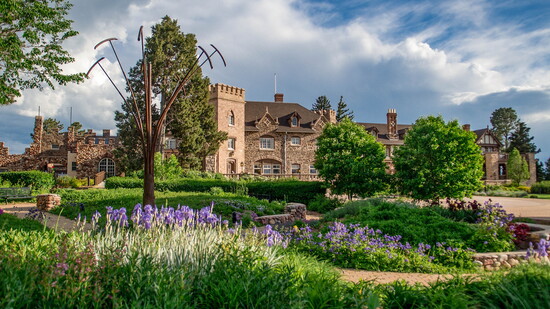
Time flies indeed. With more than 140 years of history, the Highlands Ranch Mansion hosts thousands of visitors annually to its 27,000 square foot estate. From historian-guided and self-guided tours of the home and gardens, wine and spirits tastings, lectures, festivals and weddings and other private events, the Highlands Ranch Mansion is the crown jewel of historic and cultural significance in Douglas County.
Highlands Ranch’s preeminent home began as a modest farm cottage in 1891 with its first owner, rancher Samuel Allen Long, who had homesteaded the property in 1884. Over the years, the seven families who owned and lived there made grand additions and renovations to create the sprawling stone-and-brick nine bedroom residence, featuring a ballroom, solarium, carriage house and his-and-her master bedrooms with en suite bathrooms.
On a recent tour of the Mansion, Appleby lingers by a wall featuring portraits of previous owners and recounts some of their most colorful stories, some with big personalities, some ambitious and powerful, some downright scandalous. There are strong ties to the National Livestock Association, the famed Arapahoe Hunt Club, local and state politics. The Mansion's historian says she feels these larger-than-life characters when she walks the hallways of their former home. Real life happened here.
An early owner, John Springer, sold the estate shortly after his bride Isabel was involved in a huge scandal at the Brown Palace in Denver, which ultimately brought about Springer's demise in high society.
Waite Phillips, an oil tycoon in his own right, was the brother of the founders of Phillips Petroleum.
The last and longest individual owner, Lawrence Phipps Jr., was the son of a U.S. senator and steel magnate. His name and philanthropic endeavors live on with Denver’s Phipps Mansion and Phipps Auditorium at the Denver Museum of Nature and Science.
Phipps died at the home in May 1976, in his upstairs bedroom. Appleby says it's easy to imagine whispers from the past. “I’m still looking for them,” she says, whenever she turns a corner, enters a quiet family room or closes the mansion for the evening after a day of leading tours.
The Mansion reminds us that Highlands Ranch did not develop overnight, Appleby says, but by more than a century of families who were ambitious leaders in agriculture, industry, Colorado society and politics.
“The Mansion stands as a tangible link to that history,” Appleby says. “It is a reminder of how deep Highlands Ranch’s roots run. It is what makes our community different from other modern communities around us. While our modern homes, streets, and schools are important and valued, they are features shared by many contemporary communities."
The large estate sits high on the rolling hills of Douglas County offer views to the southwest of Devil's Head Lookout and the Denver skyline to the northwest. The historic home sets our community apart by reminding residents of the important role families made in Colorado history, Appleby says.
After Phipps' death, developer Mission Viejo and Shea Homes purchased the ranch in 1978. The Highlands Ranch Metro District acquired the property in 2010, and once again expanded the home to serve as an event center and historical amenity for the community.
“Rather than allowing development to erase the past, they chose to preserve a place that anchors the community in its origins,” Appleby says. “They protected our heritage. As a result, the Mansion has now become a cultural and educational resource. It is a place for learning, gathering and connection that continues to enrich the lives of Highlands Ranch residents today.”
In its 120 year history, throughout all the architectural additions, decorating trends and generations represented within the walls of the Mansion, the living room clock prevails with its quiet message. Early owner Frank Kistler and his wife ordered the clock, the woodwork handcrafted in Italy, the timepiece in Germany, assembled by a master clockmaker in Rhode Island. It was likely brought West via train. And now, it stands guard in the Douglas County highlands, reminding visitors of an inescapable truth.