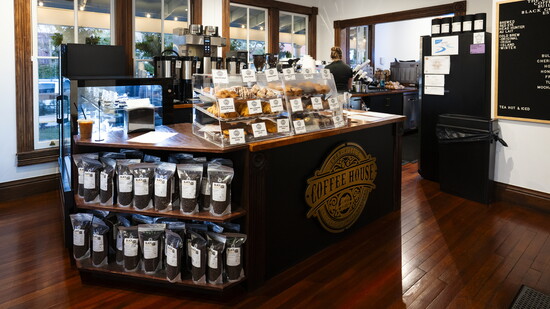
Lord-Higel’s Coffee House, distinct in its Victorian, two-story stature, stands on 409 Granada Avenue, its roof and outdoor dining area aglow with warm, decorative lights. The front path is lined with award-winning pink and purple petunias, and the porch is adorned with bright, colorful chairs that beckon travelers to sit and relax for a while. Local passersby frequently stop and acknowledge the newfound beauty of the historic landmark, now in full bloom. In all its 130 years, the house has never seen the amount of community appreciation it does today.
On December 10, 2025, Lord-Higel’s Coffee House officially opened for business, and the public gained access to Venice’s second-oldest structure along with the promise of fresh-ground coffee, expertly sourced wine, first-rate cakes, unique beer options, and more. The December ribbon-cutting ceremony not only marked the commencement of the new coffee house, but the successful conclusion of a 20-year restoration project. The City of Venice, the Historic Preservation Board, and Venice Heritage Inc. came together to celebrate their hard work and the continuation of the house’s legacy.
The city council considered multiple business proposals for the space, but Gary Lauters and Alyssa Williams, owner and general manager of Black Gold Coffee Roasters and now Lord-Higel’s Coffee House, put forth the exceptional vision of a gathering spot that both honors the past and fosters a sense of connection and belonging in the present. Their proposal was chosen unanimously. Jean Trammell, Venice Heritage vice president, noted that these ideals closely align with the original plan for the city put forth by John Nolen in 1926. “The John Nolen plan was so concerned with creating places where people can gather,” Trammell explained. “Community gathering spots were very much on Nolen’s mind, and I think this house will definitely serve as one of those.”
The coffee house has quickly become popular, and it’s not hard to see why. Every detail of Lord-Higel’s Coffee House is intentionally infused with a passion for flavor, history, and the people who made – and continue to make – it all happen. “Nothing just happens,” said Lauters. He emphasized that there are people behind all the treasures the coffee house has to offer, from the Colombian farmers who tend to the fields where the coffee beans are harvested, to the individuals from the Venice Heritage Foundation who bought the grand wooden rocking chairs that grace the back of the wrap-around porch. Lauters has established personal relationships with the very farmers who produce his company’s coffee beans and shows a deep appreciation for their work and expertise. The high quality of the coffee itself reflects the care that goes into its creation and distribution. Even the relaxing act of rocking on the charming wrap-around porch is enhanced by the plaques before each chair honoring the donors who made the experience possible.
Each product offered at the coffee house is thoughtfully chosen and impressively sourced. Coffee beans are brought from Colombia and Guatemala, and wines are procured from the U.S., Italy, France, Portugal, Spain, and Africa. The cake bars are provided by Crème de la Cocoa in St. Augustine – the co-owner of which, Nils Rowland, is a Food Network champion. All aspects of the Lord-Higel Coffee House contribute to a special experience that can’t be found anywhere else.
Lauters and Williams are also committed to sharing the house’s fascinating past, and one room is dedicated solely to its history. Patrons can sip on a cup of coffee and look Joseph Lord and George Higel in the eyes – their images displayed on the wall alongside their personal histories and connections to the house. Large, weighted windows and an exposed area of the wall revealing the interior lumber are preserved behind glass. The original wood flooring extends to the rest of the house, and one must only walk through the next doorway to marvel at the late 19th century fireplace. However, before the house was restored, these artifacts were dispersed and concealed. According to Dorothy Korwek, current Venice Heritage treasurer and former director of historical resources, an original door was obscured behind an added wall, the wood flooring was buried under tile and carpeting, and the fireplace sat in storage for over 50 years. “The house was owned by a number of different individuals,” Korwek said. She explained that each owner made their own additions, and the original pieces “faded away” over time.
The Lord-Higel House currently resides on Granada Ave, but its journey began in 1896 at a 90-acre citrus grove south of Roberts Bay (now Bayshore Estates). From 1896 to 2025, it would serve as a living-quarters for a citrus grove manager and his family, a duplex, a single-family residence, and now, a coffee house. The house was moved twice and has resided in three different Venice locations. Its survival and restoration reflect a collective desire to remain connected to the city’s rich history.
The story of the Lord-Higel House begins with Joseph Lord – real estate attorney, entrepreneur, and prolific Sarasota County landowner. Lord, a Maine native, relocated from Chicago to Orlando in 1885. There, he constructed a citrus grove on the land of his father-in-law, Frank Webber, before arriving in Sarasota in 1889. Over the course of the next seventeen years, Lord became a significant public figure in Sarasota County.
Lord and Webber established the 90-acre citrus grove south of Robert’s Bay in 1891 and built a house in the middle of the property in 1896. That same year, George Higel, who came from one of Sarasota’s oldest families, secured a position as Lord’s citrus grove manager. Higel previously worked on his own father’s citrus grove, and his first-hand knowledge prepared him for overseeing Lord’s latest endeavor.
Higel took up residence in the house Lord built on the grove (today’s Lord-Higel House), where he raised a family and recorded the happenings around him for the Sarasota Times. Higel wrote anonymously about what life was like in his time under the pen name “Nemo” (inspired by the name of his father’s boat). Interestingly, “Nemo” also means “nobody” in Latin – which perhaps reveals a clever double-meaning denoting Higel’s anonymity, or an amusing coincidence. Regardless, Higel’s writing created a time capsule for future generations – not unlike the house in which he lived.
The Lord-Higel House was saved from demolition and moved twice – once in the 1950s by George Higel’s son, George Wesley Higel, and again by the City of Venice in 2005. The night the city transported the structure to its current lot, locals gathered outside to watch the house travel the streets of Venice in the dark. “All the neighbors were there in their pajamas with flashlights watching, it was like this pajama party block-style along the route,” remembered Trammell. There was no official notice that the house would be moved that night, but news had spread and the impromptu “pajama party” ensued. Despite the community’s initial interest, the house would sit empty for the next 20 years.
The house needed intense repair and restoration when it first arrived on Granada Ave. The porch was gone, the gable roof was missing, and the windows were boarded up from previous renovations. “It looked pretty sad,” Korwek said. Over the next two decades, volunteers and contractors would work to restore the original charm of the house. One of the biggest challenges, however, was raising enough funds to cover the reconstruction. Korwek said that “convincing individuals that something is worth saving is probably the most difficult part of the whole process,” adding that imagination is key when envisioning the future potential of historic homes in distress.
As the Lord-Higel House transformed, interest followed. When Lauters started renovations to accommodate his new business, so many curious bystanders stopped by each day that he had to station someone on the corner of the street to field questions. The excitement toward the new coffee house was already building, and people were eager to be part of it. The first day Lauters installed the espresso machine, a light Florida breeze carried the smell of coffee through the house’s open doorways and into the parking lot. People soon began to follow their noses and ask if they could have a cup; and they haven’t stopped asking since.
Lord-Higel’s Coffee House has become a gathering place John Nolen would be proud of, where people can connect, unwind, and enjoy the beauty and history that surrounds them. “You don’t know where you’re going unless you know where you’ve been,” said Korwek. Lauters’ “adaptive reuse” of the space honors history without the otherwise cold atmosphere of a museum, allowing people to experience the importance of the past in a place that feels like home. “It’s a beacon of life,” said Lauters, “it’s like your front porch, except you don’t have to do the dishes.” If Joseph Lord could see the house he built in 1896 today, Lauters hopes Lord would be delighted that so many people enjoy his home – and that he’d stay for a piece of cake and a cup of coffee.
Lord-Higel's Coffee House is committed to sharing the house’s fascinating past and one room is dedicated solely to its history.
The Lord-Higel House was saved from demolition and moved twice – once in the 1950s and again in 2005.