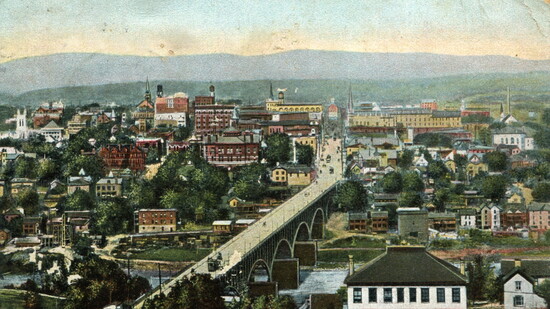
The Knoxville History Project is nearing completion on Historic South Knoxville, a new community history book to be published late this year. The book will broadly cover all of South Knoxville, but here is a brief look at a few of the district’s notable individuals, industries and communities.
Twenty years ago, it would have been hard to find a good place to buy a fancy cup of coffee or a decent draft beer across the river. But given the growth and popularity of Ijams Nature Center and the Urban Wilderness, and new businesses and residential projects, South Knoxville is becoming a different place.
Long ago, South Knoxvillians referred to the land as “South America” and often adopted a certain pride in being physically removed from downtown, its separateness worn like a badge of honor.
The first settler on the south side proved to be John Dearmond, who arrived just a few months after Revolutionary War captain and Knoxville founder James White, around 1786. While White set up his fort north of the river, Dearmond established his home on the south side, around where the Henley Bridge is today. Here, a small community known as Iredell thrived for a while, named after a county in North Carolina from which these two frontier settlers came.
A few months after Knoxville was founded in 1791, Alexander Cunningham secured permission from city commissioners (his father, Paul, was among them) to start a ferry service from the south side across the river. It’s hard to picture today, but the site of Holston Gases is where these and other ferrymen once plied their services.
By the time of the Civil War, South Knoxville was still largely rural, and a difficult landscape to cultivate due to the hills and valleys that still define it. After occupying the city in 1863, the Union Army established several fortifications on those hills, including Fort Stanley and Fort Dickerson. Halfway up the slopes below Fort Stanley, once known as Gobblers Knob, the army also set up a military hospital. It may have been a relatively quiet place for injured soldiers to convalesce.
After the war, Jack Jones ran a ferry here for a time and owned land along what would become Sevier Avenue. He also set up a fairground that included a racetrack run by African American horse fancier, jockey and successful saloonkeeper Cal Johnson, about where Suttree Landing Park is today.
By the early 1890s, several churches and schools began to emerge as cornerstones of this community. South Knoxville Presbyterian Church first started in a wooden building opposite where Kern’s Bakery is now. In the basement of that church, the South Knoxville Grammar School first assembled, before a proper one was built overlooking the Tennessee River atop what used to be called Rocky Hill, the lower portion of Gobblers Knob.
Around the same time, industry began to take hold along the south shore with D.M. Rose Lumber and East Tennessee Packing Company setting up just east of the Gay Street bridge, while to the west would be the Jefferson Woolen Mill and Scottish Lumber (where Scottish Pike derives its name). A little further south, the Vestal Lumber Company and Candoro Marble provided reliable jobs for residents in the often rough and tumble community of Vestal.
After decades of short-lived bridge projects and some years when there were no bridges at all, the completion of the current Gay Street bridge in 1898 provided a permanent way to cross the river. Despite its recent structural problems, it has lasted for a remarkable 128 years. Streetcar tracks built into the bridge would, in time, provide a connection along Sevier Avenue to a development that began about 1912 on Col. Perez Dickinson’s former 600-acre model farm known as Island Home. With its attractive leafy boulevard, Island Home Park has long been one of South Knoxville’s most desirable residential areas, perhaps even more so today, given the now popular hiking and biking trails close by. Broadway actor John Cullum is just one of several notable Island Home residents. He grew up in the 1930s and ‘40s and lived here with his family while nurturing his acting career in Knoxville.
After large parts of South Knoxville were annexed by the City of Knoxville in 1917, major road improvement projects spurred new communities. Off Chapman Highway, Lindbergh Forest in what was once known as the Woodlawn Valley, began in the late 1920s, while in the 1940s, closer to city limits, Lake Forest and Colonial Village began around two natural ponds, one of which belonged to longtime farmer Samuel McCall. In the 1950s, South Haven, off Sevierville Pike, developed on land once belonging to the James Dairy Farm.
Off Alcoa Highway, Lakemoor Hills and Timberlake neighborhoods were planned in part by several men involved with the Great Smoky Mountains National Park movement. They moved to South Knoxville and built homes with clear views of the mountains that so inspired them.
These are just a few of the fascinating stories to be included in Historic South Knoxville. If you would like to support the publication of this book, learn more at Knoxvillehistoryproject.org/southknoxsubscriber.
About KHP: The educational nonprofit Knoxville History Project tells the city’s true stories, focusing on those that have not been previously told and those that connect the city to the world. Donations to support the work of KHP are always welcomed and appreciated. Learn more at KnoxvilleHistoryProject.org.