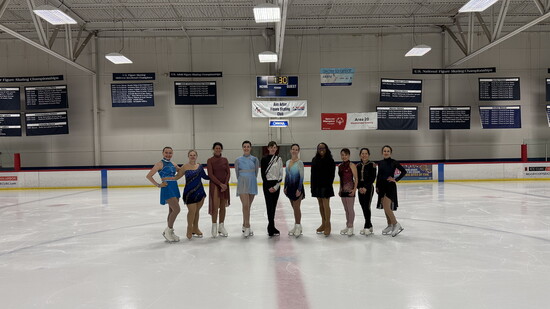
Step through the sliding doors of the BIGGBY Coffee Ice Cube, home of the Ann Arbor Figure Skating Club (AAFSC), and the space quickly takes on a rhythm of its own. Tables beside tall windows overlooking the ice fill with skaters and families moving between homework, conversation and practice. Some arrive tentative, still learning to trust the blades beneath their feet; others have spent years making the ice feel like home. They watch, learn, and return, again and again, to a place shaped as much by the people surrounding the rink as by what happens on it.
At the AAFSC, there’s room on the ice for everyone.
One of the oldest and largest skating clubs in the nation, the AAFSC is a nonprofit with roots going back to 1939. The club serves Learn-to-Skate participants through elite competitors, including two-time Olympic gold medalist Evan Bates, who started skating with the club at age 4. The AAFSC’s reach spans adult and competitive skating, synchronized skating, and Special Olympics, supported by plentiful ice time and coaches across disciplines and skill levels. Flexible sessions stretch from early morning into the evening, allowing homeschooled high-level skaters to build training into their days, while working adults and families can find time around their busy schedules.
For AAFSC president and longtime coach Doug Haw, this accessibility means helping skaters reach the levels they hope to attain. “You can achieve your full potential…whatever you choose, because we have the coaches to facilitate that.” Beyond the rink, skaters become friends, parents help one another, and coaches remain invested long after a lesson ends. “It’s a real village here,” Haw says.
At the heart of that village are the coaches. Haw is adamant that facilities alone don’t create strong skating programs — people do. AAFSC’s coaches bring different specialties, nurturing skaters from first lessons through elite competition. After 47 years of coaching around the world, Haw has watched teaching evolve. Videos now join him rinkside, helping skaters visualize an element more quickly. Yet the greatest change has little to do with technique.
Today’s young skaters, he says, carry pressures far beyond the rink. In a world increasingly shaped by social media and comparison, questions of “Am I pretty enough? Am I good enough?” can weigh heavily. “The coach’s job now, to me, is to instill confidence,” Haw says. “It used to be all about the technical side, but my focus has shifted to more confidence building — it’s paramount.”
That means pairing instruction with encouragement and attainable goals so every skater leaves feeling a little more capable than when they arrived. A landed jump or passed test becomes more than a technical milestone; it’s proof of progress, building confidence one small victory at a time.
Sometimes, that belief reaches beyond a lesson. While leading a seminar in South Africa, Haw noticed particular talent in 16-year-old Cody. When his family wondered whether he could train with Haw in North America, Haw worked to make an otherwise costly opportunity attainable — discounting his coaching, while a local family provides room and board. Cody later earned an international medal for his country. For Haw, the greater victory was making an opportunity that once seemed out of reach real.
That sense of belonging extends to synchronized skating, a discipline born in 1956 in Ann Arbor under Dr. Richard Porter. The world’s first-ever synchronized skating team, AAFSC's "The Hockettes" began performing during intermissions at University of Michigan hockey games and at ice shows hosted by the AAFSC. As the sport gained popularity, new teams formed, competitions emerged, and synchronized skating evolved into the globally recognized, elite discipline it is today.
For Haw, part of its magic is the path it creates for skaters whose aspirations may not lead toward elite singles competition but whose love for the ice remains. He calls out his three Fs of skating: fun, fitness and fundamentals. Synchro adds something else: each other. Skaters compete together, while friendships stretch beyond the rink — bowling outings, picnics, holiday parties.
Now, that community has a new horizon. With synchronized skating headed to the Olympics in 2030, young athletes can reach for a goal generations of skaters before them couldn’t. Becca Gerfen, a former synchro skater and current coach, understands the significance of that shift. For years, synchro skaters could compete at the highest levels, yet the Olympic dream was elusive.
“But now the answer’s yes,” she says. It changes the goals skaters set and the heights they can imagine. The place where synchro began may also be the place where an Olympic dream begins.
Yet for all the medals, milestones and Olympic dreams, the heart of the club rests in everyday victories. “I love seeing the impact I have on each skater,” Gerfen says. “Seeing their confidence build…and they finally figure it out and get those ‘aha’ moments. That’s the reason why I’m here.”
At AAFSC, success can look like an international podium or a first uncertain step onto the ice. What connects them is the village surrounding each skater — ready to teach, encourage and make room for whatever achievement comes next.
Learn more at annarborfsc.org.