Like any town in America, before the introduction of the automobile, Knoxvillians rode around on horseback. From its earliest days as a territorial capital to the present day, Knoxville has its own stories of special horses and riders that add a little color to the city’s history throughout the decades.
John Sevier, a frontier hero and Tennessee’s first governor, was a notable rider who rode his horse from town to town, often tying up his horse for the night when he was here, in the state capital. We know that he often took his horse across the river on a ferry before riding out to his rural farm south of the river that later became known as Marble Springs.
In the 1850s, African American Richard “Uncle Dick” Payne operated what has been called “Knoxville’s Original Water Works.” For about four decades, Payne used a mule to pull a two-wheeled cart fitted with a large barrel to distribute fresh water to locals who lived in a city that didn’t yet have running water. Payne’s long career was unusual enough to be featured in Harper’s Weekly.
By the late 1860s, the city operated a stable at City Hall at the northern end of Market Square. Horses and mules kept there also served the fire department. Later, the stable moved a couple of blocks away to State Street, just north of Union Avenue, about where Marble Alley Lofts are today. In 1876, a mounted patrol featured in a special Fourth of July parade along Gay Street.
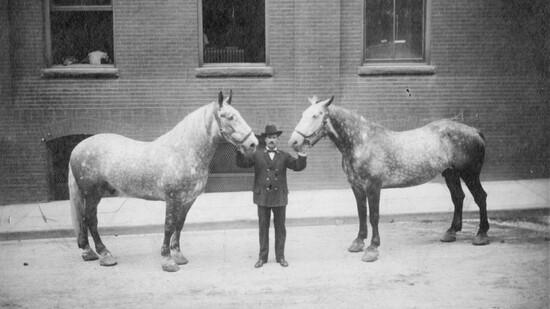
The State Street stable would be wiped out in the calamitous fire on Gay Street in April 1897 that began inside Hotel Knox on the east side of the 400 block. The deadly fire destroyed most of the buildings on that block as well as other structures that extended to State Street. Fortunately, the police were able to evacuate the horses from the stable before it caught fire, and it was soon rebuilt. In 1900, fire chief Sam Boyd proudly announced the purchase of two impressive horses named Ned and George (see photo) that would bolster the department’s ability to respond to the sound of fire alarms.
In the early 1900s, as more automobiles appeared on the city’s streets, this new form of transport gradually began to reduce the demand for horses used by the city. Around 1908, the city moved its stables to a new facility on the northwest fringe of downtown on Broadway. It stood for about 20 years before being converted into a jail. For some years, people thought it still smelled like a stable.
The turn of the century also ushered in an era of heightened awareness about the mistreatment of animals, particularly horses employed in the Hackney Carriage trade. Commonly known as “hacks,” these horse-drawn wagons, available for hire at any time of the day or night, were often driven by drivers who cared little for the welfare of their horses. Due to a city ordinance that instructed hack drivers to keep moving and not congregate or cause a nuisance to other traffic, workhorses were often in perpetual motion. The only places they could stop were unsightly hack stands. The Knox County Humane Society, organized in 1885, brought new awareness to these circumstances, claiming that many working horses were often poorly fed and simply far too old to be pulling carriages all day long.
By 1900, with multiple modes of transport appearing on city streets, just crossing Gay Street could be a hazardous undertaking—you would have to contend with other pedestrians, bicyclists, streetcars, automobiles, and, of course, horse and carts and their waste as well.
In 1916, citing the ever-increasing number of cars, the city began to reduce the number of horses in its stables, particularly those that had been in service for years. Horses remained a regular or occasional sight in downtown Knoxville into the 1930s.
Model Laundry, founded in 1914 not far from the old city stable on State Street, was one business that employed horse and carts to deliver factory uniforms at least into the 1920s. Model’s fleet of horse-drawn wagons served downtown clients and the suburbs, ultimately adding a new building across the river on Sevier Avenue that still stands today.
But by the late 1940s, when streetcar service ended, the automobile became king. It would have been a rare sight after that to see a horse and cart downtown, unless perhaps in a parade. But a recent development at the Knoxville Police Department is changing that assumption.
After a break of almost 70 years, the City of Knoxville recently brought back its Mounted Patrol Unit, acquiring Percheron horses, two of them named Waggoner and Phyl, from Mounted Patrol International—this special breed of draft horse originates from the Huisne River Valley of western France, formally known as the Perche province. The new Mounted Patrol is seen daily throughout downtown and helps with special events, where they have already become a popular sight and a firm favorite with locals and visitors to Knoxville.
About KHP: The educational nonprofit Knoxville History Project tells the city’s true stories, focusing on those that have not been previously told and those that connect the city to the world. Donations to support the work of KHP are always welcome and appreciated. Learn more at KnoxvilleHistoryProject.org