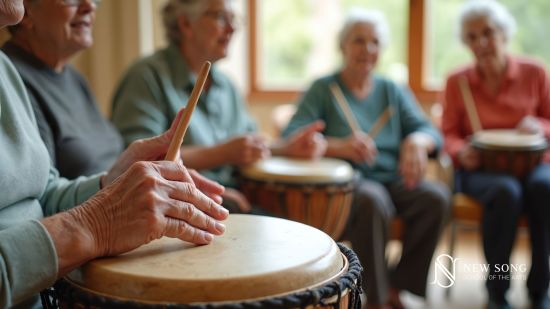
How Learning Music Helps Heal and Strengthen the Brain
By Todd Parks, Owner and Founder, New Song School of the Arts
What happens inside the brain when someone sits down at a piano, picks up a guitar, plays the drums, or begins to sing?
Far more than most of us realize.
Learning music requires the brain to listen, remember, anticipate, coordinate movement, recognize patterns, process emotion, solve problems, and make adjustments, often within fractions of a second. Few activities ask so many different areas of the brain to work together at the same time.
That is one reason scientists have become increasingly interested in the connection between music education and brain development.
Research suggests that learning and making music can produce measurable changes in how the brain functions and communicates. Scientists call this ability neuroplasticity-the brain's remarkable capacity to change, adapt, and strengthen its connections in response to experience.
And the effects of music aren't limited to childhood.
Evidence from neuroscience, traumatic brain injury rehabilitation, military medicine, aging research, and dementia care suggests something remarkable:
The human brain continues to respond to music throughout life.
Music Is a Whole-Brain Activity
Learning to play an instrument may look simple from the outside, but neurologically, it is extraordinarily complex.
Imagine a student learning a piece on the piano.
The eyes read the notes on the page. The auditory system anticipates and evaluates sound. The brain remembers rhythm and pitch. The hands perform different movements, sometimes simultaneously. The student maintains a steady beat, monitors mistakes, predicts what comes next, and makes immediate corrections.
All of this happens while the emotional centers of the brain are also responding to the music.
Researchers Sibylle Herholz and Robert Zatorre of the Montreal Neurological Institute described musical training as an especially valuable model for studying brain plasticity because learning an instrument involves multiple sensory systems along with complex cognitive abilities. Their review in the journal Neuron found evidence that musical training can produce behavioral, functional, and structural changes in the brain over periods ranging from days to years.
In other words, when someone practices music, they aren't simply training their fingers or their voice.
They are training networks within the brain.
What Is Neuroplasticity?
For many years, people assumed that the brain developed during childhood and then became relatively fixed.
We now know differently.
The brain is constantly changing in response to what we repeatedly do. Neural connections that are frequently used can become stronger and more efficient. The brain can also reorganize networks and recruit different pathways when learning new skills or recovering from injury.
That process is known as neuroplasticity.
Music provides an unusually rich environment for neuroplasticity because playing music combines:
auditory processing, memory and attention, fine and gross motor coordination, visual-spatial processing, emotional processing, timing and sequencing, pattern recognition, executive function, and continuous error correction.
Every music lesson asks these systems to communicate with one another.
And every practice session provides another opportunity to reinforce those connections.
Music Lessons and the Developing Brain
The neurological benefits of music education may begin early.
A longitudinal study from the University of Southern California's Brain and Creativity Institute followed children participating in music training and compared them with children involved in sports and children who were not enrolled in systematic extracurricular training.
After two years, researchers found that children receiving music training demonstrated stronger development in music-related auditory processing and corresponding changes in the brain. They also showed stronger neural activation in areas associated with inhibitory control—an important component of executive functioning. Because the children were followed over time, researchers were better able to distinguish changes associated with training from differences that may have existed before the children began music lessons.
This is an important distinction.
It suggests that the differences scientists observe in musicians' brains aren't simply because certain people are naturally drawn to music. The process of learning music itself can contribute to changes in the developing brain.
For parents searching for meaningful activities for their children, this adds another dimension to the value of piano lessons, guitar lessons, voice lessons, drum lessons, string lessons, and other forms of music education.
A child may be learning to play a song.
At the same time, that child is practicing attention, perseverance, memory, coordination, listening, problem-solving, and self-correction.
Can Music Help the Brain Recover After Injury?
Perhaps some of the most fascinating evidence about music and neuroplasticity comes from traumatic brain injury research.
A randomized controlled study involving people with moderate-to-severe traumatic brain injury examined the effects of neurological music therapy. Participants completed musical exercises involving activities such as rhythmic movement, drumming, piano playing, and structured musical tasks.
Researchers didn't rely only on questionnaires or observations.
They examined the brain using MRI.
After the music-based intervention, researchers found changes in important white-matter pathways—including pathways involved in communication between brain regions—and those changes were associated with improvements in executive functioning. The researchers concluded that neurological music therapy could induce structural white-matter neuroplasticity in the injured brain.
A related randomized controlled trial involving 40 patients with moderate-to-severe traumatic brain injury found improvements in executive function and measurable changes in gray-matter volume within the prefrontal cortex following neurological music therapy.
These findings should not be interpreted to mean that simply taking music lessons will cure a brain injury.
Music therapy is a clinical discipline delivered by trained professionals, and medical rehabilitation should always be supervised by appropriate healthcare providers.
But these studies reveal something profound about the brain:
Musical activity is powerful enough to engage the mechanisms the brain uses to adapt and reorganize itself.
Music, Brain Injury, and America's Military
This connection has also attracted attention within military medicine.
Traumatic brain injury has been a major concern among service members, particularly those exposed to blast injuries. Music therapy has increasingly been incorporated into interdisciplinary programs serving active-duty military personnel and veterans with traumatic brain injury, PTSD, and related neurological and psychological conditions.
A review of music therapy research involving military populations found 27 publications involving active-duty personnel and veterans, with traumatic brain injury and PTSD among the most common conditions treated.
One published case involving a severely injured service member found that music therapy, when integrated alongside physical therapy, occupational therapy, and speech-language pathology, supported rehabilitation in areas including movement, endurance, speech, attention, social integration, motivation, and quality of life.
More recently, researchers reported on active-duty Explosive Ordnance Disposal service members with mild traumatic brain injuries participating in piano-based music therapy. The clinical observations included music-skill acquisition involving dexterity, memory retention and recall, and emotional regulation. Because this was a case series rather than a large randomized trial, the findings should be considered promising rather than definitive.
That distinction is important. The scientific evidence continues to develop.
But the fact that music-making is being investigated in serious neurological rehabilitation settings tells us something important about how demanding and potentially powerful the act of making music is for the human brain.
Music Doesn't Stop Challenging the Brain as We Age
One of the most encouraging findings in music research is that the neurological value of learning does not end when childhood does.
Learning an instrument later in life still requires attention, memory, movement, coordination, auditory discrimination, and problem-solving.
A systematic review and meta-analysis examined instrument playing as a cognitive intervention for adults age 60 and older, including healthy older adults and people experiencing mild cognitive impairment or dementia.
Researchers found that instrument playing simultaneously involves motor and cognitive functions and can provide meaningful cognitive stimulation. Across the studies examined, researchers evaluated areas including memory, attention, executive function, processing speed, verbal fluency, and visuospatial abilities.
This is one reason adult music lessons and senior music lessons can be about far more than finally learning a favorite song.
Learning piano at 55, guitar at 65, or another instrument at 75 gives the brain something extremely valuable:
a new and continually challenging skill to learn.
Music and Dementia: When Songs Reach Memories That Words Cannot
The relationship between music and dementia is especially fascinating.
Families of people living with Alzheimer's disease and other forms of dementia sometimes observe something remarkable. A person who struggles to recall recent conversations or familiar names may still recognize a song from decades earlier—or even remember its lyrics.
Researchers have been studying why.
Musical memories interact with auditory processing, emotion, movement, autobiographical memory, and reward systems. Because music recruits distributed networks throughout the brain, aspects of musical responsiveness may remain accessible even as other cognitive abilities decline.
In a randomized study involving 89 people with dementia and their caregivers, regular singing and music listening were associated with improvements in mood, orientation, and remote episodic memory compared with usual care. Singing was also associated with benefits in short-term and working memory and caregiver well-being.
At the same time, it is important not to overstate the science.
A major 2025 Cochrane review examined 30 randomized studies involving 1,720 people with dementia. Researchers concluded that music-based therapeutic interventions probably produce a modest improvement in depressive symptoms and may improve some behavioral and social outcomes, but current evidence does not establish that music therapy reverses dementia or consistently improves overall cognition.
Music is not a cure for Alzheimer's disease or dementia.
But preserving engagement, encouraging social interaction, stimulating memory, supporting mood, and providing meaningful moments of connection can still be incredibly significant.
Is Listening to Music Enough?
Listening to music can be powerful.
But learning to make music asks even more of the brain.
Consider the difference between listening to a pianist and actually playing the piano.
The listener processes sound, rhythm, emotion, anticipation, and memory.
The pianist must do all of those things while simultaneously controlling ten fingers, reading patterns, remembering sequences, keeping time, adjusting dynamics, monitoring mistakes, and planning what happens next.
That active participation is one of the reasons musical instrument training is so neurologically interesting.
The goal doesn't have to be becoming a concert pianist.
The act of learning is where much of the neurological challenge occurs.
The Brain Needs Challenge, Not Perfection
This leads to an important idea for both children and adults:
You do not have to be exceptionally talented at music to benefit from learning it.
In many ways, the challenge is part of the benefit.
Every time a student struggles through a measure, coordinates two hands for the first time, learns a new chord, corrects a rhythm, memorizes a song, or tries again after making a mistake, the brain is being asked to adapt.
Progress requires repetition.
Repetition strengthens skills.
And repeated learning is one of the forces that drives neuroplasticity.
That makes music education uniquely valuable throughout life.
Music Education at New Song School of the Arts
At New Song School of the Arts, we have believed in the transformational value of arts education since our founding in 1999.
For more than 26 years, New Song has helped children, teenagers, and adults discover music through private instruction, group classes, performance opportunities, and a community centered around artistic growth. Today, New Song serves families through campuses in Argyle and Southlake, Texas, as part of a broader fine-arts program encompassing music, theatre, and visual arts.
Students can study piano, guitar, voice, drums and percussion, strings, woodwinds, brass, and other areas of music through private and group learning opportunities.
For families searching for music lessons in Argyle, TX, music lessons in Southlake, TX, or high-quality music education in the North Texas and DFW area, our goal extends beyond simply teaching students how to perform a song.
We want students to learn how to listen.
How to focus.
How to persevere.
How to solve problems.
How to express themselves.
How to create.
And how to continue learning throughout their lives.
Our mission at New Song is simple:
We Equip. We Enrich. We Inspire.
The science of music gives us one more reason why that mission matters.
Music Is Exercise for the Brain
We exercise our bodies because we understand that muscles respond to repeated challenge.
The brain responds to challenges too.
Every scale, chord progression, rhythm, melody, rehearsal, and performance asks the brain to build on what it learned before.
For a young child, music may help shape a developing brain.
For a teenager, it can challenge attention, discipline, coordination, and executive function.
For an adult, learning music can introduce an entirely new cognitive and motor skill.
For an older adult, playing an instrument can provide complex, enjoyable cognitive stimulation.
And in specialized clinical settings, music is even being used to help people recovering from neurological injury engage the brain's capacity for neuroplasticity.
We should be careful about saying that music can simply “heal the brain.” Neuroscience is more complicated than that.
But the research gives us something equally exciting to say:
Learning music challenges the brain to change.
It asks neural systems to communicate, coordinate, adapt, remember, and grow stronger through repeated use.
That is the extraordinary science behind something musicians have experienced for generations.
When you learn music, you aren't only learning notes.
You are training your brain.
About New Song School of the Arts
Founded in 1999, New Song School of the Arts provides music, theatre, and visual arts education for children and adults throughout North Texas. With campuses in Argyle and Southlake, Texas, New Song offers private music lessons, group classes, ensembles, camps, and performance opportunities designed to equip, enrich, and inspire students through the arts.
Families interested in piano lessons, guitar lessons, voice lessons, drum lessons, string lessons, woodwind lessons, brass lessons, or other music programs in Argyle or Southlake can learn more about New Song School of the Arts and explore available programs through our Welcome Team.
This article is intended for educational purposes. Music instruction is not a substitute for medical treatment or clinical music therapy. Individuals dealing with traumatic brain injury, dementia, or other neurological conditions should consult qualified healthcare professionals.
Research Referenced
Herholz, S. C., & Zatorre, R. J. (2012). Musical training as a framework for brain plasticity: Behavior, function, and structure. Neuron, 76(3), 486–502.
Habibi, A., et al. (2018). Music training and child development: A review of recent findings from a longitudinal study. Annals of the New York Academy of Sciences.
Sihvonen, A. J., et al. (2022). Neurological Music Therapy Rebuilds Structural Connectome after Traumatic Brain Injury: Secondary Analysis from a Randomized Controlled Trial. Journal of Clinical Medicine, 11(8), 2184.
Siponkoski, S.-T., et al. (2020). Music Therapy Enhances Executive Functions and Prefrontal Structural Neuroplasticity after Traumatic Brain Injury: Evidence from a Randomized Controlled Trial. Journal of Neurotrauma.
Gooding, L. F., & Langston, D. G. (2019). Music Therapy With Military Populations: A Scoping Review. Journal of Music Therapy.
Särkämö, T., et al. (2014). Cognitive, emotional, and social benefits of regular musical activities in early dementia: Randomized controlled study. The Gerontologist.
Kim, S. J., & Yoo, G. E. (2019). Instrument Playing as a Cognitive Intervention Task for Older Adults: A Systematic Review and Meta-Analysis. Frontiers in Psychology, 10, 151.
van der Steen, J. T., et al. (2025). Music-based therapeutic interventions for people with dementia. Cochrane Database of Systematic Reviews.