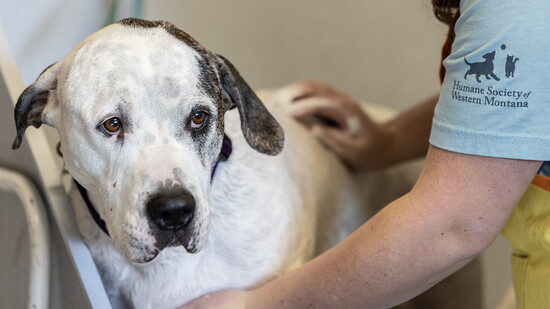
The Humane Society of Western Montana (HSWM) has maintained a 90% or above placement rate since 2009, classifying it as a no-kill shelter—an incredible level of success that saves lives by standard. Beyond that, their efforts have a direct impact on community and statewide pets: keeping them with their families, servicing their needs, and offering opportunities where there often are none. We took a deep dive of 2025 with Marta Pierpoint, the Executive Director of HSWM to get a closer look at the work they're doing to get or keep animals home.
Let’s start with impact. What did 2025 look like for HSWM?
The year-end numbers confirm what we all knew anecdotally: 2025 was a year of significant impact. In total, we served 4,798 pets, administered 7,147 vaccines, and altered 2,176 animals. These numbers represent care in action. Each vaccine prevents disease. Each bag of food helps keep a pet with their family. Each spay or neuter prevents future suffering. That is where the real impact lives.
Outreach has become a big part of your work. Can you explain why that matters — not just locally, but statewide?
People sometimes ask why we travel outside of Missoula to engage in animal welfare work. The answer is simple: we are an animal welfare organization, and we go where animals need us most. In Montana, that often means going where people face the greatest barriers to care.
Missoula has approximately 13 to 15 veterinary clinics and hospitals, offering everything from routine wellness care to emergency and specialty services for a city of about 78,000 people. By contrast, the Rocky Boy Reservation and the Blackfeet Nation have no community veterinarian. Families on Rocky Boy often travel 25 miles or more to reach care in Havre. On the Blackfeet Reservation, residents may travel 40 to 50 miles to Cut Bank for even basic services. When cost, weather, transportation, and work schedules are added, “access” becomes largely theoretical.
This gap did not happen by accident. Tribal Nations have long been left out of the animal care movement, with little infrastructure, sustained investment, or local access to veterinary services. We will never solve animal welfare challenges in Montana, or anywhere, by relying on shelters and rehoming alone. Most people want to care for their pets. When given real access to veterinary services, families show up, ask questions, follow through, and do right by their animals. One of our quiet successes in 2025 reflects this reality: after five years of consistent support, our most recent clinics on Rocky Boy were slower. Fewer pets were in need, and open surgery slots went unfilled for the first time. The community has moved from crisis response to maintenance-level support.
Is there a 2025 adoption story that really stuck with you?
There are many stories that stick with me, but the ones that are most meaningful are the long-stay animals. Not because there was anything “wrong” with them, but because they needed more time, patience, and the right match. When one of those animals finally finds their person, it reminds all of us why we do this work.
I ran this question by our staff, and after a fun conversation sharing many special adoptions, we all landed on one standout: Spyro.
Spyro had a rough start to life. He was born with a severe cleft palate that made it difficult for him to get adequate nutrition early on and was bottle-fed as a baby after his mother and littermates rejected him. His slowed development manifested in one-of-a-kind quirks: easily startling, a fear of the dark, tricky behaviors with other dogs, and a love of hard boiled eggs. He needed to find the right adopter who cherished these oddities as much as we did.
Thankfully, his previous home was able to provide the extra time and care he needed to grow strong before he arrived at HSWM. While in our care, Spyro underwent surgery to repair his cleft palate. Because it was a complex procedure, we reached out to Dr. Felz at Missoula Veterinary Dentistry & Oral Surgery, who generously offered a significant discount to help make the surgery possible.
Thanks to an outpouring of community love and support, Spyro’s life-changing surgery was fully funded in under 24 hours.
Today, he is healthy, unique, and living his best life with an outstanding adopter.
What do you need most from the community right now?
Of course, we always need donations, supplies, and volunteers. All of that matters. But one of the most important things we need from, and for, our community is understanding.
The no-kill movement has accomplished extraordinary things and fundamentally improved animal welfare. At the same time, it has created expectations that do not always match today’s reality. Many of the animals entering shelters now have complex medical needs, behavioral challenges, or both. Supporting them and placing them successfully requires more time, expertise, and resources than ever before.
Maintaining a no-kill community also requires shared responsibility. Adopters, donors, veterinarians, and community partners all play a role, especially when it comes to animals who are harder to place. Not every medical or behavioral problem can be fixed by families or professionals. That is not a failure; it is the reality of this work, and when our community understands our reality, everything becomes stronger. Rehoming an animal into a situation where it is likely to fail or cause harm is neither compassionate nor responsible.
Also, our greatest limitation is space. The demand for spay and neuter services far exceeds our current surgical capacity. During Fix It February, we converted our education room into a temporary, field-style clinic on select days. It is not an ideal solution, but it reflects both the level of need in our community and the creativity required to meet it. Let's think "larger space" for 2026.
What can the community expect in 2026? Any highlights you’re excited about?
I’m really excited about 2026. Our community showed up in such a meaningful way, especially on Giving Tuesday, that we were able to do something we’ve never done before.
The entire month of February was “Fix It February,” and every spay and neuter surgery we performed was completely free of charge. This is the largest free spay/neuter effort we’ve ever offered, and it’s 100% because our community made it possible.
We’ll also continue our free monthly vaccine clinics, which are always incredibly well attended. And one of our favorite events, Pack the House at the Wilma, is coming back. It’s part celebration, part fundraiser with live music, snacks, signature cocktails, and a year-end video. Mark your calendars for March 5th!
We will also hold our second-annual conference in June that brings together animal welfare professionals from across the region to learn from one another and strengthen the work statewide. In 2025, the 127 attendees included animal control officers, sheriffs, lawyers, veterinarians, health department directors, tribal members from all seven reservations, volunteers and many more professionals from the entire state (and beyond).
"In total, we served 4,798 pets, administered 7,147 vaccines, and altered 2,176 animals. These numbers represent care in action. Each vaccine prevents disease. Each bag of food helps keep a pet with their family. Each spay or neuter prevents future suffering." - Marta Pierpoint, Executive Director of HSWM