Career paths rarely follow a straight line. In 1924, they could take an even more unexpected turn.
Prohibition was the law of the land, and headlines were filled with unlikely criminals. In New York, a bobbed-haired bandit named Celia Cooney captured national attention. Months later, Idaho had its own version of the story.
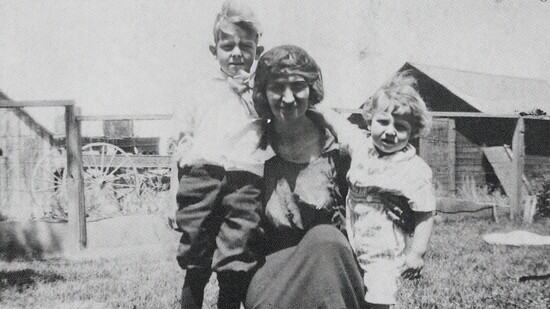
Her name was Dora Douglas.
How did the mother of two young children end up robbing the Bank of Eagle in broad daylight?
When Dora, a statuesque, slim, raven-haired woman with cornflower blue eyes, walked into a café where Oliver “Derby” Jones was dining, he asked the headwaiter for an introduction. Dora had “the prettiest smile I had ever seen,” Jones later wrote.
Their connection was immediate. On an early date, the two attended a film in which a character was sent to prison. Dora felt the character hadn’t been treated fairly. Encouraged, Jones revealed that he himself was serving time for robbery. He had been granted unusual freedom by Warden Cuddy—allowed to work outside the penitentiary, wear his own clothes, and move about the city as long as he reported back on time.
Dora accepted this reality, even visiting Jones at the prison. After his parole, their lives became further entangled when Jones met Chet Langer, who was planning a robbery.
On the morning of August 11, 1924, a Cadillac touring car pulled up outside the Bank of Eagle shortly after it opened. Two masked men entered. A third figure, also masked and dressed in a man’s coat, remained in the backseat.
The robbery was swift. Langer cleared out the vault while Jones held the banker and clerk hostage before locking them inside. The two eventually escaped using tools the banker had kept on hand for emergencies.
The group made off with $2,722—nearly $40,000 today.
Less than a day later, police arrived at Jones’ apartment. Dora, with Luther beside her, briefly resisted before surrendering. She, Jones, and her son were taken in for questioning. Langer had already been captured.
The story quickly made headlines. The Idaho Statesman reported that most of the stolen money had been recovered, though $775 remained missing.
Facing charges, Dora agreed to testify against Jones and Langer in exchange for immunity. Then, in a move that added another unexpected turn, she married Jones—making it impossible to be compelled to testify against him.
Langer was sentenced to six to fifteen years. Jones received ten to twenty.
During one of their early visits, Dora told Jones that police continued to question her about the missing money. Jones, the only one who knew where it was hidden, refused to reveal its location. “I would never talk, no matter what,” he said.
Not long after, he asked Dora for a divorce.
She agreed. After that, she never saw him again.
Dora’s story fades quietly from the record, but the lives connected to it continued forward. Her son Luther would go on to become a pilot, flying 29 bombing missions over Germany during World War II.
The missing $775 from the Bank of Eagle robbery—more than $10,000 today—was never recovered.
It is difficult to imagine today, in a place now known for its quiet neighborhoods and steady growth, that such a story once unfolded here.
But the larger mystery may be Dora herself: a young mother who stepped briefly into a life that defied expectation, then disappeared from the headlines as quickly as she entered them.