Every August, Santa Fe Indian Market transforms the heart of the city into one of the world’s largest gatherings of Native artists. Come Thanksgiving weekend, the Southwestern Association for Indian Arts (SWAIA) does something rather different. Winter Indian Market brings 160 juried Native artists under one roof at the Santa Fe Community Convention Center, trading summer’s scale and spectacle for a quieter and more personal experience. The smaller scale, though, is precisely what gives Winter Market its character.
Jamie R. Schulze (Northern Cheyenne/Sisseton Wahpeton Oyate), executive director of SWAIA, sees that intimacy as one of Winter Market’s defining strengths. The smaller setting, she says, gives visitors more time to understand not only how a piece was made, but the ideas, traditions, and contemporary Native perspectives behind it. “When someone purchases a piece after having that conversation, they’re not simply buying something beautiful,” Schulze says. “They’re investing directly in an artist and carrying a deeper understanding of their work with them.”
ART, UP CLOSE
For collectors and first-time visitors, much of Winter Indian Market’s appeal lies in access—and the opportunity to learn what inspired a piece of jewelry, how a technique was developed, or the ideas behind a particular piece. Across two days, jewelers, potters, painters, photographers, textile artists, sculptors and carvers sell their own work, creating the kind of artist-to-buyer exchange that can feel increasingly rare in the art world. That connection is woven into Indian Market’s history. When the event began in 1922, Native artists had limited involvement in selling their work, with pieces submitted and priced through outside intermediaries. By 1931, artists began selling directly to the public, a shift SWAIA describes as an important move toward greater artistic agency and control. Nearly a century later, conversation between artist and collector remains central to the experience.
MEET THE MAKERS
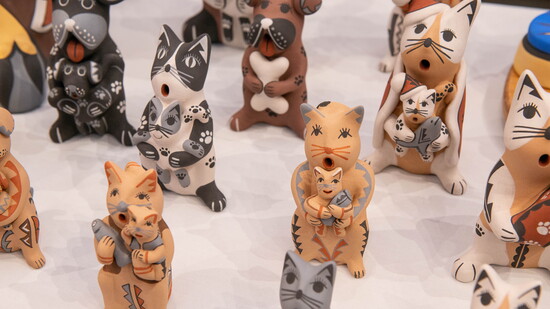
With traditional techniques appearing alongside distinctly contemporary expressions of Native art, the breadth of work on display is a huge part of the draw. Among this year’s artists are Jemez Pueblo potter Darrick Tsosie, known for his whimsical animal storytellers; carver Aaron Honyumptewa (Picuris Pueblo/Hopi and Laguna Pueblo), whose work includes intricately carved Pueblo figures; and award-winning Kewa (Santo Domingo Pueblo) bead roller Richard Abeyta, known for finely worked Heishi beads fashioned from turquoise, coral and shell.
For Hopi artists Donna Humetewa Kaye (Pesavensi) and her husband, Wilfred Kaye, that chance to explain the work firsthand is an important part of Winter Market. Donna paints with natural mineral pigments and clay gathered near the Hopi mesas, while Wilfred carves katsina figures from cottonwood root. The smaller setting, Donna says, gives them more time with the people who stop at their table—and more opportunity to share the cultural context behind what they make. Someone may recognize the word kachina, for example, without necessarily understanding its meaning or significance. That face-to-face exchange matters particularly to the Kayes. “We don’t have social media or a website, and we prefer to meet people in person,” Donna says. Those conversations can continue well beyond the market, sometimes developing into friendships with collectors who return year after year; some, she says, will visit them in August and make a point of saying they’ll see them again at the winter show.
A GIFT WITH A STORY
Winter Indian Market returns to the Santa Fe Community Convention Center November 28–29, over Thanksgiving weekend and with opening day coinciding with Small Business Saturday. The timing makes holiday shopping an unusually good fringe benefit. A squash blossom necklace or one of Darrick Tsosie’s animal storytellers already makes a distinctive gift; meeting the artist behind it adds another layer to what you take home. There’s plenty to keep you lingering beyond the booths, too, from live music and dance performances to Native food vendors and a virtual silent auction. But the art remains the reason to come—and perhaps to leave with something you hadn’t planned on buying.
Winter Indian Market brings 160 juried Native artists under one roof at the Santa Fe Community Convention Center, trading summer’s scale and spectacle for a quieter and more personal experience
We don’t have social media or a website, and we prefer to meet people in person