One of the most frustrating discoveries many accident victims make after a serious collision is learning that the insurance company has declared their vehicle a total loss, yet they still owe money on their vehicle loan.
Many people assume that if their vehicle is destroyed, the insurance company will pay off the entire loan balance. Unfortunately, that is not always the case.
This guide explains what GAP insurance is, how it works, and what you should do if your vehicle has been declared a total loss.
What Is GAP Insurance?
"GAP" stands for Guaranteed Asset Protection.
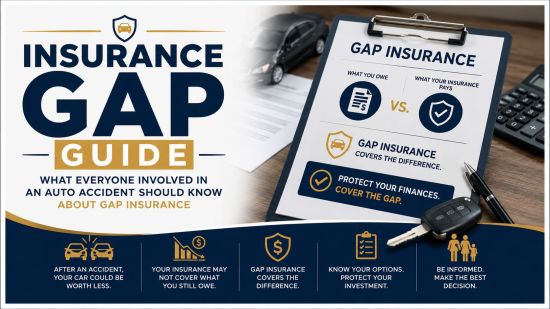
GAP insurance is designed to cover the difference—or "gap"—between:
The amount your automobile insurance company pays for your totaled vehicle; and
The amount you still owe on your vehicle loan or lease.
Without GAP insurance, you may be responsible for paying this difference yourself.
Why Does a GAP Exist?
Vehicles often depreciate faster than loan balances decrease.
As a result, many vehicle owners owe more on their loans than the vehicle is worth.
Example
Suppose:
Vehicle loan balance: $30,000
Vehicle's actual cash value: $24,000
After a collision, the insurance company declares the vehicle a total loss and pays $24,000.
You still owe:
$30,000 - $24,000 = $6,000
Without GAP coverage, you may remain responsible for that $6,000 balance.
When Is GAP Insurance Most Important?
GAP insurance is particularly valuable when:
You Made a Small Down Payment
Little equity exists in the vehicle.
You Financed the Vehicle for a Long Period
Loans lasting (72, 84, or 96 months) can create situations where the loan balance exceeds vehicle value.
You Purchased a New Vehicle
New vehicles often experience significant depreciation during the first few years of ownership.
You Rolled Debt from a Previous Vehicle into the New Loan
Negative equity from a prior vehicle can increase the amount financed and create a larger gap.
How Do I Know Whether I Have GAP Insurance?
Check:
Your Vehicle Purchase Documents - Many dealerships offer GAP coverage at the time of purchase.
Your Loan Agreement - GAP coverage may be included in financing paperwork.
Your Insurance Policy - Some automobile insurance companies offer GAP coverage as an optional endorsement.
Contact Your Lender - If you are unsure, ask your lender whether GAP coverage exists on your loan.
What Happens if My Vehicle Is Declared a Total Loss?
If your vehicle is totaled:
Step 1: The insurance company determines the vehicle's actual cash value immediately before the collision.
Step 2: The insurance company issues payment for that value.
Step 3: The payment is generally applied toward the outstanding loan balance.
Step 4: If a remaining balance exists, GAP coverage may pay all or part of the difference, depending upon the terms of the GAP contract.
Important Questions to Ask
If your vehicle is a total loss, ask:
What value has been assigned to my vehicle?
What is my current loan balance?
Do I have GAP coverage?
What amount will GAP pay?
Am I responsible for any remaining balance?
Does GAP cover deductibles?
Are there limitations or exclusions?
What GAP Insurance Usually Does Not Cover
Many GAP contracts contain limitations.
Coverage may not include:
Missed loan payments
Late fees
Extended warranties
Credit life insurance
Vehicle service contracts
Negative equity beyond contract limits
Certain loan rollovers
Read your GAP agreement carefully.
Review the Vehicle Valuation Carefully
Before accepting the insurance company's valuation, verify:
Vehicle mileage is correct.
Options and upgrades are listed.
Vehicle condition is accurately described.
Comparable vehicles are truly comparable.
Recent improvements are considered.
If the value appears too low, gather evidence supporting a higher valuation.
A higher valuation can reduce or eliminate the amount of any GAP deficiency.
If You Do Not Have GAP Insurance:
Do not panic - You may still have options.
Review the Insurance Company's Valuation - Errors sometimes occur.
Negotiate the Vehicle Value - Supporting documentation may justify a higher value.
Speak with the Lender - Some lenders may offer payment arrangements for any remaining balance.
Determine Whether Other Coverages Apply - Depending on your situation, additional insurance products or protections may exist.
Common Misunderstandings
Myth: The insurance company will pay off my loan.
Reality: The insurer generally pays the vehicle's market value—not necessarily the amount you owe.
Myth: If my car is totaled, my loan disappears.
Reality: Your loan obligation usually remains unless it is satisfied through insurance payments, GAP coverage, or other arrangements.
Myth: GAP insurance covers everything.
Reality: Coverage depends on the specific contract and may contain limitations and exclusions.
GAP Insurance Checklist
After a total-loss accident:
Obtain the insurer's valuation report.
Confirm your loan payoff amount.
Determine whether GAP coverage exists.
Review the GAP contract carefully.
Challenge inaccurate vehicle valuations.
Keep copies of all communications.
Ask questions before signing settlement documents.
Final Thoughts
A total-loss accident can create unexpected financial problems, especially when a vehicle loan balance exceeds the vehicle's value.
GAP insurance was created to address that problem. Understanding whether you have GAP coverage, how it works, and what your rights are can help protect you from unpleasant surprises after an accident.
The key is to gather information early, review all settlement documents carefully, and make sure you understand exactly what is being paid, who is being paid, and whether any balance remains your responsibility.
The Law Offices of Paul A. Samakow has been helping injured individuals since 1980 in Virginia, Maryland, and Washington, D.C. Call 301-500-0000 for a free strategy session to see if you have a case and if his office can obtain full compensation for you.