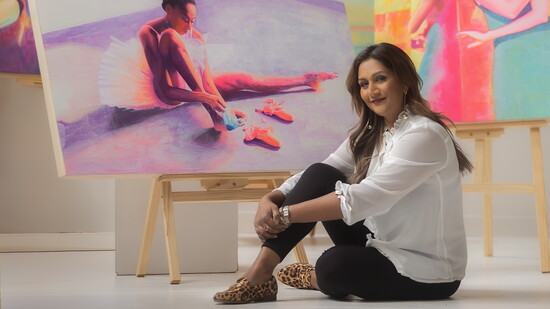
Devi Brunsch didn’t set out to write an investing playbook. But if you spend an hour with her, you realize she has. Hers just doesn’t start with stocks or spreadsheets—it starts with the courage to pivot, the discipline to build skill, and a belief that the best returns are measured in health, relationships, and community impact.
A trained artist with a Bachelor of Fine Arts, Devi entered college in the early 2000s with a dream many creatives know well: to become “the next big artist.” But as she studied art history, she noticed what was missing. The canon was overwhelmingly male. Female artists were few. And for Devi, a South Asian woman, representation felt almost nonexistent. The message, subtle but loud, was that art was a risky path—especially for someone who wanted stability and financial security.
So she invested in a different kind of future. Devi earned a master’s degree and built a successful career in software and tech—work she enjoyed and excelled in for two decades. Like many high-achievers, she learned to measure success in the language her industry rewarded: titles, bonuses, salary, momentum. “You kind of get caught in that,” she says. Until life interrupts the momentum and forces a harder question: what matters when the title disappears?
That question arrived through profound loss. Devi took a sabbatical when her parents’ health declined. Her father had passed, and on the first day of her sabbatical, her mother died. In the rawness that followed, she returned to the one place that had always offered solace—art. One day she reached for a single color and began to paint. What surprised her wasn’t only the comfort it brought, but the beauty that emerged from pain. She painted portrait after portrait of her children—works she describes as “stunning”—and felt both restored and perplexed. How could something so beautiful come from grief?
That year away from the grind became her first major investment lesson: space changes perspective. “It’s only when you remove yourself…for a long period of time, you’re able to detach,” she says. Devi now encourages anyone who feels burned out to ask for a sabbatical—one month, a few months, even a year—because clarity is often the most valuable return.
From that clarity, her definition of investment expanded. Devi’s first pillar is health: “health is wealth,” she says. Seeing her parents live long lives reminded her that we often delay investing in our well-being until it becomes urgent. The second pillar is presence—being truly available to the people you love. During her sabbatical, she noticed her stress plummet. She was present with her kids. When they talked, she listened—not with a mind racing ahead to the next email or flight. “Even when your body’s there, your brain is…your to-do list,” she says. Time, she realized, is not just something we spend. It’s something we invest.
The third pillar is community—and it’s where Devi’s story becomes a blueprint for purpose-driven wealth. She began sharing art as a tool for healing: dropping off simple paint-by-number kits for grieving friends, no pressure to talk, just a hug and a gentle invitation to create. Later, she developed workshops that teach “simple, repeatable” art practices—circles, squares, lines, filling in shapes—techniques designed to regulate the nervous system and offer calm.
Then she took it further. Devi volunteered free workshops for young girls from difficult backgrounds, bringing materials and encouraging them to keep a kit in their backpack for dysregulated moments. Months later, a program director sent photos: the student who resisted most had created several paintings and proudly shared them during circle time. “You change a life,” Devi says. “I gave her a skill for life.”
For Devi, this is investing at its highest level: skills that compound. Relationships that deepen. Community that strengthens. She plans like a designer—thinking five years out, then funneling toward what’s actionable. Each year, she sets measurable goals across her three pillars: skill-building, family and friendships, and community contribution. She invests in mentorship, including workshops with master artists, not simply to improve technique but to build meaningful relationships in her new field.
And she invests in legacy through a project close to her heart: “Brush Point,” a multi-year series inspired by Amanda, a trailblazing Black ballerina. After hearing Amanda describe the weight of being “the only one,” Devi knew she wanted to paint her—placing her strength and story into the permanence of art history. “Representation shouldn’t fall on one individual,” she says. “It should fall on each one of us.”
That belief is Devi’s final investing lesson: in a world competing for our attention, values are the compass. If you know what matters, you choose accordingly—what you say yes to, what you say no to, and what you build with your time.
Because the richest life, Devi reminds us, isn’t built in a single vertical. It’s built in an ecosystem—where health supports purpose, purpose supports community, and community reflects back a deeper kind of wealth.
“With fear out the door, I could move forward.” For Devi, the financial decision wasn’t about ignoring money—it was about putting money in its right place. Necessary, yes. Central, no.
In a world that measures success in one vertical, Devi offers a more complete ledger: the kind that tracks meaning.