Camellia sinesis, commonly known as the tea plant, is a broad-leaved evergreen shrub or small tree in the tea family, Theaceae. It has glossy, dark green leaves and small white flowers with yellow stamens, and grows best in acidic, well-drained soil with consistent moisture ad partial shade. Unlike ornamental camellias grown for formal blooms, Camellia sinensis is shaped by absorption: soil, weather, shade, tending, and the slow inward growth that becomes something gathered, steeped, and given away.
The gravel road to Jessica Williams Speakman's house felt like the stem of a wild plant: long, green-thistled, and narrowing toward whatever waited to bloom at the end.
Pockets of sunlight broke through the branches, bleaching the road and my iPhone screen. I brightened it, confirmed the address, and kept driving until a gray cat stepped into the lane and froze. Mildly accusatory and straight out of Alice in Wonderland, it seemed wholly unconcerned with the legitimacy of magazine journalism.
Jessica, on the other hand, had made room for interruption.
I greeted her at the door of the house, which sat beside 300-year-old oaks, its brick warmed by sun and freckled with shade. On the porch, a wicker chair held a pillow that read, It's mom-plicated. Dogs and chickens moved through the grass, the former with shameless hospitality, the latter with bureaucratic purpose. Elephant ears listened from the corner of the house.
Inside, the house carried the same alertness. Her children approached, not summoned from iPads or dragged up from some blue-lit trance, but present and well-mannered. They looked me in the eye, offered small, confident handshakes, and asked questions.
Where am I? I wondered.
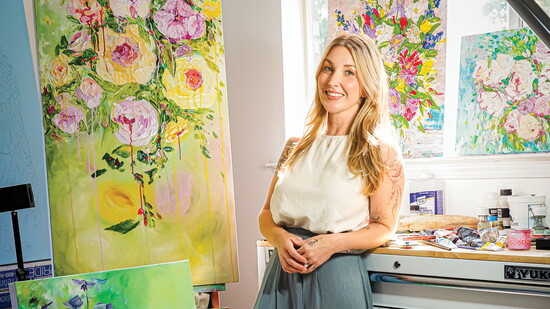
Jessica's studio seemed to have been chosen by the sun before anyone else had a vote. Paintings leaned against walls and windows. Textured flowers erupted from vases. Hummingbirds hovered mid-flash.
"You ready?" I asked.
She nodded like she was born ready.
The First Canvas
And in a sense, she was.
Some artists arrive as questions. Jessica seems to have arrived with an exclamation point, already carrying the shape of what she would spend a lifetime becoming.
She grew up on the outskirts of Bogalusa, in Lee's Creek, on twenty-five acres of cattle, kinship, church, and cultivated ground. Her mother and grandmother were gardeners, women who knew what needed shade, what needed sun, what would return, and what had to be tended before it bloomed. Long before Jessica learned composition or color theory, she was studying the architecture of living things.
"As long as I can remember, I've had the option to paint," she said.
Her mother set her at the breakfast bar with watercolors because watercolor mess could be forgiven with a rag. Oil paints were another matter. When Jessica's grandmother gave her a set, her mother sent them to school, where an art teacher welcomed the danger. In fourth grade, Jessica painted a tan puppy looking out a window, entered it in the Washington Parish Free Fair, and won first place.
Her mother still keeps the painting framed, blue ribbon attached.
Early Impressions
Through high school, art remained the one language that held her attention completely.
She did not play sports. She did not chase cheerleading or the approved choreography of small-town girlhood. She painted, joined art club, and kept her nose in magazines, studying flowers, shapes, color, anything that might become a canvas.
Then, on a school field trip to the New Orleans Museum of Art, she encountered the works of Edgar Degas and the Impressionists. She saw something she had not yet been taught to name: movement made visible through color.
"I was in awe of it," she said. "I knew this was what I wanted to do."
Jessica found her tribe in the art department at Southeastern Louisiana University. Not because she fit the stereotype. By her own account, she was clean-cut, comparatively normal, and not exactly "out wreaking havoc on society." She says this with a smirk.
They took her in anyway.
One sculpture professor gave her a line she never forgot: "If you don't know what to do with a piece of artwork, it never fails if you just make it big and paint it red."
The Lines She Left Behind
Then life, with its taste for contradiction, sent Jessica into a different kind of composition.
For roughly fifteen years, she worked in land surveying, civil engineering, floodplain management, land title research, and AutoCAD drafting. She pulled maps, marked boundaries, studied property lines and drainage, and learned the technical grammar by which land becomes legible enough to be altered.
It was useful work because people need homes, roads, subdivisions, places where life can happen.
But usefulness does not always revive the soul.
"I got tired of destroying things," she said.
By that, she meant trees, wildlife, the living density of ground before it is measured, cleared, divided, and built upon. For years, Jessica helped draw the lines by which land could be transformed. When she stepped out of engineering, she returned to what could not be surveyed: color, texture, instinct, life.
One goldfish faces outward from a vertical canvas, close enough to seem curious about the viewer. Jessica's daughter won it at the Franklinton fair, one of those bagged goldfish expected to expire before anyone gets emotionally involved. This one lived five years. Her daughter asked Jessica to paint it and, to this day, will not let her sell it.
In the painting, the fish does not drift sideways. It meets you head-on, confronting the world with questions not unlike our own.
"There are beautiful moments all throughout life," she said. "You just have to take the time to notice them."
Still Life
"What would you be without art?" I asked.
Jessica paused.
"Lost," she said.
The word landed without drama because she did not offer it dramatically. Art, for Jessica, is not a hobby arranged around the margins of life. It is outlet, prayer, work, inheritance, and weather system. It is the place where color becomes legible and feeling finds a surface sturdy enough to hold it.
Even silence, for her, is not silent.
She often paints with Bach, Mozart, or Hozier playing, a habit rooted in the classroom where her first art teacher played classical music while students worked. But when everything else falls still, Jessica does not hear nothing. She hears nature.
"It's never actually still," she said. "There is still life everywhere."
"Nature teaches us that life is wild, untamed and beautiful," she continues. "But you have to immerse yourself in it."
Technology, she believes, often tells people who to be and how to become it. Nature does not. Nature simply is. So she gives her children more soil than screens, more paint than scrolling, more worms, fishing, stories, cookies, seeds, and questions.
"If you give them your attention," she said, "they're going to want your attention over that screen."
Near the garden, I tried photographing the baby camellias she had planted. I had first misunderstood and thought Jessica had planted five. She had planted hundreds.
Her first great camellia belonged to her great-aunt Carrie Mae. Jessica later lived in Carrie Mae's house and, for a while, belonged to that tree. It was enormous, tall as a house, bright pink when it bloomed.
"When everything else was dying," Jessica said, "that camellia was coming to life."
Made in the Shade
In the cooler months, when much of the garden has thinned or gone dormant, Camellia sinensis opens. The tea camellia typically blooms in late fall or early winter, depending on cultivar and climate, producing small, fragrant flowers against glossy evergreen leaves. Its bloom is not a denial of winter, but a function of it: formed in shade, refined by stress, and released when the garden has entered its season of restraint.
The life of an artist, of course, is not all roses and sunlight.
"How do you overcome the dark places?" I asked.
Jessica told me that before every painting, she pauses to pray.
"Just guide my hands," she said, "and let this painting be whatever it is that the world needs right now."
Art, for Jessica, moves quickly from the surface to the soul of a thing, to the purpose and healing of it.
"The purpose of art," she said, "is to tell your story and spread joy."
And that kind of joy has somewhere to go.
Her paintings at Slidell Memorial belong in that lineage. The hospital has purchased multiple pieces, and Jessica has donated work for charity events. One floral painting she kept for years. The hospital asked to buy it more than once, and she resisted until her husband, Kevin, said the thing that undid her: that painting might become the one good moment in someone's awful day.
"So I let them have it," she said.
A similar tenderness gathered around another floral painting. It began as a commissioned Christmas gift for a woman facing her first Christmas after her mother's death. The family wanted something bright and commemorative. Jessica painted flowers in a vase, grief held upright, memory translated into color.
"I want my art to have a life," she said. "I want it to go be out in the world."
Not orphaning, she insists. More like a bird leaving the nest.
The Art of Letting Go
Joy, in Jessica's vocabulary, is not thin brightness. It has roots. It knows winter, exhaustion, remarriage, children, work, risk, and the ache of wondering whether one is good enough.
She is currently completing an MBA. She gardens, cooks, paints with her children, chases toddlers, and drinks sweet tea. She is also tattooed with her own living lexicon: magnolia, phoenix, moon, snake, flowers, words for love, strength, courage, grace, patience, protection. Green, her favorite color, appears in almost every painting.
Kevin entered her life through art. Before they met, he saw her paintings online and wrote about her for a local publication. Four weeks after they met, they were married.
"He brought me back to life," Jessica said.
The sentence arrived without decoration. Kevin, a Marine veteran and writer, is thorough, structural, protective. Jessica says she is the glue, the element that makes what is sound beautiful, organic, encouraging. Kevin is the root system, grounding her. Together, they paint with paragraphs and pigment.
Their home carries that exchange: books and paint, studio and swing, children's artwork in the window, eggs, dogs, chickens, a garden still learning what it wants to be.
The Unfinished Life
Camellia sinensis is a plant of long memory. Under favorable conditions, it may live for decades, sometimes generations, becoming less a shrub than an inheritance: rooted in one life, flowering into another. Its blooms appear briefly, but the plant endures, gathering one season into the next before opening again for future generations.
On the far wall of the studio, an unfinished alligator stands upright, gathering itself from scales and angles, prehistoric and almost amused.
I noticed it almost immediately, and Jessica, being a true artist, noticed my noticing.
"How long will it take you to finish it?" I asked.
She did not answer right away. And that, in itself, left like a profound answer.
Because so often, life behaves like acrylic. It dries too quickly. Magazine interviews, photoshoots, articles, layouts, deadlines, emails, errands. Why do we burn all our calories doing instead of simply being-or beholding?
But Jessica prefers to paint in oils, not acrylic.
Oil dries slower. It cures by patience, not command, and even after many years, it may never fully finish becoming what it is.
I exchanged one more glance with the unfinished gator and retraced my path beneath the trees, mindful of the camellia growing in the distance.
The gray cat was still there, sovereignly unhurried, as if guarding a truth I had yet to fully learn.
Before I pulled away, I turned my phone off. No map. No GPS. No immediate route back to the world I knew how to keep moving.
I would find my way home the slower way.
"There are beautiful moments all throughout life. You just have to take the time to notice them."
"The purpose of art is to tell your story and spread joy."