Background
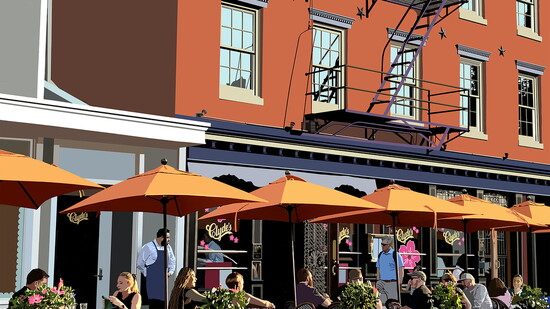
For Joseph “Craig” English, art has been a lifelong calling rooted in Northern Virginia. “My freshman year I attended Annandale High School. It was there that I was introduced to silkscreen printing and literally captivated by the process,” he recalls. That early spark eventually led to Virginia Commonwealth University's prestigious Communication Arts and Design program, which would help him build a foundation for his career.
Determined to become a full-time artist, Craig balanced a rigorous academic load, long hours part-time at the YMCA, and countless late nights in the studio. “I structured my schedule so that I could complete four years of study in three years; I was thrilled to be doing what I loved.”
After graduating during a recession, he still managed to secure a design job and immediately set up a silkscreen studio in his apartment. Within three years, he was earning enough to leave agency life behind. “Within a year, I had a portfolio of work that allowed me to start showing and selling my work at ‘street shows’, and I was making enough money to quit my agency job and start my own full-time business as a fine artist.”
Craig’s attachment to the region runs deep. “I have always loved the color and energy of the DC Metro area. My customers are Washingtonians or people who want a memory of their time in the DMV.” His work, much of it depicting familiar landmarks, neighborhoods, and everyday corners of life, aims to make the ordinary newly visible. “I like to think of my work as colorful, happy, and upbeat. When a collector tells me, ‘Your work always makes me smile,’ I feel like I have been successful.”
Art & The Cover
Craig’s cover piece, “Fresh Powder,” was born from a moment of awe. “During the first 24 hours [in Lake Tahoe], it snowed six feet; the silence was deafening and skiers on the mountain were just transfixed by the beauty.” The piece captures both stillness and anticipation: a pristine moment before movement returns.
Known for crisp edges and vibrant color, Craig brings the same intensity to nature that he brings to his iconic cityscapes. “Finding beauty in nature is easy,” he says, “but it doesn’t mean I ignore the opportunity to portray a beautiful landscape.” As he’s grown older, he finds himself increasingly “touched and moved by the natural beauty of our world.”
Art & Wellness
Health and wellness have quietly shaped Craig’s evolution as an artist. His early career relied on traditional silkscreen techniques involving toxic materials, but he eventually moved away from them out of necessity. “I wanted to create my work in a healthier environment without sacrificing style or quality.”
Today, his process still begins with photography and a pencil pattern, but digital tools allow him to build color safely and sustainably. “Color is critical to the creation of my work and my life. It's what sets apart the exceptional from the mundane.”
For Craig, creativity itself is a form of wellness. The fluid movement between photography, sketching, and digital rendering has become a meditative practice. His mobile phone, he says, is “the greatest gift to an artist like me,” allowing him to capture spontaneous moments of inspiration, something our modern fast-paced lives don’t always encourage.
Philosophy
Craig’s philosophy is grounded in gratitude, discipline, and generosity. He tells young artists that “passion and loving what you do will allow you to find the path to success.” That passion, however, requires balance. A once-self-proclaimed disorganized artist, he learned that clutter drained his creativity: “By being disorganized, I was wasting the time when I could be creative.”
Physical activity remains central to his well-being. Though he no longer runs, he rides his e-bike on a 15-mile route near his home “about five days a week,” giving him time outside and moments to reset. He works whenever inspiration calls, sometimes even at four in the morning because, as he puts it, “I love working so much that I never consider it a chore.”
Most importantly, Craig holds a deep belief in accessibility and service: “I made a promise to myself that my work would always be affordable; I never wanted someone who loved my work to say, ‘I can’t afford your art.’”
And at the heart of everything is one central truth:
“The most important aspect of a ‘well-lived life’ is the realization that your talent is a gift. Being thankful for that gift, you should try to give as much of yourself to others as possible.”