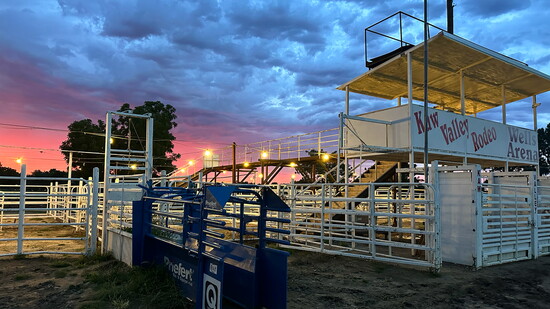
It’s a super hot, late July evening in the Flint Hills of Kansas. It’s that time of year where summer seems to just rise from the pavement. The smell of funnel cakes, burgers, kettle corn and all the fair-food favorites fill the blistering air. Carnival rides spin in the distance. The echoes of 4-H livestock shows drift across the fairgrounds. Cowboys, families, kids and longtime rodeo fans grab their seats with the same anticipation. Once the sun starts to set, under the lights, it begins: the greatest show on dirt.
For 50 years, the Professional Rodeo Cowboys Association’s Kaw Valley Rodeo has stood as one of Manhattan’s most cherished summertime traditions.
In 1975, the Riley County Fair Board needed evening entertainment during the county fair. A group of local rodeo enthusiasts believed professional rodeo could find a home in Manhattan. The fairgrounds already had an arena, established through a federal grant, so the location was set. What followed was the building of an organization, a tradition and, eventually, one of the area’s most beloved annual events.
The Kaw Valley Rodeo Association was formally created as a Kansas nonprofit corporation on January 6, 1976, with notarization on January 26, 1976. Its founding documents show the organization was created for more than simply staging a rodeo. The association was formed to conduct rodeos and equestrian events in conjunction with the annual Riley County 4-H Fair, to promote family entertainment and education, to preserve the western heritage of the Flint Hills, and to support the young people participating in the fair.
That mission has carried through five decades.
The original incorporators were Robert E. “Bob” Brummett, M.J. “Buck” Gehrt and Wayne Dunafon. The first board of directors expanded that leadership to include George Rader, Charles R. White, Pinky Busick, Stanley Parsons, Ronald D. Innes, Dean Coughenhour, Bill Colvin, and Bernard Wells, the namesake of the arena. Bob Newsome was serving as county extension director at the time, and the Riley County Fair Board remained a vital partner in helping the rodeo get off the ground.
Those early years required faith, persistence and a fair amount of cowboy ingenuity. There were no grandstands at first, no elaborate chutes and only three sides of an arena. County equipment helped prepare the grounds. Bleachers were borrowed from K-State’s Ahearn Fieldhouse. Local businesses and individuals donated water piping, electrical wiring and financial support. With no reserve fund to fall back on, the first rodeo depended heavily on community backing, and a little luck from the weather.
The weather held, and so did the rodeo.
From the beginning, the Kaw Valley Rodeo was shaped by people who knew the sport and believed in bringing it to local families. Brummett and Dunafon were veterans of the professional rodeo scene. Dunafon, a world-renowned rodeo cowboy, was also nationally recognized as one of Philip Morris’ original Marlboro Men. His legacy in the sport now includes induction into both the National Rodeo Hall of Fame, and the Kansas Cowboy Hall of Fame.
Pinky Busick, then with Manhattan Parks and Recreation, helped recruit stock contractor Bob Barnes of Cherokee, Iowa, to advise the original organizers. When the early logistics became too much for Barnes to continue as contractor, the association moved forward. In 1977, Rafter H Rodeo Livestock Company became part of the Kaw Valley story, beginning a long relationship that would help shape the quality and reputation of the event for decades.
Headquartered in Tahlequah, Oklahoma, Rafter H was formed in 1961 by Dell Hall, a former contestant in both riding and timed events. Hall understood that in rodeo, the stock draw can make or break a competitor. His goal was to provide livestock that gave contestants an equal chance, minimizing luck and allowing the best cowboy or cowgirl to win.
Over the years, Rafter H’s bucking stock earned recognition at major rodeos, including the Prairie Circuit Finals and the National Finals Rodeo. His wife, Betty, served as a PRCA timer, and their daughter, Shelly, a PRCA secretary, making rodeo not only a business, but a family contribution to the sport. Shelley stills serves in that role each summer in Manhattan.
As a Professional Rodeo Cowboys Association rodeo, the Kaw Valley Rodeo brings a true professional standard to Wells Arena each summer. The competition features the seven traditional PRCA events: bareback riding, steer wrestling, team roping, saddle bronc riding, tie-down roping, barrel racing and bull riding. Alongside the main events, crowd favorites like Mutton Bustin’ and the calf scramble give younger contestants their own moment in the arena, adding to the family atmosphere that has long defined the rodeo.
That professionalism has helped draw many major competitors to Manhattan. Through the years, the Kaw Valley Rodeo has welcomed numerous world champions, and some of the most recognizable names in rodeo, including Don Gay, Ty Murray, Tuff Hedeman, Clay O’Brien Cooper, and the Etbauer family. The legendary Lane Frost also rode at the Kaw Valley Rodeo in the 1980s. Often coinciding with the Cheyenne Frontier Days, the rodeo would catch contests coming back and forth from Wyoming, thus becoming both a Kansas proving ground, and a cherished summer rodeo stop.
Originally held Monday through Wednesday, the rodeo eventually shifted to a Thursday-through-Saturday format at the recommendation of longtime association president Larry Alcott. The change proved to be a strong move. In recent years, average nightly attendance has climbed north of 2,800, putting the arena right near capacity.
The rodeo also became known for inviting the next generation into the arena. Mutton busting was added in 1996, giving young riders their own taste of rodeo courage. Junior rodeo events, calf scrambles, and kids’ nights helped make the week about more than spectatorship. It became a place where children could meet cowboys, cheer from the stands and imagine themselves inside the arena.
Community causes have become part of the rodeo’s identity as well. Military Appreciation Night honors Fort Riley families and service members, while Tough Enough to Wear Pink, first added in 2007, raises awareness and support for cancer research alongside The Terry C. Johnson Center for Basic Cancer Research at Kansas State University. Annual food drives benefit local organizations, and fundraisers have helped maintain Wells Arena as a safe equestrian facility for 4-H clubs, the K-State Rodeo Team, youth groups and the general public.
The rodeo has modernized, too. A digital scoreboard arrived in 2008 and has since evolved into a full HD video board. Online ticket sales began in 2011, and beer sales were first introduced that same year. Digital tickets followed in 2023. In 2026, the rodeo will reach another milestone when it is streamed for the first time globally on The Cowboy Channel. Yet even with those updates, the heart of the Kaw Valley Rodeo remains familiar: Wells Arena, late July heat and quality, professional rodeo.
What began as evening entertainment for the fair has become a half-century legacy. It has survived lean beginnings, changing schedules, inflation, new technology and generations of competitors, all while keeping its place in Manhattan’s summer story.
For 50 years, the Kaw Valley Rodeo has carried the spirit of the Flint Hills into the arena — tough, generous, community-minded and proud of its western roots. And as the gates swing open once again, it does more than celebrate a milestone. It honors everyone who helped build it, everyone who kept it going, and everyone still willing to gather under the lights for one more ride.
"This rodeo is a 365-day-a-year job, not just three nights of entertainment. It takes a whole community to make it work.” - Larry Alcott
“Dell Hall stuck with us when money was tight, and that loyalty helped shape the Kaw Valley Rodeo. We're grateful Rafter H has been our stock contractor" - Doug Williams