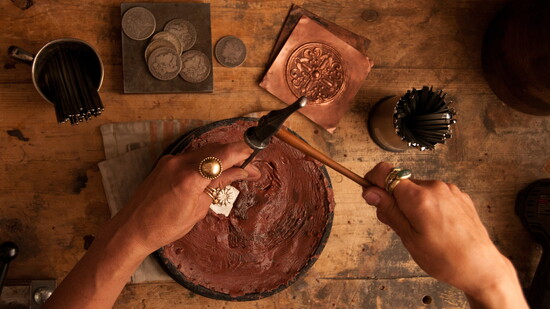
From her Cerrillos Hills studio, the Santa Fe jeweler creates heirloom pieces that combine precious materials, Native traditions, and powerful storytelling.
Keri Ataumbi’s jewelry often begins the way a conversation does—with an opening that draws you in. A glint of gold, a carved shell, a form that feels both ancient and entirely new. “The pieces can be an invitation to connect,” she says. “People see something beautiful, then you can share the story.” Her sense of adornment as invitation stemmed from her mother, a driving force in Native American fashion. Growing up on the Shoshone side of the Wind River Reservation in Wyoming, Ataumbi remembers her in cloth t-dresses, “always paying attention to contemporary styles, but playing with them through a very traditional voice,” regularly stopping strangers in their tracks. “Mom was a grassroots educator, and she did that through her adornment,” she says. In the 1960s, her mother ran a trading post that treated work by local artists as fine art, rather than roadside crafts. One wall held materials (beads, hides, fringe, sinew) that community members, including Ataumbi and her sister (acclaimed native beadworker Teri Greeves), had to buy. “She wanted us to learn business,” she says. “We couldn’t just raid the shelves.”
After a brief stint on the East Coast, Ataumbi came to Santa Fe in 1990 to visit her mother—and stayed. “I’ve basically been here ever since, and kind of feel like I grew up in Santa Fe.” The city still resonates because of its long history as a crossroads. “The Southwest has always been a trading center,” she says. “All of that converged here.” Ataumbi studied painting with an emphasis on sculpture at the Institute of American Indian Arts in Santa Fe, but it was a community college jewelry course—taken later, almost incidentally—that changed everything.
Today, her studio—wrapped in a vegetable garden and alive with birds and wildlife—sits in the Cerrillos Hills just south of the city, a landscape long defined by turquoise: the historic Tiffany Mine lies nearby, but for centuries, trade routes stretched into Mexico and beyond. “You develop a relationship with a place like this,” says Ataumbi of the landscape where she creates museum-quality jewelry that reads more like small-scale sculpture—intimate, wearable, and deeply considered. Materials span diamonds and horn to shell and hide, each chosen with intention. “I work with recycled and fair-trade metals,” she says. “There’s already so much gold and silver in the world.” In her studio, even filings and dust are saved, refined, and reused. Her process is both technical and spiritual. Some pieces begin with personal memory: conch shell gathered while sailing with her husband became a flower earring made during a period when she missed the ocean. Others unfold over years. “When we make something, especially for someone, the process is like a prayer,” she says. Many draw on Kiowa creation stories and broader Native cosmologies. “There are more than 500 Native nations in what’s now the United States, and every one of them has its own creation story,” she adds. “Imagine how rich this country would be if we actually knew all those stories and respected them.”
Ataumbi structures her practice around the natural and cultural worlds. Limited collections are released at equinoxes, “small collections that rotate around those points of the celestial calendar,” while another body of work builds each year toward Santa Fe Indian Market, where Ataumbi has shown for 25 years. “There’s nowhere else that you can see that many Native artists in one place,” she says. “It’s where friendships and real understanding start.” As her work gains broader visibility—from museum collections to red carpets, including pieces worn by Lily Gladstone at the Met Gala—Ataumbi sees a long-overdue shift. “It’s about time, she says, “because in this country, there is no place you’re not on Native land.” For Ataumbi, that recognition is both personal and part of a broader re-centering of Native voices within American art and design. The core of her practice, however, remains unchanged: to create objects that hold meaning, invite conversation, and carry stories forward. In her hands, jewelry becomes a way of learning—one that asks you to pause, look closer, and listen.
People see something beautiful, then you can share the story.
The Southwest has always been a trading center.