Maui native Kimi Werner, a self-described hippie and hunter, grew up off-the-grid in Haiku following bubbles—bubbles created by her father Chris Werner’s skindiving fins.
At just five years old, she tagged along with her free-diving dad on his spear fishing adventures in Maui’s pristine offshore waters. Mesmerized by the unique beauty of that undersea wonderland, Kimi says she would sometimes lose sight of him. That’s when she discovered that by remaining calm, she could scan the ocean surface for those bubbles and catch up with him again.
“Those outings were much more than just sport,” Kimi says. “At the time, my family didn’t have a lot of money. My father hunted on land and in the ocean to put food on our table.”
Sustainability was always top of mind, she says. “It was my mother, June, and my grandmother, Margaret, who emphasized the importance of only taking what we need and wasting nothing. My father taught us—my sister Christy and me—by example.”
Today, Kimi, 45, lives on Oʻahu with her husband Justin Turkowski and their six-year-old son Buddy. Over the years, she evolved as an internationally respected ocean conservationist, certified culinary chef and in-demand speaker. In 2008, she was recognized as the United States National Spearfishing Champion, free-diving to a depth of more than 150 feet on a single breath; most recently, her debut book, “Kimi’s Kitchen,” was published in March and is dedicated to Buddy.
The book doubles as both an intimate biography and a cookbook, featuring amazing underwater images, vintage family photos from her childhood in rural Maui, and tantalizing food shots illustrating the 80 featured recipes.
In July, Kimi’s book signing tour brought her to the Kona Coast for a week-long series of events; among her stops were Hualālai Resort and Kona Sea Salt farm. Speaking at Four Seasons Resort Hualalai on July 18, she credited the island’s “Try Wait” initiative for restoring dwindling fish populations and renewing coral proliferation along 3.6 miles of Kaʻupulehu coastline (fronting the resort) and the neighboring region of Kūkiʻo. The protected area extends out to waters with a depth of 120 feet. The initiative placed a 10-year moratorium on fishing and the collection of marine life of any kind in the designated area. The moratorium, she says, is set to be lifted at the end of this year or early 2027. Currently, the non-profit group set to manage the fishing grounds, Hui Kahuwai, is developing a plan to maintain and build on the positive results achieved over the past decade, according to Kimi.
Dinner followed her presentation, featuring a four-course sustainable seafood menu created by the culinary team at Four Seasons’ signature oceanfront restaurant, ULU. It showcased recipes from “Kimi’s Kitchen,” with all perfectly prepared and beautifully presented, while also showcasing the diversity of seafood found in Hawaiian waters and creative methods of cooking them.
First up that evening, Poisson Cru featuring ono, cucumbers, tomatoes, onions, cilantro, citrus and coconut milk—a recipe inspired by Kimi’s travels to Tahiti. Ahi Tataki seasoned with Cajun spice, shoyu, citrus, ginger and cilantro was served next, followed by Coconut Lime Octopus with collard greens and chili pepper water. The finale? Sweet & Sour Snapper sautéed with bell pepper, onion, ginger and cilantro.
Kimi says her hope is that the cookbook evokes curiosity and encourages readers to take a closer look at their own ecosystems for local food sourcing, making their home cooking a little wilder while tightening the gap often found between themselves and nature.
As for future plans, Kimi does have another book idea simmering. At the moment, she only shares that it will be a children’s book this time around. We say, write on!
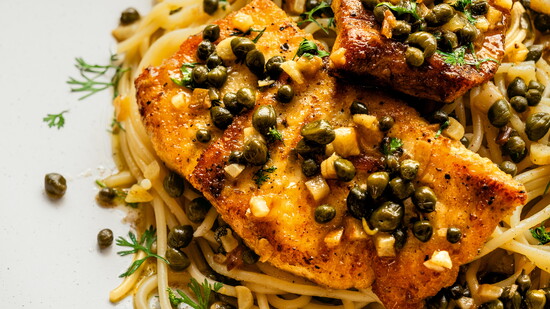
Garlicky Fish Piccata
Serves 4
- 1 pound boneless, skinless mū (bigeye bream or bigeye emperor fish), cut into 3 by 4-inch pieces
- Flaky sea salt and freshly ground black pepper
- All-purpose flour for dredging
- 6 tablespoons salted butter, plus more as needed
- 5 garlic cloves, chopped
- ¼ cup capers and their brine
- ¼ cup dry white wine (I prefer Chardonnay)
- Juice of ½ lemon
- Juice of ½ orange
- Chopped fresh flat-leaf parsley for garnishing
- Cooked, buttered pasta for serving
- Fish Alternatives: Lingcod, Halibut, Rockfish
My dad didn't cook very much in our household, mainly because that was Mom's specialty that she did so well. But he did have a few dishes up his sleeve for the nights when he insisted my mom take a break; whenever he did proclaim his turn to throw down, we would beg him for chicken picante. Dad would butter-braise thick pieces of chicken breasts and add generous amounts of white wine, capers, and lemon juice. The kitchen would smell enticing as we asked on repeat if dinner was ready yet; like clockwork, my dad would always say, "I'll serve no wine until it's time!" Turns out what he actually was making was a delicious chicken piccata. He must've read a recipe somewhere long ago and remembered everything but the right name for it. So, during my entire upbringing, we fondly referred to this dish as Chicken Picante, completely unaware that "picante" means spicy and there's nothing spicy in it. But it's delicious. This quicker version uses fish instead of chicken.
Season the fish with salt and pepper. Dredge both sides of the fish in flour until fully coated.
In a large skillet over medium-high heat, melt 3 tablespoons of the butter. Working in batches, place the floured fish pieces in the skillet. Cook until the bottom side turns a nice golden brown, 3 to 4 minutes, then flip and repeat on the other side. Transfer the fish to a plate and cook the remaining pieces, adding more butter if needed.
Discard the butter in the skillet and wipe the skillet clean. Over medium-high heat, melt 2 tablespoons of the butter in the skillet. Add the garlic and cook for 1 to 2 minutes, stirring occasionally. When the garlic begins to brown, add the capers and their brine, wine, lemon juice, and orange juice, and stir. Let the sauce reduce for 2 minutes, then add the remaining 1 tablespoon of butter and stir until it melts. Pour the sauce over the fish fillets and garnish with parsley. Serve immediately with buttered pasta.
“My father hunted on land and in the ocean to put food on our table.”