Since its earliest days, Knoxville has considered the Fourth of July to be a cause for much celebration. The first event can be traced to 1793, less than two years after Knoxville was established by the first settler, James White, and Gov. William Blount. Two years later, federal troops built a blockhouse here, overlooking the Tennessee River, only 100 yards or so from Blount’s frame house, offering the fledgling settlement some protection on the frontier.
Three years before the territory became a state in 1796, Commander William Rickard, in charge of the garrison at the blockhouse, assumed the role of master of ceremonies for a Fourth of July celebration that lasted several hours. A parade of soldiers kicked off proceedings, followed by a “federal salute” with cannons. A lengthy banquet ensued with prominent guests toasting 15 honorees, including Gov. Blount; Henry Knox, the Secretary of War, for whom Knoxville is named; Marquis de Lafayette, the popular French soldier and ally in the Revolutionary War; and Chief Piomingo of the Chickasaw Nation, who at the time were cooperating with the United States. A volley of gunshots would ring out before a fireworks display lit up the night sky.
After the Civil War, Fourth of July celebrations became more expansive affairs, involving street parades. In 1868, the event wasn’t enjoyed only by people who lived downtown but also by thousands of rural folk who descended upon the town to join in the fun. Still, due to resentment for the Union, many Southern cities didn’t celebrate the Fourth of July until the late 19th century.
The parade itself, with a route that looped around town, was led by city dignitaries as well as firemen; “banner ladies”—all in white, each holding a flag for the 36 states of the union; the Goddess of Liberty; and foot and mounted “delegations from the country.” In the late afternoon, a balloon ascension entertained the onlookers. In the evening, a grand fireworks display, held on Gay Street near the “baseball ground” in the 400-block of Gay Street—which sounds impressive even by today’s standards—included rockets, Roman candles, a “kaleidoscope” and a “waterfall.” There was also “Gypsie dances” and a portrayal of President George Washington on horseback.
That year, the editor of the Daily Press & Herald announced that there would be no newspaper on Sunday the fifth, since it would be “highly unconstitutional for printers to work on the fourth.” It’s not clear who else might have been granted the day off, but by 1870, the U.S. Congress declared the Fourth of July an unpaid national holiday for federal employees, and it wouldn’t become a paid holiday until 1938.
The year 1876 was a big deal when the country celebrated its 100th birthday, with some elements echoing back to earlier times. Similarly to what federal soldiers did back in 1793, but this time at daybreak, UT Cadets fired a 13-gun salute. Church bells rang out across town throughout the morning before the now obligatory parade, including city officials, military companies and the “Sevier Horsemen,” honoring the first state governor and frontier hero, John Sevier. A series of floats, mostly organized by local trade and industry merchants, included a seven-foot-long cigar.
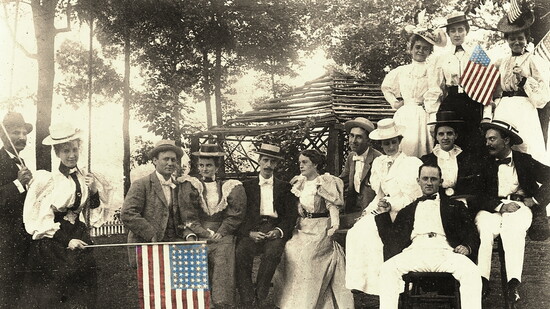
By 1895, revelries expanded beyond downtown, and all sorts of people planned their own festivities. Many rode the streetcar out to Lake Ottosee (what we know today as Chilhowee Park) to attend a “Young People’s Picnic,” with bicycle races, tub races, hammer throws, and one rather curious game that involved contestants diving to the bottom of the lake to retrieve a frog tied to a brick (one can hope that the frogs weren’t real). Elsewhere, the Grand Army of the Republic held its own picnic at Fountain City while the Black community held several gatherings, one at Baldwin Park (north of Fort Sanders), where a colored baseball team took on opponents from Chattanooga.
By 1910, over on the UT campus, teachers at the Summer School for the South, an educational “festival of seminars,” as it was described, that ran here between 1902 and 1918, embraced the day. A line of 2,000 educators marched up the winding lane to the top of The Hill, filling Jefferson Hall, especially built for the school, for an “amassing of banners,” readings, songs and orchestral performances.
In the 1920s, many who took the day off headed for the outdoors. If one wished to sit in the sun, dance or indulge in various amusements, Chilhowee Park was still the place to go. At Caswell Park, one could watch the Smokies baseball team play the Augusta Tygers. Others went swimming at Whittle Springs, while farther out of town, Maynard Baird and his Southern Serenaders jazz band wowed crowds at the Kinzel Springs resort. Most of these venues capped off the day with their own fireworks displays, as is done all over town today.
For the past several decades, the city has put on the “Festival on the Fourth,” a free event at World’s Fair Park. This year, festivities begin at 5:00 p.m. with concerts by the Knoxville Symphony Orchestra and Dirty Grass Soul. And if you wish to catch the annual fireworks display, they’ll be firing them off at 9:45 p.m. from the Henley Bridge. It will become a part of our ongoing history.
About KHP: The educational nonprofit Knoxville History Project tells the city’s true stories, focusing on those that have not been previously told and those that connect the city to the world. Donations to support the work of KHP are always welcome and appreciated. Learn more at KnoxvilleHistoryProject.org.