At the nonprofit Knoxville History Project, we are always on the lookout for old images to expand our Knoxville Shoebox digital collection, which enhances our programs and publications. If you have interesting photographs, postcards, brochures or ephemera from any era, we’d love to hear from you so we can preserve the visual history of Knoxville and make it available for researchers of the future.
This month, we present several very rare views of Knoxville that we have been waiting patiently for years to show up.
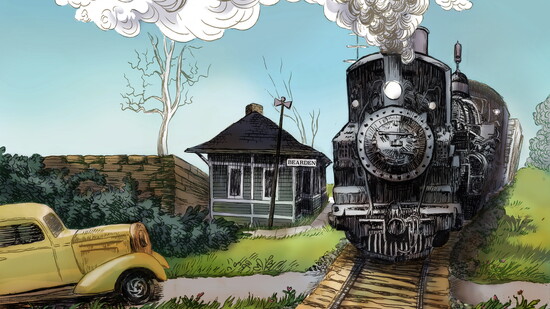
Bearden Train Station: In 2020, when KHP published Historic Bearden: The 200-year story of Knoxville’s Fourth Creek Valley, we looked for photographs of the Bearden train station. We searched every local archive and put out calls at various community events. We even commissioned Knoxville artist Esther Sitver to recreate the station using an old, grainy newspaper photo from 1938 as source material. Now, six years later, thanks to KHP friends Charles Susano and Alex Riedl, we’re thrilled to be able to share a vintage postcard, dating to 1908, of this legendary train station.
The East Tennessee and Georgia Railroad came to Knoxville in 1855, and a station five miles west of downtown served the growing community that would initially be known as Erin (later known as Cooper and, by the 1890s, Bearden). In June that year, four teenage boys were known to have caught the train at Erin as stowaways and would boast for the rest of their lives that they had ridden the first train into Knoxville.
After the Civil War, the rail line became the East Tennessee, Virginia and Georgia Railroad. Spaced five miles apart, to the west there would also have been stations at Ebenezer and Concord. The Erin Station was then known as a “flag station,” meaning the train would stop only if it was signaled to, either for a passenger or a freight shipment.
In 1873, with the help of Marcus DeLafayette Bearden (who five years before had served as the mayor of Knoxville and sheriff of Knox County at the same time), the Tennessee state legislature agreed to establish a new mental institution in the eastern part of the state. What became known as the Lyons View Asylum (later East State Mental Hospital) finally opened its doors in 1886. The first patients, 49 of them, arrived from Nashville at the station in March of that year and walked almost a mile to the new mental hospital.
In honor of the local leader who championed the hospital’s construction, the community would, within the next decade, rename itself as Bearden.
In the early years of the 20th century, the railroad “grade crossing” near the train station was a dangerous spot. The present underpass and railroad trestle on S. Northshore Drive wouldn’t be built until 1939. The site of the old Bearden train station, just a few yards west of the underpass, still exists but is privately owned.
Knoxville Drive-in Theatre: Another long-sought Bearden photograph has also shown up this summer. The Knoxville Drive-in Movie Theatre opened in 1948 on Forest Park Boulevard and ran until 1980. For local theatre historians Tim Burns and Bradley Reeves, both of whom grew up in the area and have fond memories of the place, have long considered a photo of the Drive-in a modern-day holy grail.
The location of the Drive-in was part of the old “borrow pit” for Scott’s Brickyard, which operated there from around 1904 for 20 years. The Drive-in was a modest operation, having enough space for just over 500 vehicles. It didn’t always show new films; its first presentation was Pot O’ Gold, starring James Stewart and Paulette Goddard, which had been released seven years earlier.
By 1956, next door to the Drive-in, Parker Brothers hardware store moved into the former White Store on Forest Park Boulevard and would remain there for 40 years. By 1959, its immediate neighbor was a small, short-lived amusement park named Kiddy Land, with its miniature train ride issuing regular toots. The noise annoyed filmgoers. The park would be issued a curfew of 8:00 p.m. but regularly ignored the decree. On that corner today is Everly Brothers Park.
As seen on the marquee, Smoky and the Bandit, released in 1977, played at the Drive-in in March the following year. At the end of the 1980 season, not long after it showed the camp-horror classic Friday the 13th, the theater would close for the winter with two mostly forgotten Halloween-themed movies, Don’t Answer the Phone and The Hearse. Within two years, the lot began to take on the appearance of a ghost town, overgrown with weeds.
These incredibly rare black-and-white photographs were taken by Knoxville artist John Kelley in the late 1970s and, like the Bearden train station postcard, prove to be remarkable and important documents of Knoxville history.
If you have gems from the past to share, please contact us at 865.337.7723 or email paul@knoxhistoryproject.org. Learn more at KnoxvilleHistoryProject.org.
About KHP: The educational nonprofit Knoxville History Project tells the city’s true stories, focusing on those that have not been previously told and those that connect the city to the world. Donations to support the work of KHP are always welcome and appreciated. Learn more at KnoxvilleHistoryProject.org