At the nonprofit Knoxville History Project, we are always on the lookout for old images to expand our Knoxville Shoebox digital collection. If you have interesting photographs, postcards, brochures or ephemera from any era, we’d love to hear from you so we can preserve the visual history of Knoxville and make it available to future researchers.
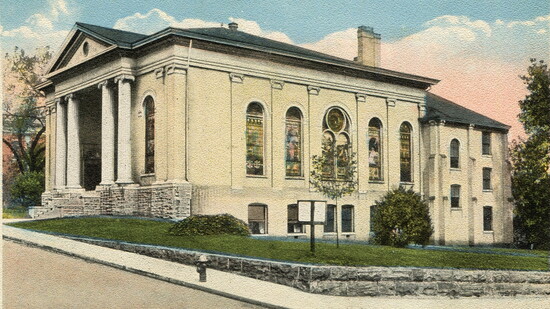
This month, we present several vintage postcards from the Dave Parmalee Knoxville Digital Postcard Collection, shared with us by Alec Riedl, which highlight historic downtown churches.
To get in touch, please contact us at 865.337.7723 or email paul@knoxhistoryproject.org. Learn more at KnoxvilleHistoryProject.org.
First Presbyterian Church: After being established by Rev. Samuel Carrick in 1792, First Presbyterian, Knoxville’s earliest church, held its early services in various public spaces. The city’s original settler, Captain James White, donated his former turnip patch (next to his fortified stockade) to serve as a location for a churchyard years before a building was built—it was almost a quarter of a century after Knoxville’s founding before the first church building was erected in 1816. The current one on State Street is actually the third building, designed by Baumann Brothers and completed in 1902. It’s especially appealing due to its stained-glass windows, two of which were designed by the famous Tiffany studios.
Along with Rev. Carrick and Captain White, several notable early Knoxvillians are buried in the churchyard, including Gov. William Blount, who sited the new capital of the Southwest Territory here in what he named Knoxville in 1791. His wife, Mary Blount, after whom the city of Maryville and Blount County are named, is buried alongside him.
St. John’s Episcopal Cathedral: On the corner of Cumberland Avenue and Walnut, across from the Rev. James Park House, the current church building dates to 1892, when the original church was rebuilt in a Romanesque style, featuring rose windows and distinctive stonework, and designed by Ohio architect J.W. Yost. Several notable Knoxvillians are associated with this church, including author Frances Hodgson Burnett (one of her enduring works is The Secret Garden, published in 1911), whose family worshipped here in the 1870s. Literary giant James Agee (whose autobiographical novel, A Death in the Family, won the Pulitzer Prize posthumously in 1958) was baptized here and sang in the choir as a boy, and his artist uncle Hugh Tyler painted parts of the church interior in 1919. Another artist, Charles Krutch, painter of the Smoky Mountains, also played the organ here in his day.
First Baptist Church: Organized back in 1843, the original congregation included 46 members, almost half of whom were African American. For about 50 years, the second church building stood on Gay Street, where the Journal Arcade on the 600 block stands today. In 1924, a new structure, adorned in marble, was built just west of the Knox County Courthouse on Main Street at Walnut. Architecturally, it has been compared to the work of Englishman Christopher Wren, who designed the globally iconic St. Paul’s Cathedral in London. Originally, the tall steeple featured a radio tower, which transmitted one of Knoxville’s earliest radio stations, the religious-based WFBC. On Christmas Eve that first year, the station broadcast a notable live service featuring Christmas Carols on the airwaves. Inside, the church features a rather distinctive octagonal design. One of the most notable members of the church is the opera star Mary Costa, who sang in the choir here during her early years.
Church of the Immaculate Conception: Knoxville’s first Catholic church was originally built in 1855 at the same time the city completed its first railway station, serving the East Tennessee and Georgia railroad. Many of the early parishioners were Irish immigrants, who had escaped the devastating potato famine of the 1840s and then immigrated to the United States. Quite a few found their way to Knoxville, attracted by opportunities to find work building railroads.
Father Abram Joseph Ryan, known as the Poet-Priest of the Confederacy during the Civil War, served here from 1865-1867. The current building was built in 1886 next to the original church, and its new design incorporated a four-sided clock that was not only visible from Market Square, but also from down at the railroad station and “Irish Town,” to the north of the railroad tracks, where many parishioners lived. Author Cormac McCarthy described the church in his famous 1979 work, Suttree.
Church Street United Methodist Church: Originally located at various downtown locations over the years—the congregation dates back to about 1816—the church maintained a longstanding presence on Church Street from 1836 onwards and became known as Church Street United Methodist. In 1931, the church moved into a new grand structure on Henley Street, overlooking the Tennessee River and was designed by the architectural powerhouse of Knoxville-based Charles Barber of Barber & McMurry, and nationally recognized John Russell Pope, who is perhaps best known for the Jefferson Memorial in Washington, D.C. The new church opened about the same time that work was completed on the adjacent Henley Bridge. Church Street Methodist is known for hosting musical events dating back to 1935, when the Knoxville Symphony Orchestra performed its concert here. In recent years, the church has served as a notable venue for artists such as Bela Fleck during the standout Big Ears Festival.
About KHP: The educational nonprofit Knoxville History Project tells the city’s true stories, focusing on those that have not been previously told and those that connect the city to the world. Donations to support the work of KHP are always welcome and appreciated. Learn more at KnoxvilleHistoryProject.org.