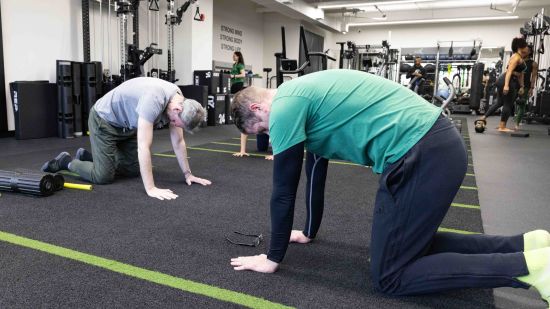
Last Longer, Lift Stronger: Training the Deep Core and The Pelvic Floor
When most people hear "pelvic floor," they usually think of women's health, pregnancy, childbirth, or postpartum recovery.
That connection makes sense. The pelvic floor conversation has been heavily centered around women needing strength and control before and after giving birth.
But men have pelvic floors too.
And for men, this is not some side conversation. It connects to sexual wellness, urinary confidence, breathing mechanics, deep core strength, heavy lifting, and aging with more confidence.
As a 6x bodybuilder, someone who has dabbled in powerlifting, and a man crossing the 40-year-old threshold, I take this seriously. Not as a gimmick or as a soft wellness trend. I see it as part of the full system.
The pelvic floor is not just about "Kegels."
It is not just about squeezing.
It is not just about random contractions.
It is about control.
Control in the bathroom.
Control under the barbell.
Control over breath, pressure, and tension.
That is the real conversation.
Aging, urinary control, and being proactive
The second reason men should care about pelvic floor control is aging.
Most men do not want to talk about urinary leakage, urgency, dribbling, or incontinence. But avoiding the topic does not make it disappear.
Urinary incontinence becomes more common as men age. A 2023 scoping review reported that urinary incontinence prevalence among community-dwelling men ranges from about 4.81% to 32.17%, and among older men, defined as men 65 and older, estimates range from 21% to 32% (Gibson et al., 2023).(SpringerLink)
That should get men's attention.
Not because we should panic.
Because we should be proactive.
Men will train chest, back, shoulders, legs, arms, grip, conditioning, and mobility. We will chase a bigger squat, a stronger deadlift, better abs, and better aesthetics.
But many men never think about training the system that supports bladder control, pelvic stability, and pressure management.
If we are training for longevity, strength, and confidence, pelvic floor control deserves a seat at the table.
The pelvic floor and the deep core
Now let's bring this back to training.
For standard weight lifting it's imperative to have a strong core. It tends to expose itself throughout other ways if not engaged properly. A strong core is what helps you engage and transition from the fundamentals, to more dynamic training and so forth. Not to mention if you are chasing 315+ squats, a 405 deadlift, a 145 strict overhead press, loaded carries, kettlebell work, or serious core strength, you need to understand pressure. Heavy lifting is not just about having strong glutes, quads, lats, and abs.
It is about how well the body creates, contains, and directs intra-abdominal pressure.
Think of it like this:
Diaphragm = top of the pressure system
Pelvic floor = bottom of the pressure system
Deep core and abdominal wall = the walls
When you brace for a squat, deadlift, overhead press, or heavy carry, pressure has to go somewhere. If you cannot manage that pressure well, you may flare the ribs, overextend the low back, lose position, bear down too aggressively, or leak tension.
That is why "core strength" is bigger than abs.
A preliminary study in healthy men found that pelvic floor muscle length changes during breathing, supporting the idea that the male pelvic floor interacts with respiration and intra-abdominal pressure rather than functioning as a completely separate system (Ryan et al., 2023).(PubMed)
That matters for lifting because breathing and bracing are pressure skills.
If the diaphragm and pelvic floor are not coordinating well, your brace may be messy. You may hold your breath too aggressively. You may push pressure downward instead of creating full-body tension. You may feel strong, but still be inefficient.
A strong core is not just about being able to plank for a long time.
A strong core means you can breathe, brace, stabilize, resist rotation, and maintain position under load.
That is what we care about.
How we integrate this at Nesfield Performance
At Nesfield Performance, we do not look at core training as just crunches, planks, and random ab finishers.
We look at how people organize their body.
Can they breathe?
Can they stack their ribs over their pelvis?
Can they brace without over-bracing?
Can they resist rotation?
Can they control pressure?
Can they move under load without leaking position?
A lot of the movements we integrate train the deep core without needing to look overly complicated.
One example is the Pallof press.
On paper, it looks easy. You stand sideways to a cable or band, press the handle straight out, resist rotation, and bring it back in.
Simple.
But when it is done correctly, it teaches a lot:
Anti-rotation.
Rib and pelvis stacking.
Breath control.
Deep core engagement.
Pelvic positioning.
Pressure management.
Full-body tension without turning into a stiff brick.
This is the type of exercise that quietly exposes whether someone actually owns their trunk.
Common Pallof press mistakes
1. Moving too fast
People rush the movement and turn it into a random cable press.
That misses the point.
The goal is not speed. The goal is control. Press out, pause, breathe, own the position, then return.
2. Poor rib and pelvis stacking
If the ribs flare and the low back arches, the person is not truly controlling the core. They are borrowing stability from spinal extension.
We want the ribs stacked over the pelvis, glutes lightly engaged, and the body organized from the floor up.
3. Holding the breath too aggressively
Some people brace like they are about to max out a deadlift even when the load is light.
That can create excessive pressure and poor awareness.
The better goal is to maintain tension while still being able to breathe.
4. Letting the cable rotate the body
The whole point of the Pallof press is resisting rotation.
If the torso keeps drifting toward the machine or band, the load is too heavy or the person is not controlling the movement.
5. Treating it like an arm exercise
The arms move, but the core controls.
If someone only feels shoulders and arms, they are missing the lesson.
Pallof press progressions we use
Once someone understands the standard version, we can progress the movement.
Split-stance Pallof press
This adds more demand on the hips, pelvis, and trunk. It teaches the body to stabilize from an asymmetrical position, which carries over well to lunges, carries, athletic movement, and real life.
Half-kneeling Pallof press
Half-kneeling forces more awareness of the pelvis and rib cage. It is harder to hide compensations here. If someone arches the back, shifts the hips, or loses their breath, it shows up quickly.
Pallof press to overhead
This progression adds shoulder flexion and more core demand. Press forward, move overhead, maintain stacked ribs, breathe, and keep the pelvis controlled.
This is where people start to understand that core strength is not just about feeling a burn.
It is about resisting movement.
Controlling pressure.
Maintaining position.
Breathing under tension.
These are the types of movements that build a rock-solid core because they teach the body to coordinate tension, breath, and control.
Putting Everything into Perspective
For men, pelvic floor training should not be treated like a joke or something only women need to think about.
It connects to the bathroom.
It connects to the squat rack.
It connects to breathing.
It connects to aging.
It connects to confidence.
It also matters for urinary confidence as we age and for managing pressure during heavy lifting.
The more intentional your deep core system becomes, the more intentional your body becomes under pressure.
And for men, pressure shows up everywhere: training, aging, and life.
Stronger pelvic floor. Better breathing. Better control. Heavier lifts. More confidence.
Ready to train smarter, lift stronger, and build control that carries over everywhere?
At Nesfield Performance in Bethesda, we build programs around the full system — not just the muscles you can see. Whether you're chasing heavier lifts, better performance, or simply want to move and age with more confidence, we'll meet you where you are.
Semi-private training. Expert coaching. A community that keeps you accountable.
📞 Book your free consultation today and let's build something that actually works. 📞 240.652.2808 | 📧 info@reply.nesfieldperformance.com | 🌐 nesfieldperformance.com
About the author:
Chris Njoku Moser: CPT, Nutrition Coach — Personal Trainer and Nutrition Coach at Nesfield Performance, Bethesda. Evidence-based coaching in strength, recovery, and sustainable habit change.
About Nesfield Performance:
Nesfield Performance — a Bethesda performance & wellness studio serving Chevy Chase and the DC suburbs. We combine strength training, movement education, nutrition guidance, and recovery strategies to build long-term resilience and health. Learn more: nesfieldperformance.com
References
Gibson, W., Hunter, K. F., Camicioli, R., Booth, J., Skelton, D. A., & Dumoulin, C. (2023). A scoping review of risk factors for urinary incontinence in older men. BMC Geriatrics, 23, Article 534. https://doi.org/10.1186/s12877-023-04249-7
La Pera, G. (2014). Awareness and timing of pelvic floor muscle contraction, pelvic exercises and rehabilitation of pelvic floor in lifelong premature ejaculation: 5 years experience. Archivio Italiano di Urologia e Andrologia, 86(2), 123–125. https://doi.org/10.4081/aiua.2014.2.123
Ryan, V., Kamm, M. A., Khera, A. J., & Dinning, P. G. (2023). Pelvic floor muscle length changes with breathing in males: A preliminary report. Neurourology and Urodynamics, 42(8), 1795–1804. https://doi.org/10.1002/nau.25246