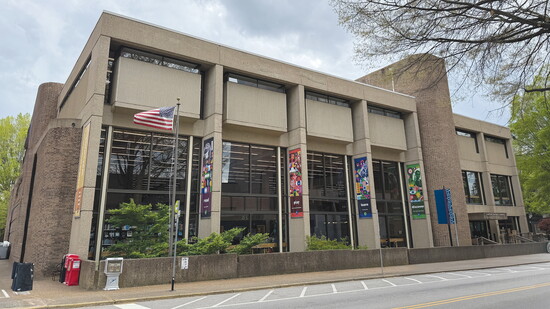
The Lawson McGhee Library, on the corner of W. Church Avenue and Walnut Street, has stood there for more than 50 years. Crammed full of books, DVDs, vinyl records and other media, serves the community, just like its numerous branches, almost every day of the week. The library has been a downtown fixture, albeit not always in the same place, for over 140 years.
Although there is a claim that Knoxville’s first library dates to the early 1800s, it was in 1873 when a band of “public-spirited citizens” came together to support what they termed the Reading Room Association. They described their ambition to establish a library, which would “make such an institution not only interesting but valuable as a source and means of instruction and information to every man, woman, boy and girl in Knoxville.” However, the fledgling library would serve only those who could afford to pay a subscription fee. It would remain that way for a few years while the library occupied several locations before settling at the Board of Trade on the 100 block of Gay Street.
By 1879, subscribers and supporters came together to consider a new charter: to become a public library to serve everyone. The motion passed, and the association became the Public Library of Knoxville. It wasn’t strictly free yet, although over the years, membership fees were reduced. Still, the original Lawson McGhee Library is regarded as the first durable public library in Tennessee.
In 1885, Knoxville industrialist Charles McClung McGhee, who accumulated his wealth through railroads and coal mining, declared that he wished to erect on the northeast “corner of Gay and Vine Streets a building to be used as a public library, and at the same time a memorial to a beloved child.” That child referred to his own daughter, Mrs. May Lawson McGhee Williams, who had died two years prior. Her passing occurred during the birth of her child in New York at the age of 23.
After a ceremony to lay the building’s cornerstone that summer, the new library opened in late 1886. Rev. Thomas Humes, then aged 70, the former President of the University of Tennessee and a pastor at St. John’s Episcopal Church, took the position of librarian. To help pay for operations on the upper floors, the library rented the ground floor to the Knoxville Business College.
Following Humes’s death in 1892, the library hired its first trained librarian, Mary Louise Davis, who had previously served at the New York State Library in Albany. Although Davis stayed only a few years, the library continued its investment in professional leadership.
In the late 1890s, the Tennessee state legislature passed an act “authorizing free public libraries in the state,” which encouraged cities with populations of more than 20,000 (about 30,000 people lived in Knoxville at the time) to fund their own public libraries. However, it would be another 20 years before that happened here.
After a fire damaged the original library in 1904, books were moved to a temporary location, and trustees put the building up for auction to pay for a new library. A surprise bidder, Italian immigrant Fiorenzo Rebori, who had sold fruit and peanuts in a lean-to building alongside the library for many years, purchased the building and continued to own it for several decades, while maintaining his own business on the street.
The new Lawson McGhee Library, on the corner of Market Street at Commerce Avenue, two blocks up from the northern part of Market Square, opened in January 1917. Finished in marble, this new library would be open free of charge to all city residents.
Ahead of the opening, trustees had hired a new librarian, Mary Utopia Rothrock, who would greatly advance the library system in her 20-year career, including the addition of new branch libraries.
A year later, with the help of Charles Cansler, the Free Colored Library opened on Vine Avenue, and another in Mechanicsville would open to serve the Black community in 1930.
Not long after the city and Knox County library systems consolidated in 1967, the Knox County Library system sought a new location to accommodate its growing resources and a growing population. A third library building, this time designed by Knoxville architect Bruce McCarty, opened during the summer of 1971. Meanwhile, despite efforts to save the empty Market Street library building for other uses, it was torn down in late 1974 to make way for Summit Hill Drive.
The new library on W. Church Street at Walnut, with its concrete modernist design, replaced Second Presbyterian Church (which moved to Kingston Pike) and remains there to this day. Just inside the lobby hangs a portrait of Lawson McGhee herself, painted by local artist John Kelley in 1985, who fondly remembers the library as “a great oasis of culture and inspiration.”
One of the Knoxville History Project’s Downtown Art Wraps features Kelley’s painting of Lawson McGhee on a nearby corner, which is seen by thousands of drivers and pedestrians every day, not far from where Charles McClung McGhee once lived himself, up the hill on Locust Street.
About KHP: The educational nonprofit Knoxville History Project tells the city’s true stories, focusing on those that have not been previously told and those that connect the city to the world. Donations to support the work of KHP are always welcomed and appreciated. Learn more at KnoxvilleHistoryProject.org.