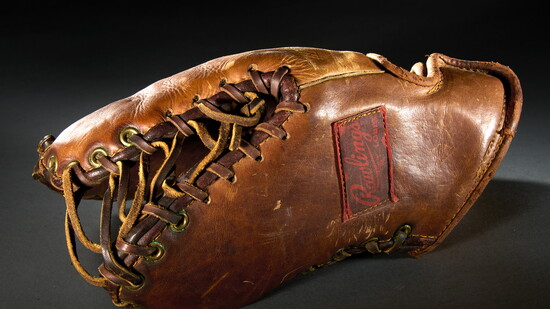
In St. Louis, baseball has never been merely entertainment. It is inheritance, civic language, family memory and ritual passed from one generation to the next as naturally as a glove handed from parent to child. Few writers understand that truth more completely than acclaimed sports historian Ed Wheatley, whose newest volume, The Finest in the Field: A History of Baseball Through 50 Iconic Gloves, is a work of scholarship, a visual treasure and a deeply affectionate meditation on America’s game.
Its arrival feels especially timely. This year marks the 150th anniversary of Major League Baseball, as well as the centennial of the St. Louis Cardinals’ first World Series championship in 1926: two milestones that underscore how thoroughly baseball is woven into the American story and the identity of this city.
Produced in collaboration with Rawlings, the St. Louis-founded company long regarded as the world’s premier maker of baseball gloves, the book represents Ed's eighth sports title. Legendary broadcaster and fellow St. Louis native Bob Costas offered perhaps the most elegant endorsement possible, calling it simply a “beautiful book.”
Bob is correct.
Yet beauty alone doesn't explain the significance of this volume. Ed created something rarer: a book that understands baseball not only through numbers, pennants and famous names, but through craftsmanship, touch, memory and place.
That begins, fittingly, in St. Louis.
Founded here in the late 19th century, Rawlings grew from a local sporting-goods enterprise into one of baseball’s defining institutions, eventually manufacturing more gloves used by professionals than any competitor. For generations of young players, to receive a Rawlings glove was to feel oneself admitted into the fraternity of the sport.
Ed understands the emotional power of the baseball glove. He views it as “baseball’s most personal possession: an object shaped by hand and devotion of its owner. A bat can be borrowed. Cleats can be replaced. But a glove is shaped by the hand, broken in through labor and molded over time into something nearly inseparable from its owner.” It bears the memory of catches made and missed.
That idea gives The Finest in the Field its unusual warmth. On the surface, the book chronicles the history of the Gold Glove and Platinum Glove Awards and honors the greatest defenders ever to take the field. Beneath that structure lies a richer story: how excellence, identity and legacy are carried in the equipment players trust most.
Naturally, the Cardinals occupy a place of distinction.
No franchise in baseball history has produced more Gold Glove winners than St. Louis, and Ed rightly treats the club as defensive royalty. Bob Gibson’s ferocious athleticism, Keith Hernandez’s elegance at first base, Yadier Molina’s mastery behind the plate, and Ozzie Smith’s sorcery at shortstop remind readers that run prevention can be every bit as dramatic as run production.
For St. Louisans, those names are more than statistics; they're civic touchstones. Their brilliance helped define eras of Cardinals baseball and affirmed a local belief the game should be played with intelligence, precision and grace.
Ed also reaches beyond Missouri to illuminate national icons through wonderfully human details. Among the most evocative stories is of George H.W. Bush, who played collegiate baseball at Yale and competed in the first two College World Series. The president kept his old “Trapper” mitt for decades, through Congress, the vice presidency and presidency itself. “When faced with consequential decisions, he was said to pull his old glove from the Oval Office desk, place it on his hand and reflect.”
It is a quintessentially American image: power consulting memory, leadership steadied by sport.
Elsewhere, Ed reminds readers that legends often begin humbly. “Johnny Bench, one of baseball’s greatest catchers, once picked cotton through summer heat to earn money for his first glove.” Ozzie Smith reportedly used a paper bag before finding real leather.
Contemporary stars receive their due as well. Ed highlights Cal Raleigh’s rise as a power-hitting catcher and celebrates Ha-Seong Kim, whose defensive versatility and Gold Glove achievement carried international significance.
Still, the emotional center of the volume remains the glove itself.
A ball glove carries the imprint of repetition. Its pocket remembers catches long after crowds forget scores. It survives childhood bedrooms, attic shelves, marriages, moves and grief. To hold an old glove is often to hold a family archive.
That sensibility is what makes Ed such an ideal steward for this project. He writes neither as a statistician nor as a sentimentalist alone, but as a historian who understands the truest record of baseball lives in both box scores and keepsakes.
For St. Louis readers especially, The Finest in the Field is more than a handsome coffee-table volume. It's a reminder that one of baseball’s enduring institutions was built here, and that from this city came gloves that helped shape generations of dreams.
Some books are read. Others are treasured. Ed Wheatley has written the latter.
It's a quintessentially American image: power consulting memory, leadership steadied by sport.
A ball glove carries the imprint of repetition. Its pocket remembers catches long after crowds forget scores. It survives childhood bedrooms, attic shelves, marriages, moves and grief.