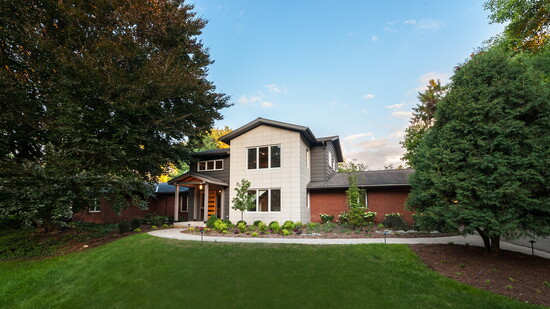
When Gary Rochman first walked up to the 1956 brick ranch in Ann Arbor Hills, he saw a home emblematic of its era—solidly built, thoughtfully proportioned, and set within a neighborhood that had only grown more desirable over time. Like many mid-century homes in Ann Arbor, it reflected a period when craftsmanship and restraint guided residential design.
What drew Rochman in wasn’t what the house lacked, but what it quietly offered. Beneath its low rooflines and horizontal form was a structure with strong bones and clear potential—one that could evolve to meet the needs of the family living there while remaining true to its original character.
That balance—between honoring what already exists and imagining what a home can become—is where Rochman Design-Build does its best work.
Over the decades, Rochman has remodeled countless older Ann Arbor homes, but this project stood out. It would ultimately earn the firm a National Association of the Remodeling Industry (NARI) Regional Contractor of the Year award, not just for its craftsmanship, but for the clarity of its vision. More than a renovation, the project became a case study in Rochman’s approach: listen carefully, explore broadly, and design with intention—from every angle.
Founded as Ann Arbor’s first design-build firm, Rochman Design-Build operates on a simple but powerful premise: architecture and construction work best when they are fully integrated. Gary Rochman’s background—shaped by earning a degree in architecture while also working as a carpenter, and later as a structural engineer—led him to embrace the “master builder” model, where one team is responsible for both imagining and executing a home.
“For residential scale,” Rochman says, “the master builder was always the ideal.”
That philosophy proved essential in this Ann Arbor Hills remodel. The homeowners loved their neighborhood and their home’s footprint but needed more bedroom space and a true primary suite. Like many mid-century ranches, the house had strong bones and generous width but limited vertical presence. Rather than default to a first-floor expansion, Rochman and his team resisted jumping to conclusions.
Instead, they explored. During the conceptual design phase, they presented more than a dozen ideas—expanding front or back, reconfiguring the first floor, adding a second story, and combinations of all three.
“Most people know what they like when they see it,” Rochman says, “but have a hard time imagining it.”
Over time, one idea clearly rose to the top: building up, rather than out. Extending the first floor would have made the home longer and flatter, diluting its proportions. Adding a second story proved more transformative, solving functional needs while giving the home a stronger identity.
That’s where contrast came into play.
“You see beauty oftentimes when it’s contrasted with something,” Rochman says. “High ceilings look beautiful when you come out of a lower ceiling space. Light materials stand out next to darker ones.”
The design leaned into that idea. Vertically, the addition introduced height and rhythm to a previously low-slung structure. Externally, contrasting materials—wood, stone, glass, and varied color tones—were layered thoughtfully against the original brick. Inside, ceiling heights shifted intentionally, creating moments of compression and release that felt both dynamic and comfortable.
One of the most defining elements of the remodel is the front entry—an area Rochman identified early as an opportunity to give the home a stronger sense of arrival. What had once felt understated became a true focal point, anchoring the renovation.
At the center of it all is a sculptural staircase paired with what the team calls the “bamboo monolith”—a large, built-in wall that houses a generous coat closet and helps divide the entry from the rest of the home. Designed to be seen from multiple vantage points, it balances openness with precision.
“We knew it would be visible from a lot of different spaces,” Rochman says. “So we had to design it from a lot of different views.”
From the underside of the stairs to the perspective from above, from the interior to the street-facing windows, every angle mattered. Open risers, glass railings, and fully finished treads give the staircase a sense of lightness, allowing it to act as a connector rather than a divider. It’s architectural, but never overbearing—precise, but inviting.
Behind the scenes, the project also reflects Rochman Design-Build’s emphasis on proactive discovery. Older homes often hide decades of changes—some thoughtful, others less so.
“Sometimes we feel like archaeologists,” Rochman says. “We’re pulling back layers and seeing what was done in the ’60s, the ’80s, or the last decade.”
As a design-build firm, Rochman can investigate early—opening walls strategically, using fiber optic cameras, and understanding the home’s structure and systems before finalizing plans. That early insight minimizes surprises during construction and ensures the design is grounded in reality, not assumptions.
What made this project especially rewarding, Rochman notes, was the alignment between the homeowners, the house, and the design solution. The clients trusted the process, stayed open to exploration, and committed to a vision that respected the home’s original character while reshaping it for modern life. That kind of alignment is also what allows Rochman Design-Build to foster lasting relationships based on trust with homeowners—something especially important in remodeling, where clients are living in their homes throughout the process.
Different houses need different things, and this one responded beautifully to contrast, verticality, and thoughtful restraint. In a city like Ann Arbor—where homes span centuries, styles, and scales—that kind of sensitivity matters. This award-winning remodel isn’t just about adding space or updating finishes. It’s about understanding how a home works, how it’s seen, and how it feels to live in—today and for decades to come.
And when that happens, the result doesn’t feel like an addition at all. It feels like the house finally became what it was always meant to be.
Learn more at rochmandesignbuild.com.