The practice of training bonsai trees is one that requires patience, slowness, and a fundamental respect for the tree and how it wants to exist. To grow and cultivate a successful bonsai tree, one must essentially become a collaborator with another living thing and its natural tendencies.
A key word here is “natural.”
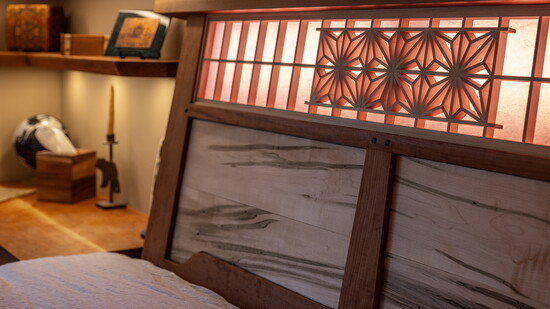
Phallon Arthun and Travis Orr are the husband-and-wife owners of Little Hinoki Designs and Mountain Maple Woodworks, respectively. In their businesses—interior design for Phallon; woodworking for Travis—they place a huge emphasis on working with what is natural to achieve something holistic. This can mean anything from the materials they work with, how a room is composed and what is in it, or slowing down to give a project the time it needs to be fully realized.
In many ways, the work that Phallon and Travis do is a lot like having and nurturing a bonsai tree.
“I was so fascinated by bonsai because the concept is: you take this tiny baby tree and you essentially make it look like a big tree,” Phallon says. “And I really liked that concept because you're the artist in that sense, you're mimicking nature, but nothing's ever going to be more beautiful than nature makes it. And I feel like that's also a good way to describe what we do.”
They’ve spent time in Japan and Scandinavia deepening their skills, studying ways of building and design that are much older than what we see here in the States, methods that are often ancient, rooted in times of relative scarcity, where the materials used had their basis in the surrounding environment and produced structures that have sometimes outlasted even the cultures that made them.
“I want to bring more natural materials back into our lives,” Phallon says. “Even our walls are not made of anything real now. I typically like to use lime wash paints, and using clay walls as accent walls. It requires more than your average building company, I think, because they're not going to be interested in doing those specialty things.”
“Wood, of course, is an awesome material,” adds Travis. “It has so many benefits. Oftentimes today it's seen as a nice thing to look at, but a poor material because it needs maintenance or has defects. It demonstrates a lack of understanding of the adaptability and versatility of wood. Especially when you see how Europeans have used wood and have structures that have lasted hundreds and hundreds of years. Thousands of years in some cases. Same thing in Japan.”
“One thing they do in Japan,” Phallon says, “if they find a piece of a home’s timber frame that’s rotting, they just take that piece out. Cut it out and join in a new piece and the whole structure is usable.”
“Environment” is another key word here. It’s a word that is often tossed around casually, but its deeper contexts and meanings tend to get obscured in everyday use.
“Building today in the United States is very wasteful,” Travis says. “On the one hand, it does build things quickly; they just don't last very long. You see buildings starting to fail after 20 years, or maybe a 50-year life cycle, if you're lucky. I don't really care what type of certifications you have, LEED or otherwise. If you're going to tear it down in 50 years or less, does it really matter? A building that's built to last for hundreds of years, that's really the so-called ‘green’ option.”
“In order to get, for lack of a better term, ‘environmental points,’ they’ll factor in, like, ‘Oh, we’ll be able to recycle x amount of the styrofoam insulation or metal studs.’ In practice, is that going to happen? Maybe, maybe not,” Travis says.
“Also, recycling takes a lot of energy,” Phallon says, “and oftentimes they just end up shipping [the material] overseas and it goes and sits in a lot. Who knows what they’re doing, if they’re burning it or what happens to it.”
“It's a real big hope and wish,” Travis says, “whereas, if you were to just build with natural materials, you could actually have something that's recyclable. Or at the very worst, it just goes back into the earth. But it's not convenient, right? Or cheap. And that's the rub. But then you have to kind of start evaluating what ‘cost’ really means.”
So, what does “cost” mean? Can it be measured, and how does this consideration manifest itself in the work that Phallon and Travis do?
Phallon has an anecdote of an experience they had in Japan that points toward their shared philosophy of respect and care.
“So [Travis’] teacher makes beautiful furniture,” she says. “He had a big block of wood in his house for like a year and a half because he didn't know what to do with it, because it was so beautiful. He was waiting for the wood to tell him what it was supposed to be. They have a lot of respect for even just the wood grain. We got back and he had made something with it. It was cool to see it finished, but he spent a lot of time thinking about it.”
“That was a big takeaway for us: understand your materials,” Travis says. “If it's not necessary and it doesn't add anything, don't do it. If it adds something, do it. Respect the materials. Understand the materials. Be honest with what you're building.”
And, Phallon adds, from an interior design perspective, “it's also a respect for what's already there.”
“When I go in and I look at somebody's house, I want to look at what style this house is or what this house is trying to be and what the customer wants, because sometimes they don't go together,” she says. “If I go into an English style house and somebody wants a minimalist kitchen, I can do that. That's really easy to just do, but it doesn't mean a couple months down the road they’re gonna look at it and still be happy with it. They're probably not going to be.”
“Things have to make sense,” adds Travis.
It’s probably clear by now that Phallon’s and Travis’ respective clienteles are most likely a self-selecting group, the kind of customers who want to trust what their builder or designer bring to the table as far as vision and expertise.
“We don’t want to betray our own philosophy,” Phallon says.
“If people are like, ‘it has to be exactly this way,’ it might not work for us, just because we have to have a little bit of creative direction, at a minimum,” Travis says. “Obviously, the client at the end of the day needs to get what they want, but we might not be the people to serve that person if it's going to be completely antithetical to what we do.”
“That was a big takeaway for us: understand your materials.” - Travis Orr
"Nothing's ever going to be more beautiful than nature makes it. And I feel like that's also a good way to describe what we do.” Phallon Arthun