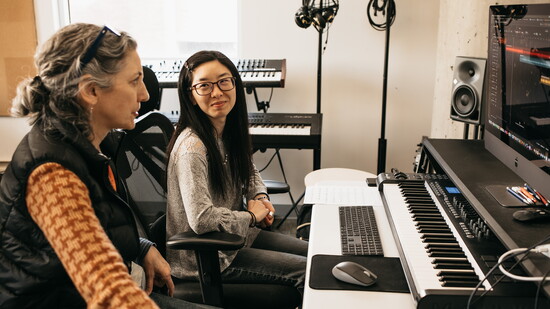
At MacPhail Center for Music, contemporary music is no longer a side note – it is an expanding creative ecosystem designed for today’s musicians. The Contemporary Music Program brings together songwriting, jazz, rock, pop, blues, R&B, electronic production, and composition under one umbrella. This reflects how music is actually made now: across genres, across technologies, and often beginning with a single idea in a laptop, a voice memo, or a groove in a rehearsal room.
Rather than separating “traditional” and “modern,” the program integrates them, offering students of all ages and experience levels pathways into individual lessons, ensembles, group classes, and studio-based production. It is a shift that acknowledges a simple reality: many students don’t first encounter music through sheet music or formal conservatory training anymore. They encounter it through playlists, digital audio, beat-making apps, and collaborative online tools – and MacPhail has built a structure that meets them there.
Barbara Cohen, director of the Contemporary Music Program and a teaching artist in composition and songwriting, describes the philosophy behind the work as deeply human. “Composing and songwriting are powerful storytelling tools,” she explains. “They go deep into our subconscious. These musical stories shine a light on things we didn’t realize we felt or knew about ourselves and the world around us. As a teacher, it’s a real joy and privilege to support student songwriters as they develop their composition skills and create their musical worlds.”
That idea – music as both craft and self-discovery – runs through every corner of the program.
A Creative Umbrella for Modern Music-Making
The Contemporary Music Program at MacPhail Center for Music functions as a broad creative umbrella, bringing together long-standing strengths in jazz, composition, rock, pop, blues, R&B, songwriting, and electronic production. While MacPhail has long been recognized for classical instruction, the contemporary program formalizes and expands its decades-old modern offerings into a unified identity.
According to Cohen, the goal is to build “a creative, collaborative environment where students can develop their musical skills, find their artistic voice, and build a community.” That includes everything from private lessons to ensemble-based learning and studio production experiences.
Students might spend one day working on guitar technique, the next refining a beat in a digital audio workstation, and another composing for film or developing a song from scratch. The flexibility is intentional, mirroring how contemporary artists actually work.
Jazz: Tradition, Innovation, and Community
Jazz remains a cornerstone of MacPhail’s contemporary offerings, grounded in its identity as a living art form that spans tradition and innovation. MacPhail Center for Music celebrates jazz as a foundational American genre, shaped by Black American musical history and continually evolving through new voices and approaches.
The program offers a wide range of jazz experiences, including private lessons, combos, ensembles, camps, master classes, and more. Students are encouraged not only to study repertoire, but also to participate in improvisation, collaboration, and live performance.
One of the most distinctive opportunities is the Dakota Ensemble, an elite instrumental jazz combo led by guitarist and composer Zacc Harris. The group functions as a professional-level training experience for advanced youth musicians. Students rehearse weekly, develop improvisational fluency, and perform in high-level settings, including iconic venues such as the Dakota Jazz Club. Participation is tuition-free, reinforcing MacPhail’s commitment to access for emerging talent.
Cohen notes that these experiences are designed to immerse students in real musical environments, where learning happens through listening, responding, and performing with others. “It’s about developing ensemble skills and learning how to communicate musically in real time,” she emphasizes.
The program also includes summer jazz camps, adult jazz combos, improvisation ensembles, and singer-focused jam sessions, offering entry points for a wide range of experience levels. Across all of these offerings, students are encouraged to engage in improvisation, and stylistic exploration – from blues foundations to bebop vocabulary and beyond.
Music Production and Technology: Building Music from the Ground Up
A major pillar of the Contemporary Music Program is its Music Production & Technology track, also known as EMRA (Electronic Music Recording Arts). Founded by Michael Cain and expanded over the past several years, this program reflects the increasing importance of digital tools in music creation.
Students learn hands-on production skills in studio environments, working with recording, mixing, beat-making, sound design, arranging, and mastering. Instruction is highly individualized and often interdisciplinary, combining elements of songwriting, performance, and technology.
Cohen describes the program as intentionally flexible. A student might work on songwriting one week, then shift to arranging bass lines in a digital session the next. “You can have one teacher and they’ll teach multiple things,” she explains. “It becomes a full creative cycle – writing a song, arranging it, recording it, and producing it.”
The result is often a finished project, such as a demo or EP, but just as importantly, students gain fluency in the language of modern music production. Whether or not a student arrives with prior musical experience, the program is designed to make creation accessible through tools like looping, sampling, and beat construction.
Composition, Songwriting, and Finding a Voice
Songwriting and composition sit at the emotional center of MacPhail’s contemporary programming. Courses and private lessons in these areas focus on helping students develop their own artistic voice, whether through acoustic instruments or electronic platforms.
Cohen highlights the transformative nature of this work. Writing music, she says, is not just about technique – it is about expression and discovery. Students are encouraged to explore narrative, emotion, and identity through sound, often uncovering personal insights in the process of creating.
This exploration extends well beyond contemporary music alone, with many students from MacPhail’s classical programs also participating in songwriting and composition to unlock new forms of artistic expression.
Ensemble Culture and Community Performance
MacPhail’s contemporary ecosystem is built around ensembles that reflect real-world music making. Groups such as jazz combos, improvisation ensembles, and artist-led workshops create spaces where students can experiment and grow together.
One particularly dynamic example is the Sound Rebels Ensemble, where students use instruments, laptops, and voice to create music collaboratively in real time. Another is Rock Camp, which culminates in a live performance at the Seventh Street Entry, giving youth students a taste of professional stage experience.
Additional performances take place at community events such as the Mill City Farmers Market, as well as internal recitals and master classes featuring guest artists from across the jazz and contemporary music world.
Guest clinicians have included internationally recognized performers, offering students direct access to working professionals and expanding their understanding of musical careers beyond the classroom.
A Program Shaped by Today’s Musicians
At its core, MacPhail’s Contemporary Music Program reflects how music is actually being created today – fluidly, collaboratively, and across genres and platforms. It embraces both tradition and innovation, giving students access to modern musical history, songwriting craft, electronic production, and ensemble performance within a single educational framework.
For Barbara Cohen, the most meaningful outcome is not just technical growth, but personal transformation. Watching students develop confidence in their own ideas is, she says, one of the most rewarding parts of teaching.
In that sense, the program is less about defining what contemporary music is – and more about giving students the tools to define it for themselves.
501 S 2nd St. | 612-321-0100 | macphail.org