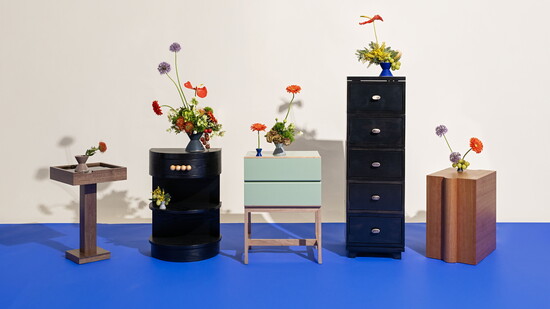
When Carrie Dessertine launched design firm Mey & Co, she built a reputation for thoughtful interiors and custom furnishings for hospitality spaces around the country. Now she’s turning that expertise inward. Her newly launched brand, Meyette, offers both restored vintage pieces and an original collection of furniture designed in-house with longevity, craftsmanship, and sustainability in mind.
For Dessertine, the project has been decades in the making. “This has been something I wanted to do for the last 20-plus years,” she says. With the debut of Meyette this spring, she’s finally bringing that vision to life. We spoke with Dessertine about slow commerce, heirloom design, and building a creative company as a woman in the design world.
Meyette grew out of Mey & Co, your design firm. How did you know it was time to create something new?
Part of it was timing. We had a slight slowdown in projects—some of our larger hospitality work paused around the election and interest rates shifting—and I thought, what can we do with this little bit of lag?
For many of our hospitality projects, we design custom furniture. I love that process, but it’s always within a brand. You’re creating for someone else’s identity. There’s always a little voice saying, “Ooh, I wish it were a little more like this or a little more like that.” We decided to take that opportunity to build some things for ourselves and see if we could launch this. It’s something I’ve wanted to do for a very long time.
Meyette is described as “built for life today and legacy tomorrow.” What does legacy mean to you, particularly as a woman in design?
I don’t actually use the word legacy very often, but to me it means creating something that continues. When you’re building things, whether it’s a company or a physical object, the hope is that it’s not fleeting.
Historically, those kinds of legacy brands are often named after and driven by men. But there were always women there too—they just weren’t the ones whose names were on the door. The hope is that that becomes more normal. Our office right now is six women working away at both ends of this creative endeavor.
In a culture built around fast consumption, how does Meyette approach slow commerce?
It starts with setting expectations. The idea is to build something that lasts much longer than the typical five-year lifespan of mass-market furniture.
Most furniture you can get quickly ships the next day, but the tradeoff is that it doesn’t last very long. We’re trying to do the opposite. Every piece in our collection is made to order, which means there’s a lead time of about 12 to 14 weeks. But it also means the piece is made specifically for you. We’re not producing tons of inventory to sit in a warehouse.
The hope is that it lives in someone’s house for the next 30 or 40 years and maybe gets passed down. It takes patience on the front end, but the idea is that it pays off in the long run.
What makes something an heirloom?
I think it’s mostly about quality and purposefulness, something specially made with a story behind it.
Every one of our pieces will have a label that tells you who made it and when. That provenance matters. I always think of a sleigh bed in my house that was the first piece of furniture my grandmother ever bought for herself. On the slats underneath the mattress it says her name and the date because it was made specifically for her. We’re trying to build more things like that instead of pieces that last five years and end up in a landfill.
Your original collection pieces are named after family members. What inspired that?
This project is deeply personal. My family has invested in me not just financially but with a lot of patience over the years.
Once the pieces were designed, we started asking ourselves: who does this remind us of? Some names come from my family, some from the families of our team members. When we photographed the collection, we brought in my kids, my mom, my stepfather, and members of the team to model in the images. Furniture is meant to be lived with.
The whole project started to feel very intergenerational, and the naming became part of that story.
One phrase associated with Meyette is “thoughtful disruption.” What does that look like in a piece of furniture?
In interiors we often talk about creating systems—design rhythms that help people understand a space and feel comfortable in it. But what’s most interesting is when that system gets disrupted in a thoughtful way. For example, we designed a simple wood bench. There are lots of benches in the world, it’s not a new typology. But instead of straightforward legs, the legs extend beyond the frame at a 45-degree angle so you see the cut edge and the joinery. It’s about taking something simple and pushing it just enough to make it interesting.
Your work isn’t trend-driven. How do you design for both past and future?
Honestly, it’s about not paying too much attention to the present. If you focus too heavily on what’s happening right now, that’s how things become trendy, and trends disappear.
We try to learn from the past: how things were fabricated, why they worked, and what made them last. Sometimes there’s a modern improvement. Sometimes the older solution was already perfect. The goal is to design something you could imagine existing 20 years ago or 20 years from now.
Meyette also restores vintage pieces. What draws you to a particular find?
We find them in a lot of places: flea markets like Brimfield, online auctions, in-person auctions. They’re usually pieces from about 50 to 100 years ago. I tend to pick things that simply resonate with me.
Once they come into the studio, we collaborate with local restoration specialists depending on what they need: cleaning, structural repair, or upholstery. We’re also careful about materials, using fabrics with mostly natural fibers and sustainable upholstery wherever possible. The goal is to create something healthy for your home and durable over time.
As a female founder, how has your leadership evolved over the years?
Leadership is hard. When I was in my late twenties working as a senior project manager in New York, my management style was very different. Now I spend much more time thinking about culture and making sure we function as a team rather than a strictly top-down structure. I want the studio to feel supportive. You invest in people. You want them to be happy and stay and have lives outside the office. I don’t know if that’s a woman thing or just a management thing, but it matters deeply to me.
You’ve spoken about the importance of understanding how things are actually made. Why does that matter in design—and especially for women entering the field?
I apprenticed as a furniture maker when I was younger. Even though I went on to get two architecture degrees, those experiences were incredibly important because they taught me how things actually go together. To draw something well, you need to understand how it’s made.
Historically, that kind of apprenticeship and making has often been gatekept as male. I don’t think that should be the case. I’ve been trying to figure out ways for our team to spend time in the shops we work with—millwork shops, furniture shops—learning directly from the makers. Those opportunities matter. The only way to change those systems is to keep passing them down and making sure women are in the room and in the shop, learning the whole process.
How has Portland shaped the way Meyette operates?
Maine is a small community, and that’s actually a huge advantage. All of these incredible makers we work with—I can drive to their shops, have a conversation, see the process. Because of that, we’re very transparent about who makes our pieces. We might design a bench, but we’ll also say it was built by Davis Boatbuilding. Portland isn’t the kind of place where you can white-label everything and keep all your contacts secret—everyone knows everyone.
Aesthetically, Maine is also more casual. Even though our pieces aren’t inexpensive, they still feel approachable. That balance is really important to us.
“Every piece is made to order. It takes patience on the front end, but the idea is that it pays off in the long run.”
“If you focus too heavily on what’s happening right now, that’s how things become trendy—and trends disappear.”