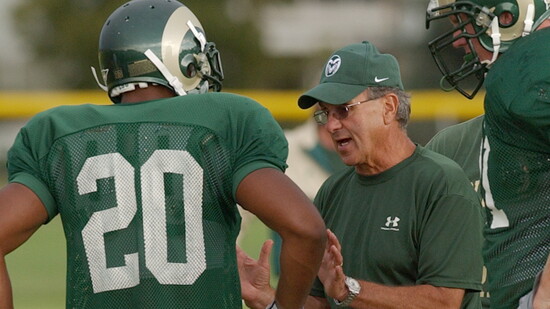
Some names become part of a place.
In Fort Collins, Sonny Lubick is one of them.
For decades, his name has been connected to Colorado State University football, to packed stadiums, bowl games, unforgettable wins and a chapter in CSU history that helped shape the pride of an entire community. But sit with Sonny for even a short time, and it becomes clear that the story is not simply about football. It is about people. It is about loyalty. It is about family. It is about a life built with one relationship, one lesson and one act of kindness at a time.
And if you ask Sonny about the legacy so many others see so clearly, he will almost always point somewhere else.
To his coaches.
To his players.
To Fort Collins.
To his children.
And most of all, to his wife, Carol Jo.
“She’s the glue,” Sonny says. “She’s the rock. None of this happens without her.”
Long before his name became synonymous with Colorado State football, Sonny was a kid from Montana who loved sports, recess and competition. He grew up in an era when sports were woven into the rhythm of everyday life. Basketball, baseball, football, if there were enough kids to play, they played. After high school, his path shifted unexpectedly. An injury while working in the copper mines changed the direction of his life, leading him to college, teaching and eventually coaching.
What followed was a career that took him from small schools to Montana State, Fort Collins, Stanford, the University of Miami and, ultimately, back to Colorado State University in 1993. At Miami, he was part of a powerhouse program and national championship teams. But when the opportunity came to return to CSU, Sonny saw a different kind of challenge. He saw a hungry program, a university ready to believe, and a community waiting for something to rally around. Still, Sonny says he never set out to build something larger than football.
“You never realize you’re doing that,” he says. “You get in there, you get working, and things just happen.”
What happened was an era that changed CSU football. The wins came. The bowl games came. The pride came. Students and alumni traveled, celebrated and believed. At Canvas Stadium, the field now bears his name, Sonny Lubick Field, a visible reminder of the era he helped build at Colorado State. But for Sonny, the deeper legacy has always been found in the people: the players, students, family and community who continue to carry those lessons forward.
But even then, Sonny does not speak about it as something he did alone.
“There was no ‘I,’” he says. “It was all of us.”
That sense of “us” may be the truest thread running through Sonny’s life. He talks about success not as a straight line, but as something shaped by failure, resilience and the people who help you keep going. He believes losses teach more than wins. He believes hard days reveal character. And he believes the most important thing a person can bring to any role is themselves.
Today, as he works with students at CSU’s College of Business, Sonny continues to share many of the same lessons that shaped his coaching career.
“Your best asset is yourself,” he tells his students, a reminder to trust who they are and what they bring into the room.
It is a simple message, but it carries the weight of a man who has lived through pressure, public expectation, tough losses, great victories and the perspective that only comes with time. Sonny speaks openly about failure, not as something to fear, but as something necessary.
“If you’re not failing, you’re not trying hard enough,” he says.
That philosophy shaped him as a coach, but also as a husband, father and grandfather. Looking back now, Sonny is quick to acknowledge that coaching demanded more than people saw. Long hours. Early mornings. Late nights. Moves across the country. Seasons of uncertainty. While Sonny was building teams, Carol Jo was building the foundation that allowed their family to endure it all.
A nurse by profession and the steady heart of the Lubick family, Carol Jo carried the weight that often stayed behind the scenes. She moved their family from place to place. She cared for their children. She worked. She supported Sonny’s opportunities, even when they came with sacrifice. She saw things, as Sonny puts it, “through her lens,” which he says was often better than his own.
“She may not have been the one on the sideline,” he says, “but she was always there, offering steady support, honest perspective and the kind of advice that kept everything grounded.”
Carol Jo also kept him grounded. Through the highs of success, the pressures of coaching and the demands of a very public role, she was the steady presence beside him. She offered an honest perspective, quiet encouragement, and the kind of love that helped keep family at the center of it all.
That, in many ways, is their love story: honest, steady, supportive and real.
“She never let that job get to my head,” he says with a chuckle.
Their marriage, now spanning more than five decades, is deeply woven into the legacy people associate with the Lubick name. Sonny may have been the coach on the sideline, but Carol Jo has always been part of the heartbeat behind it all. People know her not only as Sonny’s wife, but as someone who helped build the sense of family, connection and community that still surrounds their name in Fort Collins today. Players know her. Coaches’ families know her. And even now, people still ask about Carol Jo with the same warmth and affection they have carried for years.
During the season, she often welcomed players into their home before games, offering cookies, ice cream and a sense of belonging. Sonny jokes that the players may have come for the cookies, but the deeper truth is unmistakable: Carol Jo helped create the family culture so many people still remember.
“She had as much impact as most of the coaches,” Sonny says.
That family culture extended beyond the football facility and into the Lubick home. Their children, Matt, Michelle, and Marc, grew up in a family built around leadership, service, and a commitment to others. Matt and Marc followed football into their own coaching careers, with Matt currently coaching at the University of Kansas and Marc with the Buffalo Bills. Michelle became an educator and later helped turn one of the family’s most difficult chapters into a source of hope for others.
That commitment to family and service would later take on even deeper meaning as the Lubicks walked through some of their hardest seasons together. For all the public moments connected to football, some of the family’s most defining chapters happened far from the stadium, in hospital rooms, treatment centers, and quiet moments where strength meant simply taking the next step.
When Marc was diagnosed with cancer, the Lubick family was forced to face every parent’s worst fear. Years later, Matt would face leukemia and undergo a stem cell transplant, with Michelle serving as part of that journey as a stem cell donor. Through both battles, Carol Jo’s strength, both as a mother and a nurse, became a source of stability for the family. She stayed beside her children through treatments, hospital stays, and long stretches of uncertainty.
The family learned resilience not as an idea, but as a daily choice.
“You do what you have to do,” Sonny says.
Out of that pain came RamStrength, the cancer support foundation Michelle helped start after her brother Marc was diagnosed with a rare form of cancer. What began as a deeply personal desire to support her family has grown into a meaningful force for Northern Colorado cancer survivors, providing financial assistance for basic needs, scholarships, programs and services.
For Fort Collins, RamStrength has become more than a foundation. It is an extension of the values the Lubick family has carried for decades: showing up, caring deeply and making sure people know they are not alone. Through its work, RamStrength has helped individuals and families facing cancer with practical needs that often become overwhelming during treatment. A rent payment. A car payment. Help with daily expenses. Support for students trying to continue their education while also battling illness. These are the kinds of needs that may not always be seen from the outside but can mean everything to someone fighting to make it through another day.
To date, RamStrength has raised more than $2.5 million, turning one family’s pain into meaningful support for cancer survivors and their families.
Sonny speaks with genuine pride about the students and families impacted by the organization, especially those who write back with gratitude after receiving help during some of the hardest moments of their lives. He talks about CSU students battling cancer while trying to stay in school, families carrying financial stress on top of medical fear and survivors who return years later as reminders of what hope, community and perseverance can do.
In many ways, RamStrength reflects the same lessons Sonny spent a lifetime teaching on the football field. Keep going. Don’t give up. Lean on the people beside you. And when someone else is struggling, find a way to help carry the weight.
“It doesn’t get any better than that,” he says.
For Sonny, strength has changed meaning over the years. Once, it looked like a fourth-quarter comeback, a player fighting through pain or a team refusing to quit when everything seemed to be going against them. Through his family’s own challenges, strength took on a deeper meaning: walking through uncertainty together, surrounding one another through treatment, turning pain into purpose and watching a community show up again and again.
That community has always mattered to Sonny.
He still loves walking across the CSU campus, especially on a beautiful day in Fort Collins. These days, his connection to Colorado State continues through his work with students at CSU’s College of Business, where he shares lessons in leadership, resilience, and character. He notices the familiar faces, the people who stop to say hello, and those who still take a moment to thank him for what he did for Colorado State. Those moments mean something to him because they were never about status. They were about connection.
That may be why Fort Collins embraced him so deeply. Sonny never seemed separate from the community. He belonged to it. And in many ways, it belonged to him.
When asked what he hopes people remember when the records and football memories fade, Sonny does not talk about wins, trophies or packed stadiums.
He hopes they remember kindness.
He hopes they remember family.
He hopes they remember that he cared.
Because behind the coach, behind the name, behind the legacy etched into Colorado State history, there is a man who still believes in showing up, staying humble, loving your family and treating people right.
And perhaps that is Sonny Lubick’s greatest legacy of all.
Sonny Lubick stood on sidelines teaching young adults how to respond to adversity.
He preached resilience and perseverance. He believed setbacks were temporary and that character was revealed when life became hard.
Those lessons helped build football teams in Fort Collins.
Years later, the words Sonny shared with generations took on a deeper meaning as the Lubick family faced challenges far beyond football.
For the Lubick family, resilience became deeply personal when Sonny and Carol Jo’s youngest son, Marc, was diagnosed with cancer. Years later, their oldest son, Matt, faced leukemia and underwent a stem cell transplant, with his sister Michelle stepping forward as his donor.
These challenges were not measured in wins or losses. They were measured in treatments, uncertainty, determination and faith.
The same values Sonny spent a lifetime teaching, perseverance, resilience and showing up when life gets hard, became the foundation that carried their family forward.
That journey lives on through RamStrength, helping families facing battles of their own and reminding them they do not have to face them alone.
“Family is the team that carries you through every season.”