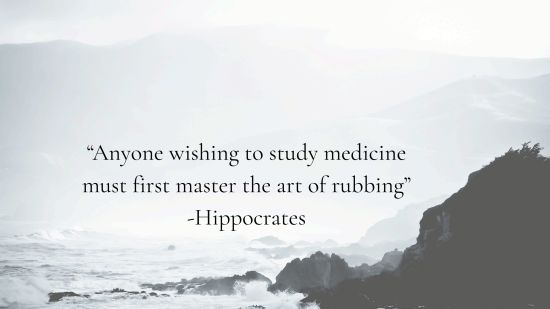
When people ask me about my journey to becoming a massage therapist they are often surprised to learn that my great grandfather Leo put it all in motion long before I ever was born. He was the original healer in our family and people often respond "Wow... he was really ahead of the times!" Not wanting to go into a dissertation; I usually leave it at that. The truth is, he was just at the end of a time when the world considered massage, movement and natural interventions the standard. He was just before a time when modern technology would boom and the medicine we know and accept as the standard of care would be introduced. In this article we will journey through this historical transition of Massage as an orthodox treatment to being known as an alternative intervention.
Long before “alternative” became a buzzword, massage stood at the heart of healing — not on the fringes, not as a luxury add-on, but as an orthodox cornerstone of medical care. When we trace the roots of what we today enthusiastically call integrative or complementary medicine, we find that therapies like massage weren’t born in opposition to conventional medicine — they were medicine.
Scholars of medical history remind us that massage has a rich, continuous heritage in professional healthcare. In the late 19th and early 20th centuries, physicians and nurses didn’t delegate touch to the “alternative” world. They practiced, taught, and wrote about massage as a legitimate, evidence-driven therapeutic modality. It was part of the healing toolkit — used in hospitals, taught in medical texts, and trusted in daily clinical practice.
So how did something so central become marginalized? After World War II, as medicine increasingly leaned into pharmaceuticals and high-tech interventions, hands-on healing gradually receded from mainstream practice. Touch became decoupled from science, and massage was shuffled into a different category — “complementary” — a label that, while useful in some contexts, also unintentionally reinforced the idea that touch is optional or secondary.
But here’s the truth I champion at Resurrection Bodyworks: the body doesn’t compartmentalize healing the way our medical systems do. The human nervous system, musculoskeletal system, immune response, and psychology are deeply intertwined — and massage speaks to all of them. Massage isn’t just a feel-good luxury; it modulates circulation, nervous system function, tissue health, and even stress pathways. These are precisely the mechanisms medicine seeks to influence when treating pain, dysfunction, or recovery. Modern research continues to validate what ancient healers understood intuitively — touch matters.
Reframing massage as originally orthodox medicine isn’t about rejecting modern medical science. It’s about remembering that healing has always been holistic. Before massage became “alternative,” it was just medicine — the kind that trusted the hands, the whole body, and the body’s innate capacity to move toward health.
At Resurrection Bodyworks, I honor that lineage. I see ourselves not as fringe practitioners but as part of a continuum of care that bridges ancient wisdom and contemporary clinical practice. Whether I'm helping someone recover from injury, ease chronic pain, support surgical healing, or simply restore balance, I stand on a foundation that’s as old as medicine itself.
In a world that’s rediscovering what was once foundational, let’s reclaim touch as medicine — in its most human, connective, and transformative form. Because healing isn’t just something you do to the body; it’s something the body feels — and responds to — with every gentle, intentional touch.
Works Cited
Goldstone, L. A. (2000). Massage as an orthodox medical treatment: Past and future. Complementary Therapies in Nursing & Midwifery, 6(4), 200–205. https://doi.org/10.1054/ctnm.2000.0493