Buon Natale, Feliz Navidad, Joyeux Noël! Around the world, people exchange similar greetings, yet here in the islands—as we hang banners from streetlights and put out welcome mats and window decals—we know there is only one way to say “Merry Christmas to you.”
Even those who have never set foot on our shores know the crooning words of Mele Kalikimaka. But for those who live here, you might wonder where this phrase actually comes from. What does it mean? After all, we never hear either word used in any other context. For Kalikimaka, it makes sense; Christmas, after all, comes only once a year. But Mele? You’d expect it to mean happy or something of the sort.
Other holidays are straightforward. Take Hauʻoli Makahiki Hou, for example. A direct translation:
Hauʻoli: Happy, Joyful.
Makahiki: Year (also an ancient seasonal Hawaiian festival).
Hou: New, Fresh. Happy New Year.
But Mele Kalikimaka is different. As a lover of language, history and Christmas, I had long been interested. What I found shouldn’t have been surprising.
Many words and phrases in our world carry deep historical roots. Others are modern inventions, while still more have been borrowed from other languages to fill gaps and convey ideas that didn’t previously exist. Like the Hindi origins of shampoo or the Arabic origins of coffee, Mele Kalikimaka falls into this category of loanwords.
In fact, Mele Kalikimaka isn't actually Hawaiian at all. Hawaiian speakers can tell you that, in reality, it’s gibberish. In function, however, it’s a phonetic translation of the English phrase, adapted to fit the confines of the Hawaiian alphabet.
Because Hawaiian lacks the letters or sounds R, S, or T, speakers usually made substitutions. L’s often replaced R’s, while K’s stood in for S’s and T’s. Thus, “Merry” became “Mele,” while “Christmas” was broken down into sounds that could be approximated as “Kalik mak.” Add to that the convention of Hawaiian vowel usage, and you get Mele Kalikimaka.
Again, this isn’t that astonishing when you consider how recent a concept Christmas is in Hawai'i’s history. While the Eastern Hemisphere has celebrated the Nativity since the 300s A.D., Hawai'i was one of the last places to truly adopt the holiday, in the early 1800s.
Unfortunately, we don't know exactly when people started using the phrase Mele Kalikimaka. What is certain, however, is that the first published account appears in a Hawaiian-language newspaper in 1904: Ka Nupepa Kuokoa. Did they come up with it themselves? Unlikely. Odds are, they simply put into print a greeting already in wide circulation.
From there, Mele Kalikimaka spread, but it took decades for a songwriter to make it what it is today.
As Hawaiian culture evolved and absorbed new traditions, so did its music. The Portuguese paniolo introduction of the ukulele was especially important to this new Hapa Haole (Hawaiian/English fusion) music genre. In the early 1900s, when the Hawaiian language was being discouraged, Hapa Haole artists helped popularize it and keep it alive.
Holidays provided plenty of material for new songs.
In this music scene, Robert “Alex” Anderson emerged. An Oʻahu-born WWI fighter pilot and POW turned businessman, he spent his free time writing over 100 Haupe Haole hits.
One of his biggest hits is rumored to have been inspired by his own stenographer, who, at Christmas, complained to Anderson that no original Hawaiian Christmas tunes existed. Everything was a translation of English or German carols, and so few captured what a Hawaiian Christmas felt like! Anderson was hooked.
So in 1949, Anderson composed both the lyrics and melody of Mele Kalikimaka. It became the quintessential soundtrack to Hawai'i’s festive season. Eager to see the song take off, he shared it with friend and regular golfing buddy Bing Crosby during a visit to the island.
Crosby loved the song so much that in 1950 he recorded the first-ever version of Mele Kalikimaka with The Andrews Sisters as a surprise for Anderson. Five years later, it appeared on Bing Crosby’s Merry Christmas album, and the rest is history.
Over the years, other artists have added to this song's legacy, spreading its reach far and wide, and the origin of the English loan phrase has mostly been forgotten. But just because words are borrowed doesn’t mean they don’t have significance.
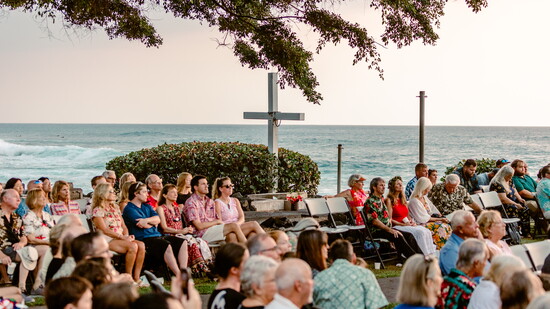
For those of us who live on the Kona Coast, Mele Kalikimaka means driving the truck to Mauna Kea and loading up with snow to build a snowman that lasts a day. It means a drizzly Christmas Festival of Lights in Hōlualoa, the Kailua Lighted Boat parade and meeting Santa at Parker Ranch Shopping Center in Waimea. It means outdoor candlelight services in the island breeze and gathering with both ʻohana and hānai in front of trees that may not be native, but bring joy to our hearts.
Today, for so many, Mele Kalikimaka means a fusion of families, cultures and languages that have twined to form the community we know. So, from our Kona Coast ʻohana to yours, may you have a very Mele Kalikimaka!
While the Eastern Hemisphere has celebrated the Nativity since the 300s A.D., Hawai'i was one of the last places to truly adopt the holiday, in the early 1800s.