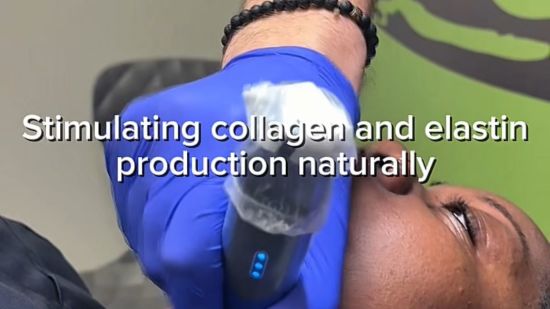
Microneedling and Morpheus8 are two of the most popular treatments for improving skin texture and firmness. Both use very fine needles to get the skin to make new collagen, but Morpheus8 adds radiofrequency energy, which lets it work deeper in the skin. Because of that, each one is better suited for different concerns.
How Microneedling works
At 4Ever Young we use SkinPen, which in 2018 became the first microneedling device cleared by the FDA. Microneedling works by creating a controlled injury, meaning the injury is very small, evenly spaced, and made at a set depth that your provider chooses based on your skin and the area being treated. The needles make thousands of tiny channels, and because each one is so small, the top layer of skin stays mostly intact and heals quickly. Even though the injury is minor, the skin still responds the same way it would to any wound, by sending in repair cells and making new collagen. The skin first makes a softer type of collagen, and over the next few months it is replaced by the sturdier collagen that gives skin its structure. Due to this, results keep improving for weeks after each session.
In a study of 10 patients who had six sessions spaced two weeks apart, skin samples showed significant increases in several types of collagen at three months. A 2025 review of 723 patients with an average age of 48 found that 83% were satisfied with their results, and the most common side effect was temporary redness. Most people look like they have a mild sunburn for a day or two, and the skin's protective barrier usually recovers within two to three days.
How Morpheus8 works
Morpheus8 is a type of radiofrequency (RF) microneedling. It also works through a controlled injury, and it adds a second type of injury, which is a small, precise zone of heat around each needle tip. The needles are coated so the energy only comes out near the tips, below the surface, which heats the deeper layers of the skin and the fat just underneath while protecting the top layer. That heat tightens existing collagen and triggers the skin to build new collagen and elastin. The depth is adjusted for each area. In one published study, providers treated about 1 to 2 mm deep around the eyes, 3 mm on the face and neck, and 3 to 4 mm on the body.
A 2026 review of RF microneedling for facial rejuvenation found consistent improvements in skin texture and tightening, with side effects that were mostly mild and temporary. Results build slowly, and improvement continues for at least six months after treatment. Downtime is usually 2 to 5 days of redness and swelling. RF microneedling has also been shown to reduce active acne and oil production, and it can be used safely across skin tones with the right settings.
Which one is right for you
If your main concerns are texture, fine lines, or mild acne scars and you want minimal downtime, SkinPen microneedling is usually the best place to start. It also works well as maintenance between other treatments.
If you are noticing early sagging along the jawline or neck, have deeper acne scars, or deal with breakouts and oily skin, Morpheus8 is usually the better choice since it reaches deeper and adds heat to tighten the skin.
Many patients use both over time, and both pair well with treatments like Botox and filler. Daily sunscreen is important after either one, since freshly treated skin is more sensitive to the sun.
Microneedling and Morpheus8 in Kingwood, TX
At 4Ever Young Kingwood, we offer both SkinPen microneedling and Morpheus8, so we can recommend the one that fits your skin and your goals, or a plan that uses both. Consultations are always free, with no pressure to book anything.
We see patients from Kingwood, Humble, Atascocita, Porter, and the greater Houston area. Call (281) 242-1724 to schedule your free consultation, or visit us at 30130 Rock Creek Dr., Suite 300, Kingwood, TX 77339.
References
1. Alster TS, Graham PM. Microneedling: a review and practical guide. Dermatologic Surgery. 2018;44(3):397-404. PMID: 28796657.
2. American Med Spa Association. SkinPen Precision microneedling device makes FDA clearance. 2018. https://americanmedspa.org/news/skinpen-precision-microneedling-device-makes-fda-clearance
3. Dayan E, Chia C, Burns AJ, Theodorou S. Adjustable depth fractional radiofrequency combined with bipolar radiofrequency: a minimally invasive combination treatment for skin laxity. Aesthetic Surgery Journal. 2019;39(Suppl 3):S112-S119. PMID: 30958550.
4. El-Domyati M, Barakat M, Awad S, et al. Multiple microneedling sessions for minimally invasive facial rejuvenation: an objective assessment. International Journal of Dermatology. 2015;54(12):1361-1369. PMID: 26096653.
5. Foppiani JA, Fanning JE, Beltran K, et al. Microneedling for facial rejuvenation: a systematic review. Aesthetic Plastic Surgery. 2025;49(17):4949-4960. PMID: 40542236.
6. Hantash BM, Ubeid AA, Chang H, et al. Bipolar fractional radiofrequency treatment induces neoelastogenesis and neocollagenesis. Lasers in Surgery and Medicine. 2009;41(1):1-9. PMID: 19143021.
7. Kim ST, Lee KH, Sim HJ, et al. Treatment of acne vulgaris with fractional radiofrequency microneedling. Journal of Dermatology. 2014;41(7):586-591. PMID: 24807263.
8. Kumar N, Suh DH, Lee SJ, et al. Radiofrequency microneedling for facial rejuvenation: a systematic review. Journal of Cosmetic Dermatology. 2026;25(4):e70845. PMID: 41947517.
9. Tan MG, Jo CE, Chapas A, et al. Radiofrequency microneedling: a comprehensive and critical review. Dermatologic Surgery. 2021;47(6):755-761. PMID: 33577211.
10. Tao YL, Bin Jameel AA, Miao YY, et al. The self-recovery of facial skin barrier and erythema after nanochip treatment. Journal of Cosmetic and Laser Therapy. 2017;19(7):427-433. PMID: 28657367.
This content is for educational purposes only and is not medical advice.