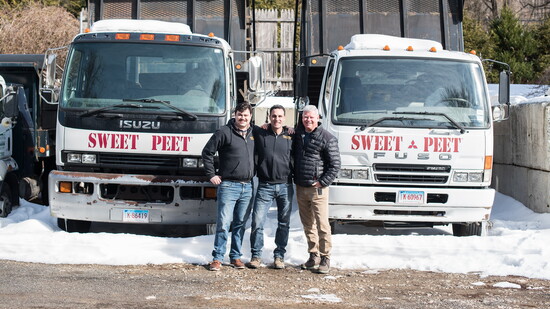
The first time Chris Tartaglia dumped a load of Sweet Peet mulch for a customer, she took one look at it—and lost her shoes.
“She was ecstatic,” he says, laughing at the memory. “She kicked her shoes off and danced in the mulch pile. I remember thinking—OK… we might be onto something here.”
More than two decades later, that “something” has grown into a beloved family-run operation serving customers throughout Fairfield County and beyond. Sweet Peet isn’t your typical mulch—and the team behind it isn’t your typical business.
That very first client sensed how different Sweet Peet was from traditional mulch, which is often, at best, a mystery product—and at worst, potentially harmful to your yard. Shredded hardwood mulch can come from diseased trees or pressure-treated wood and may harbor artillery fungus spores.
“You don’t know what you’re getting with hardwood mulch,” says Paul Kenning, who co-owns Sweet Peet with Chris and has been in the landscaping business since the 1980s. “There are places where you can dump shrubs, stumps, any wood product and they shred it all together. Something might be diseased—you just don’t know. And oftentimes, traditional mulch products are dyed.”
Once added to landscaping beds, traditional hardwood mulch simply sits on top of the soil. Over time, it crusts and mats together, depleting nitrogen in the process. Rainwater runs off rather than soaking in, and heavy storms can wash the wood chips across your yard. Year after year, homeowners often have to remove the dense, compacted layer before adding fresh mulch.
Sweet Peet works in the opposite way. It gradually breaks down under sunlight and temperature, returning organic matter, trace minerals, and nitrogen to the soil—becoming part of your topsoil in the process. With repeated use, garden beds grow deeper, richer, and more fertile over time, encouraging beneficial earthworms.
“The benefit of any mulch is to mimic what happens in the woods,” Paul says. “The leaves fall, they stay there, they protect the ground. Sweet Peet does that—and then becomes part of the earth itself.”
Sweet Peet is a patented product developed by Brent Lamour and Shawn Goff, who began by collecting horse manure along with the accompanying hay and ripe de bois (hardwood shavings) from farms in and around Pawling. As they worked with the material, they discovered that a natural heating process could destroy weed seeds before they germinated, transforming the manure and stall sweepings into a stable, nutrient-rich mulch and top-dressing.
“It’s actually odorless,” says Margie, Paul’s wife and Sweet Peet’s financial officer, laughing. “I mean—it has a scent. But it’s pleasant. Earthy and loamy. Nothing like what you’d expect given its origins.”
Sweet Peet holds moisture far better than traditional mulch and is particularly well-suited to Connecticut’s notoriously stubborn, clay-heavy soil—a legacy of glacial history that left behind compacted, dense layers that feel more akin to cement than dirt. It also helps combat the negative effects of acid rain.
“If you have very tight soil or soil full of clay, you can mix this product in and it will help keep it loose,” Chris tells us.
For gardeners, the results are striking: the greens are more vibrant, flowers have repeat blooms, and plants thrive longer into the season.
“I have a place in front of my house where I plant annuals,” Paul says. “I don’t even need to use a shovel—I can just dig with my hands. The soil is that rich.”
Paul first encountered Sweet Peet while running his landscaping business and began using it on his own projects. Impressed by the results, he became an early champion of the product and eventually opened the Wilton franchise—the only one in the area. When it came time to choose a partner, he knew exactly who to call: Chris Tartaglia.
The partnership was rooted in long-standing family ties. Chris’s father grew up with Margie’s father. Chris’s mother babysat Margie. Margie later babysat Chris.
Chris, whose background is in excavation, agreed to join him, and the two opened the Wilton location in 1999.
“Nothing happens without Chris—that’s why I sought him out,” Paul says. “We need equipment to lift the product and move it. He can run and fix anything.”
“We started with Paul and I answering phones after work,” Chris adds. “Customers would leave a message with what they wanted, and we’d make deliveries after work.”
The business grew steadily by word of mouth. Margie came on to manage finances and technology. Her father, Joe, helped run the office and load trucks. Now Paul and Margie’s son, Eamon, continues the tradition as operations manager—handling orders, scheduling deliveries, and keeping everything moving.
“You can’t get more of a family business than this,” Paul says with a laugh.
Sweet Peet still operates very much like a classic mom-and-pop shop. While open year-round, early spring is when the yard comes alive. Truckloads of product arrive, forming a towering mound. Chris is there every day at 4:30 a.m., pushing up loads of Sweet Peet to get ready for pickup. Customers line up at the window to talk through their needs with Eamon, while Paul is on hand to help with whatever needs doing.
“People will call and ask what time we’re open until,” Paul says. “And I’ll say, ’Well, what time can you get here?’”
The mulch is typically sold by the yard, but 1.5-cubic-foot bags—priced at $10—offer flexibility for those who prefer to tackle yardwork gradually.
“It’s convenience you’re buying in a bag,” Eamon tells us. “A lot of people like to poke away at yardwork, so they’ll come in every weekend to buy a few bags. They also don’t want a pile sitting in their driveway.”
Bagging has also helped Sweet Peet reach a wider audience—and shown just how beloved the product has become. Customers travel from New Jersey, Massachusetts, Rhode Island, and Maine to stock up. A store on Cape Cod orders 40 bags each season for local sales, and pallets have even been shipped to Martha’s Vineyard.
The team tried using compostable bags—a natural fit for an organic product—but found that they broke down over the winter. For now, traditional packaging ensures the product remains fresh and intact until it’s time for yardwork in the spring.
Some people assume Sweet Peet’s deep brown color is artificial. It isn’t. After a heavy rainfall, a bit of color may leach into the surrounding areas, but that’s simply the tannins in the ripe de bois surfacing and is completely natural.
For many customers, the organic credentials are a major draw, offering a product that supports sustainable gardening without relying on chemicals or artificial ingredients. For others, it’s purely aesthetic.
“Some customers buy it just because they like how it looks,” Chris says. “Others keep coming back year after year because the product is that good.”
The results speak for themselves, but Sweet Peet’s loyal clientele will tell you the people behind the business are just as much a part of the appeal.
“We’re a really friendly place to work with,” Paul says. “We’re going to look after you. We’ll come early, stay late, load your bags. If there’s a problem, we’re going to fix it.”
After all, when your very first customer kicks off her shoes and dances barefoot in your mulch pile, you know you’ve got something worth protecting.
New this year: Sweet Peet of Wilton will be open on Sundays! Hours are Monday–Friday 7 a.m.–5 p.m., Saturday 7 a.m.–3 p.m., and Sunday 9 a.m.–12 p.m. Sweet Peet is located at 586 Danbury Road—look for the red pickup truck. Call 203-762-2196 or visit sweetpeetwilton.com for more information. And be sure to follow @SweetPeetofWilton on Instagram for updates and to see Paul’s Pro Tips.