The St. Louis Arch was visible in the distance, along with the distinct round shape of the old Stouffer’s hotel, and other buildings that make up the St. Louis skyline.
Hidden by a dense, verdant tree line was the Mississippi River, separating those skyscrapers from the ancient one on which we stood.
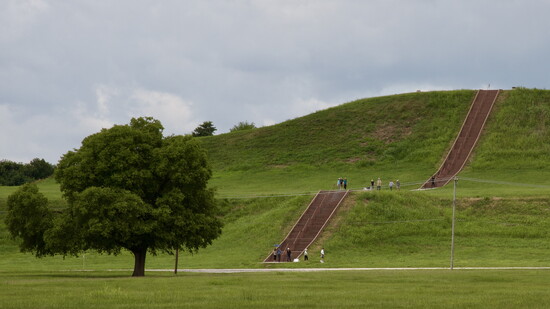
My husband and I had climbed to the top Monks Mound, the largest prehistoric earthen construction in the western hemisphere. Built over a period of 300 years around the end of the first century CE, Monks Mound is 100 feet tall, 700 feet wide and covers 14 acres.
Monks Mound is the highlight of Cahokia Mounds, an Illinois state historic site and UNESCO World Heritage Site. About 15 minutes east of St. Louis, Cahokia is a great day trip during your next visit to St. Louis.
I’m ashamed to say that I grew up within a 90-minute drive from Cahokia and have visited the region all my adult life, but it took the pandemic for us to find our way to this 2,200-acre parklike setting. That was key at the time – being outside, away from others. But we were desperate to travel, to experience something new.
Cahokia Mounds allowed us more than that. It impressed.
You may be one of those people who have been to Effigy Mounds National Monument in eastern Iowa. So, why, you may be thinking, should you go to Cahokia, Illinois?
The short answer is this:
Cahokia was built at a different time by different people for a different purpose.
And while Effigy Mounds is a national park and Cahokia Mounds is a mere state historic site, they are equally well presented with an equally compelling story of human history in the Midwest.
Experts estimate that, about 1,000 years ago, at least 20,000 people lived in Cahokia. Some estimate nearly 50,000. Either way, it was the largest community in North America at the time.
“Cahokia was a city with all of the problems of a city, such as feeding and housing that many people,” says Bill Iseminger, an archaeologist who worked at the site for nearly 50 years. “The demands of finding wood for homes and for cooking, for feeding so many people for hundreds of years was a complex task.”
The Effigy Mounds were built in the Woodland era, which was a little earlier than Cahokia. As society evolved, it became more complex with social structure and dedicated roles for individuals. You can see this in Cahokia.
The Effigy Mounds were also used to honor their clan animals. Some of the mounds in Cahokia were built to elevate their leaders. Others were used for religious ceremonies and for burial purposes.
At one point, Cahokia covered more than 4,000 acres with 120 mounds. Today, the state of Illinois protects 2,200 acres and 72 mounds. It is the largest prehistoric Indian site in the U.S. and Canada.
“I think most visitors, even professionals, have a hard time grasping how big it was and how advanced the social and economic structure was,” says Bill.
Another distinction at Cahokia is Mound 72. At a little over seven feet high, it’s not that impressive to look at. It’s what they didn’t find inside that puzzles the minds of even the most experienced archeologist.
The mound technically covers three smaller mounds and pits. In those spaces are the remains of many people.
The space included more than 15,000 shell beads, 800 arrowheads that had never been used, rolls of copper and other items.
Mound 72 appears to be on the center line of the community. It also aligns with the summer and winter solstice.
"There is nothing else like Mound 72 anywhere in North America," says Bill.
This and more are explained in the historic site’s interpretive center, which has recently undergone a major renovation. While the grounds and the walking trails through the various mounds are open every day, sunup to sundown, the interpretive center is not expected to be open until September 1.
Call ahead for confirmation: (618) 346-5160; www.cahokiamounds.org.
While you are on the Illinois side of the Mighty Mississippi, you might enjoy the view from the Lewis and Clark Confluence Tower in Hartford, Illinois. From the top of the 150-foot tower, you can easily see the Missouri River flowing into the Mississippi. It is the path that the Corps of Discovery navigated in the spring of 1804 as they began their two year journey up the Missouri, past Kansas City, in an attempt to find a water route to the Pacific.
This tower has also just reopened after a renovation. As you make your travel plans, note that the Confluence Tower is open Thursday through Sunday. Learn more about the area at www.riversandroutes.com.