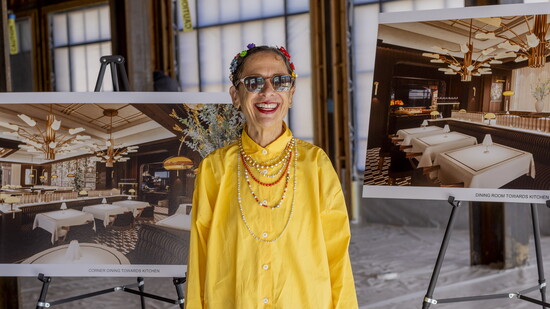
When Nancy Silverton hops on a Zoom for this interview, she is exactly where one might hope to find one of America's most influential chefs: in the dining room at Chi Spacca, her intimate, meat-centric restaurant at Melrose and Highland, surrounded by plates of food. But today, Silverton isn't simply overseeing the eatery that has become one of the most distinctive in her collection at Mozza Restaurant Group. She and her team are testing dishes for what comes next: Spacca Tutto, the highly anticipated Italian American steakhouse she is preparing to open at Palisades Village this month. Throughout the conversation, Silverton periodically breaks away as new dishes arrive at the table. "I like the spice," she tells her team while considering one plate, but wonders whether the vinaigrette underneath should be thicker. Homemade Ritz-style crackers are being tested to accompany a spinach-artichoke dip. "I love that. I think we should also do potato chips there," she says, already thinking about another possibility: "with onion dip. As a bar snack?" Later, a plate of mushrooms catches her attention. "Wow, that looks great," she says. "That mushroom really looks great." She tastes, studies and adjusts, debating salt, texture, portion size and presentation before seamlessly returning to a conversation spanning more than four decades of her career. "Oh, yes, absolutely," she says when asked if she is still always this involved in the process. "And I will be."
It is an illuminating glimpse of Silverton at 72. And somehow, at a point when another chef might be contemplating slowing down, Silverton is experiencing another remarkable period of expansion and recognition. This year, she received the James Beard Foundation's Lifetime Achievement Award—another extraordinary distinction in a career already filled with them—and was named to the prestigious Time100 list of the most influential people around the world. Meanwhile Max & Helen's, the nostalgic Larchmont diner she developed with Somebody Feed Phil creator Phil Rosenthal, has become one of the city's most talked-about dining destinations. Her restaurant empire now stretches around the globe, from Singapore to Lanai, Hawaii, with an upcoming project in Bozeman, Montana. Yet perhaps her most meaningful new opening is much closer to home. After decades with much of her restaurant world centered around Melrose and Hollywood, Silverton is coming to Pacific Palisades for the first time.
Silverton's story doesn't begin with a child dreaming of becoming a chef. Born and raised in Los Angeles, her strongest early memories of food have little to do with any particular dish. "My memory is about sitting at the table with my family," she says, recalling how her mother, a television writer, prepared dinner every night. "And that was much more important than the food." Cooking arrived almost accidentally: in college, she began working in the dormitory kitchen, initially as a way of meeting a boy, and discovered instead how much she loved feeding people and working with her hands. She left college during her senior year for Le Cordon Bleu in London, then landed at Michael's in Santa Monica—one of the restaurants at the forefront of the emerging California cuisine movement—where pastry happened to be the only opening in the kitchen. "Pastry was definitely the part of the kitchen that I didn't want to be in," she says. She took the position assuming she would eventually move to the savory side. Instead, pastry became her path.
Working at Michael’s during chef Jonathan Waxman’s tenure, Silverton found herself among a generation of young cooks helping define a new style of American dining. “We were all figuring it out as we went, and I loved it,” she says. From there, she followed chef Mark Peel, her future husband, to a new restaurant on the Sunset Strip being opened by Wolfgang Puck. That restaurant was Spago and the year was 1982. Puck was not yet the international celebrity he would become, and Silverton had no idea what the restaurant would become either. But as Spago’s pastry chef, she emerged as a culinary talent in her own right, working in an environment she remembers as inclusive, collaborative and remarkably free. Her years at Michael’s and Spago, she says, were a “wonderful, wonderful experience” that she wouldn’t trade for anything.
Following a brief move to New York, Silverton and Peel returned to Los Angeles to create something of their own, opening La Brea Bakery in January 1989, followed by Campanile that June. The bakery's hearth-baked artisan loaves became a phenomenon that helped introduce a style of bread now ubiquitous in Los Angeles. "I don't want to say that I invented that bread because I certainly did not," she says, "but I did help promote it and help make it popular and certainly helped bring it to Los Angeles." Campanile, meanwhile, became one of the defining Los Angeles restaurants of its era. After she and Peel’s paths diverged, Silverton embarked on her next chapter, opening Pizzeria Mozza in 2007 with its celebrated wood-fired pizzas, followed later that year by Osteria Mozza, a more refined Italian restaurant anchored by Silverton’s signature mozzarella bar. Osteria Mozza earned a Michelin star, and the Mozza name grew into an international collection of restaurants. In February 2013, Silverton opened Chi Spacca next door—an intimate Italian steakhouse centered on meat, fire and exceptional ingredients, and the direct precursor to what’s coming to Palisades Village. Along the way, Silverton’s influence has extended well beyond her restaurant kitchens. She has authored 11 cookbooks spanning nearly four decades, from Desserts and Breads from the La Brea Bakery to The Mozza Cookbook, Chi Spacca and The Cookie That Changed My Life, and ventured into products with Nancy’s Fancy, her line of gelato and sorbetto. She also serves as Culinary Ambassador for The Farmhouse at Ojai Valley Inn, helping shape its culinary programming and bringing together acclaimed chefs for intimate dinners, demonstrations and special events. In 2017, her profile grew even further when she became the subject of an episode of Netflix’s acclaimed documentary series Chef’s Table, introducing a much wider audience not only to her food, but to the obsessive attention to detail that has defined her career.
For all Silverton has done in Los Angeles, the westside has remained conspicuously absent from the restaurant empire she built after her formative years at Michael’s. She’s lived in Hancock Park since the early 1990s, and her professional life has stayed centered there, in Larchmont, Melrose and Highland. Rick Caruso had for years approached her about a concept at The Grove. “It was just very challenging because it was too close to what I had here,” she says. Pacific Palisades was geographically different—but after the January 2025 fire, the opportunity became about much more than expanding her restaurant footprint. The devastation extended far beyond the loss of homes and businesses, taking with it many of the familiar places and gathering spots that help make a neighborhood feel like home. The idea that a restaurant could play even a small role in bringing some of that life back resonated with Silverton. “It was such a wonderful way to contribute to the rebirth of that neighborhood that drew me in to having a restaurant there,” Silverton says. When Caruso approached her about joining the reopening of Palisades Village, little pitch was needed. “That’s all he really had to say,” she recalls. “It wasn’t like you had to explain to me the devastation.” In fact, Silverton is candid that without the fire, she probably wouldn’t be opening a restaurant in Pacific Palisades at all. “I don’t think I would have done it,” she says of an ordinary-circumstances pitch. “But in this case, I said, yes, I would love to hear more.”
The resulting Spacca Tutto—located in the former Draycott space and designed by AvroKO—takes the DNA of Chi Spacca and translates it for a different place, scale and purpose. "I didn't want to call it Chi Spacca because I felt there would be too much comparison," she says. "But we still wanted 'Spacca' in the name." Spacca Tutto evokes the feeling of "let's go" or "come on," and gave her team "the opportunity to bring some of the classics of Spacca but make it much more," she says. Where Chi Spacca is intimate and highly specific, Spacca Tutto will be a broad, generous Italian American steakhouse built to function as a true neighborhood restaurant. Silverton says Caruso was intent on bringing an unmistakably local culinary voice into the Village. “I think he wanted a Nancy Silverton restaurant,” she says. “He wanted a brand that people recognized as being part of Los Angeles.” Silverton uses the word “steakhouse” to describe it, although her definition is revealing. “To me a steakhouse is not just where I’m going for steak,” she says. “It’s where I’m going for large choices, and a big menu.” There will certainly be plenty of steak—the team is working through eight to 10 different cuts, sources, sauces and butters—but the larger idea is comforting abundance. "It's familiar," she says. "Everything will be familiar." However, that certainly doesn't mean ordinary: classic steakhouse sides like creamed spinach, potatoes and a wedge salad are being reconsidered through her lens, with the same rigorous sourcing found throughout her restaurants. "There's no magic and no secrets," she says. "It's just well sourcing, well-chosen and well cooked."
That same instinct for familiarity drives Max & Helen's. "It's food that people want to eat," she says. "It's that familiar component that people love." After decades at the forefront of American food culture, she isn’t interested in novelty simply for the sake of novelty. Instead, she has repeatedly taken foods people think they already understand—bread, pizza, mozzarella, salumi, steak—and demonstrated just how memorable they can become when ingredients and execution are taken seriously. That approach has made her one of the defining figures in Los Angeles dining, a city she believes draws chefs from around the world not only to eat but "to be inspired by our community." Yet she still speaks about her own accolades with a certain disbelief. "All I wanted to be was a cook," she says of her early ambitions. "I didn't even think about the idea of ever owning a restaurant. Everything else has been one unexpected achievement."
Perhaps that is what makes Spacca Tutto such a fitting next chapter in Nancy Silverton’s career. More than 40 years ago, she discovered almost accidentally that feeding people gave her satisfaction. Since then, she has helped change the way Los Angeles eats while creating restaurants that have become part of the fabric of the city itself. Now, she is opening another spot not because she necessarily needed or even planned to open one, but because this particular restaurant, in this particular community, felt worth saying yes to. “A restaurant is just not a place to feed people,” Silverton says. “It’s a place for people’s memories and a place for people to celebrate.” In a community rebuilding both its homes and its gathering places, it’s hard to imagine a more fitting place—or moment—for her to create another one.
Spacca Tutto
15255 Palisades Village Ln., Pacific Palisades
spaccatutto.com