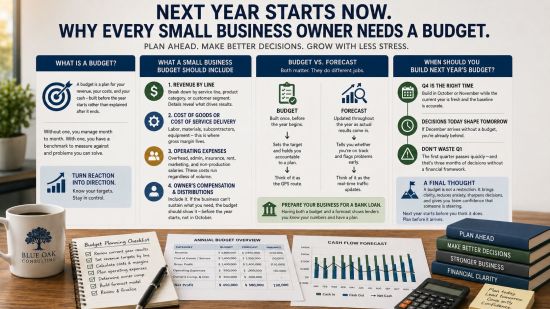
Budget is one of those words that makes small business owners uncomfortable. It sounds corporate. It sounds like extra work. It sounds like something you build once and ignore when reality does not cooperate.
None of that is true when it is done right. A budget is simply your best thinking, written down, about what the next 12 months should look like. And for a small business owner trying to stop reacting to financial problems and start planning ahead, it is the most valuable document you will build all year.
What Is a Budget and Why Does Every Small Business Need One?
A budget is a plan for your revenue, your costs, and your cash - built before the year starts rather than explained after it ends. It is not a prediction. It is a decision about where you want to go and what it will cost to get there.
Without one, most small business owners manage month to month. A strong month feels good. A slow month creates panic. The difference between the two rarely gets analyzed because there is no benchmark to measure against. A budget creates that benchmark. It turns "this month was bad" into "we came in 12 percent below our service revenue target and here is why" - which is a problem you can actually solve.
What Should a Small Business Budget Include?
A practical budget for a small business in the $500K to $25M range does not need to be complicated. It needs to cover four things:
Revenue by line. Break your expected revenue down by service line, product category, or customer segment - whatever makes sense for your business. Lumping everything into one number hides problems and makes the budget almost useless as a management tool.
Cost of goods or cost of service delivery. What does it cost to produce what you sell? Labor, materials, subcontractors, equipment - these belong here. This is where gross margin lives, and gross margin is the most important number on your P&L.
Operating expenses. Overhead, admin, insurance, rent, marketing, and salaries for non-production staff. These are the costs that run regardless of revenue volume.
Owner's compensation and distributions. Many small business owners leave this out entirely. That is a mistake. If the business cannot sustain what you need to take out of it, the budget should surface that truth before the year starts - not in October.
What Is the Difference Between a Budget and a Forecast?
A budget is built once, before the year begins. A forecast is updated throughout the year as actual results come in. Both matter, but they do different jobs.
The budget sets the target and holds you accountable to a plan. The forecast tells you whether you are on track to hit it and flags problems while you still have time to respond. Think of the budget as the GPS route and the forecast as the real-time traffic updates - you need both to arrive where you intended.
For small businesses preparing for a bank loan or a line of credit, having both documents ready is one of the clearest signals a lender looks for. It says: this owner knows their numbers and has a plan.
When Should a Small Business Build Its Budget for Next Year?
The fourth quarter is the right time - ideally October or November, before the year closes. Building the budget while the current year is still fresh gives you the most accurate baseline. You know what worked, what did not, and what is likely to change.
If December arrives without a budget for next year, you are already behind. The first quarter tends to pass before the plan catches up - and that is three months of decisions made without a financial framework to guide them.
A Final Thought
A budget is an act of intention. It is a declaration that you have thought carefully about where the business is going, what it will take to get there, and what you are unwilling to let slide along the way. That kind of clarity does not just improve financial performance. It reduces anxiety, sharpens decisions, and gives the people around you confidence that someone is steering.
Next year starts before you think it does. The owners who win are the ones who plan before it arrives.
Chris Thomas is the founder of Blue Oak Consulting, a fractional CFO firm serving small businesses across North Texas. Visit www.blueoakconsulting.net to learn more.