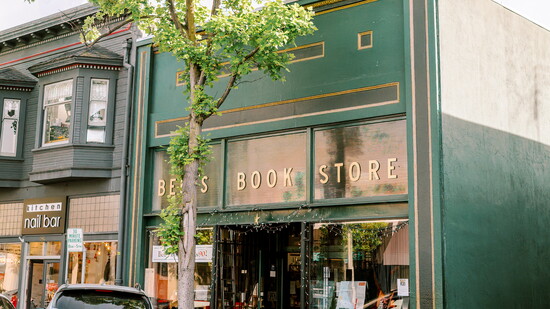
In the spring of 1935, a twenty-four-year-old named Herbert Bell drove up from Los Angeles in a station wagon full of books. He had come to Palo Alto with his employer, a book dealer named David Lawyer, for the students at Stanford. A year later, Lawyer decided there was no money in selling books to students and sold his share to Bell for twenty-three hundred dollars. Bell, who was fond of understatement, said he "went singing his way into poverty, and lived on hamburgers for some time."
What followed was ninety years.
The shop moved a few times before it settled. It landed on 536 Emerson in 1938, moved to 408 University during the war for book drives, and spent two years at the Cardinal Hotel on Hamilton, where ceilings tall enough for the shelves and ladders became the shop's signature. In 1950, the Bells bought 536 Emerson Street outright. Built in 1924, the building has egg-and-dart molding, marble along the base, pressed tin ceilings, a period staircase, a skylit balcony, and tiny LP listening rooms. In 1988, the city designated it Category Two on the Historic Register.
Palo Alto in 1935 was a small agricultural town. The word "startup" meant a car that needed a crank. Bell's was there when the semiconductor industry took root around it: when Hewlett and Packard were working out of a garage nearby, when Stanford tore up a parking lot and built a research park, and when the orchards gave way to office blocks. The shop did not protest any of this. It did not, so far as anyone can tell, change its ambiance very much either.
The fragrance of gilt leather bindings and antique linen rag pages evokes another time. You come in, and your shoulders drop an inch before you notice.
Bell's sells new books, used books, and rare books. More than one hundred fifty thousand of them, across five hundred subject categories, with an emphasis on literature and history. What Bell's offers, actually, is a stretch of thirty minutes in which nothing is asked of you. The books are not trying to convert you, though they can be persuasive. Someone will come down a ladder eventually with a first edition you were not looking for, and you will take it home.
The shop has more books than fit, which is a condition some bookstores apologize for and Bell's simply accepts. As they bring in thousands monthly, it takes time to sort, research and shelve. This year alone, Bell's purchased ten personal libraries from Stanford professors. Scholars wait for the latest offerings: seventy boxes of Medieval history, signed Steinbeck first editions, early Darwin titles, and, this month, first printings of Tolkien, Asimov, Bradbury, and Stephen King.
The shop is in its second generation. Faith Bell, Herbert's daughter, came back from a decade in Canada in 1983 and worked alongside her mother, Valeria Bell, for thirty years and now is the owner. Her husband, Christopher Storer, a retired philosophy professor, acts as bookkeeper. Employees stay long. Barbara Worl worked the shop for fifty-five years, a noted rosarian with two roses named for her. Tarna Rosendahl is in her 19th year; her daughter Emma covers Saturdays. Kris Falk, Kevin Shlosberg, and Dave Coon have decades of bookselling experience between them. Ninety years after Bell arrived in Palo Alto, the shop is still there. Still family-owned. Still independent. And now, the only bookstore in downtown Palo Alto.
A bookstore is a peculiar kind of business. It does not scale. It pivots, to reflect the interests of its community. The industry around Bell's has spent ninety years learning new verbs. Bell's has mostly stuck with the old ones: tended, kept, found, read.
Things have moved fast here, for a very long time. Bell's has not. It has kept a room where a certain kind of quiet is possible, and a certain kind of attention. It has sold books to three generations of the same families, while welcoming newcomers from all around the world. The ladders still work. The floorboards still do what floorboards are supposed to do. There is in a town that prizes disruption, something almost subversive about a place that refuses to be disruptive.
You should go. Bring a little time. Look up.
A bookstore is a peculiar kind of business. It does not scale. It pivots, to reflect the interests of its community.
There is, in a town that prizes disruption, something almost subversive about a place that quietly refuses to be disrupted. The ladders still work.