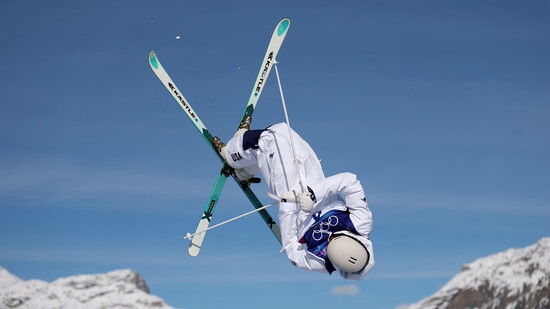
Is there a singular, secret sauce fueling the competitive spirit of every athlete? Three elite Durango athletes sound off on training, tragedy, big sisters, and some other surprise ingredients. Meet Charlie Mickel, an Olympian freestyle skier specializing in moguls; Kyle Krieckhaus, an up-and-coming juggernaut in pro disc golf; and Noah Blue Elk Hotchkiss, a mono-ski and wheelchair basketball national champion.
Q: What sparked your passion for sports?
For Krieckhaus and Mickel, older sisters led the way. Krieckhaus’s passion for disc golf surged during the COVID pandemic. It was the family’s escape hatch from lockdown, but for him, it also sparked a friendly sibling rivalry. He recounts, “My older sister was better than me at disc golf, apparently. And the story goes that I had to play more and get better to beat her.” In fact, he got so good that he’s now ranked among the top 1,000 pro players, fifth best among all college players, and won his division in the recent Collegiate National Disc Golf Championships.
Mickel notes that his parents were avid skiers, and as such, the kids learned to ski before they learned to ride bikes. With an older sister on the U.S. Ski Team and a win at the Junior World Championship as a teen, Mickel felt inspired to be like her…or maybe even better. “I’ve been a three-time National Champion, won the North American circuit, podiumed at a World Cup, and I’ve been to the Olympics,” he says, but notes that he can’t catch her on academics now that she holds a doctorate in clinical psychology.
Tragedy on an unthinkable scale ushered Noah Blue Elk Hotchkiss into competitive downhill skiing and professional basketball. A life-altering accident took his stepmother's life, left Noah paralyzed from the waist down, and hospitalized his brother and sister with severe injuries. He was only 11 years old. Many months later, Hotchkiss discovered mono-skiing through the Adaptive Sports Association. He went from never having skied before to ripping down mountains on a Sit-Ski adaptive device, and on to winning many awards and a national title in downhill ski competitions!
For a time, he trained with Paralympians, until another sport won Hotchkiss’s eternal devotion: wheelchair basketball. He confesses, “I didn’t even know that it existed until I went to an adaptive sports camp.” Before long, Hotchkiss rose to become a national champion and received a full-ride scholarship to play for the University of Illinois, where he made the All-American team.
Q: How much do you train and what are your goals?
Currently, Krieckhaus juggles his training and college class schedules. “I normally go to the gym five times a week. I play tournaments on [weekends].”
However, give him a basket and a disk, and he’ll putt for hours. As a youngster, traveling with parents who taught abroad, Krieckhaus has lived in about seven countries so far. He spent two years in Hong Kong with nowhere to play disc golf—except in the family’s apartment or in a rented room at a gym. This year, he’s angling for a top ten finish at a pro tour event and is looking on track with some first-place podiums already secured.
Mickel adheres to an arduous protocol with four days on and one day off. “On” days demand a whopping five hours of training that mixes weightlifting, cardio, and water ramping, which involves blasting down a ramp paved with a furry plastic grass to simulate icy snow. The skier vaults off the ramp and flips, twists, and pretzels in various acrobatic stunts.
With the next Winter Olympics a long way off in 2030, Mickel is looking forward to concentrating on perfecting his mogul techniques. “It's a lot of stress with the pressure of competing, and there's a ton of travel,” he explains. In the lead-up to the 2026 Winter Olympics, Mickel bounced among Austria, Chile, Finland, Canada, the U.S., Finland again, Italy, and Japan.
Hotchkiss maintains a consistent training regimen while also playing with the National Wheelchair Basketball Association (NWBA) for the Utah Wheelin’ Jazz. He weightlifts three days a week and shoots hoops five days a week. In college, he could devote upwards of six hours a day to training and playing, but now he must balance his time with a full-time career leading the Tribal Adaptive Organization, which he founded at age 17! The TAO provides national outreach to connect Native American youth to adaptive sports opportunities. And if that weren’t enough, Hotchkiss has set his sights on qualifying for the 2028 Paralympics in Los Angeles. “I’m working on getting stronger. I’m feeling good! I’m feeling ready!”
Q: How has athletic competition changed you?
Krieckhaus has developed a more Zen-like mindset. He cares less about winning or losing. He explains, “It’s not about performance. It’s the process. Did I put my best self out there? Did I stay in the present moment?” He goes on, “You can't change the future because it's not the future yet, and you can't change the past because it's already happened. All you can do is try to make the present the best it can be.”
Mickel notes that he has cultivated unshakable patience thanks to the daily routines and consistent habits woven into athletic training. He says, “It's like what you do every day and like the small things that add up to make a big difference. If you're trying to move in a steady direction, a little baby step every day is going to get you a lot farther than one big leap.”
“Sports is medicine,” Hotchkiss declares. “It was my medicine. It helped me heal from trauma.” Athletics radically altered how he saw himself following the accident. He was no longer a disabled person; instead, he was a serious athlete. “Nowadays, I’m an athlete. I’m an educator. I wear a lot of different hats and disability comes last,” he says, suggesting inadvertently that the biggest victory for any athlete is not necessarily one that appears on the scoreboard, but rather, one that occurs internally—a quiet triumph of spirit.