It’s a humid summer morning, and a rush of cool air hits me as I step into Café Melba. All around me is the sound and smell of a restaurant that sleeps – before the prep crew arrives to chop and dice, before the ovens kick on, before the front-of-house staff slinks in. The scents of fry oil, degreaser, and Fabuloso compete for my attention, and I’m instantly transported back to the many evenings I spent waiting tables after college – slicing lemons, balancing martini glasses, rolling silverware, flirting with line cooks, and subsisting on nothing but free bread and Diet Pepsi.
Restaurants are nostalgic spaces. For Dan Kardos, owner and chef at Café Melba, they are all he’s ever known.
“I’ve worked in restaurants since I was fifteen,” he tells me that morning. “I’ve done every job – dishwasher, server, cook, even corporate strategy. I’ve opened five or six other restaurants, but this is the first one I’ve done entirely on my own, and according to my own vision.”
We’re sitting at a table in Melba’s outdoor courtyard. The space is intentionally reminiscent of the ruin bars of Budapest's old Jewish quarter – bars built into buildings left in rubble after the devastation of the 1940s and '50s, later reclaimed by young artists who filled them with color and eclectic furniture. Nothing matches on purpose. The walls are covered floor to ceiling in art, almost all of it local: sculptures from Tony Jabornik, a Czech Republic native who lives up the street; paintings from local artists Gigi Motley and John Tarka; murals by Jess Ortega across the parking lot at the laundromat and ice cream shop; pieces Kardos has picked up on his own travels through Europe. “There’s never enough hanging up,” Kardos tells me, surveying the walls. “There’s always room for more.”
Kardos, 45, fits well in this space: an amalgamation of aesthetics himself, he dons lime green athletic shorts, a black Café Melba T-shirt, a le petit laundry baseball cap (the name of the laundromat he owns across the street), and gold wire-rimmed glasses. Every now and then he swirls his iced coffee from Scratch Baking or smooths his reddish-brown facial hair. He talks with his hands and seems to have trouble sitting still.
After growing up in Stratford, Kardos graduated from the Culinary Institute of America in 2000 and landed a job at the Waldorf Astoria in New York before he was even twenty. Then came September 11th, which shut down that part of the city and cost him his place on staff. "I could wait to get my job back, or I could figure it out," he says. He chose the latter, bouncing between kitchens until he met Bill Taibe, who ran a restaurant called Relish on Washington Street, right as South Norwalk was becoming one of the region's hottest restaurant scenes. "There were no restaurants in Westport at that point. Nothing in Stamford. Barcelona wasn't even open yet," he recalls.
What followed was two decades of kitchens up and down the East Coast. He spent years with the Barteca Group opening Bar Taco and Barcelona locations, helped open The Whelk in Westport, and eventually took over the kitchen at Harvest Supper in New Canaan, owned by well-known New York restaurateurs Jack and Grace Lamb. Later he headed south, eventually landing a research-and-development chef role with a large hospitality group that ran seventeen restaurants, bakeries, and breweries. By his own account, it was a great job – and one he wasn't built for. "I didn’t fit in. I can't have a boss," he says simply.
That restlessness eventually pulled him back to Connecticut, when friends who'd bought a dive bar in Milford called and asked for help with the menu. That partnership turned into Liberty Rock, a Milford bar that ran for nearly a decade before closing recently when the building was sold.
By the time the pandemic had passed, Kardos and his wife Julie were living just up the street from a small strip that included a vacant juice bar. He wasn't picturing a restaurant. "Honestly, it was the courtyard that drew me in," he says. "I thought it'd be cool for a low-key, neighborhood, off-the-radar kind of place." His real plan, he says, was something closer to a private studio – a space for cooking classes, the occasional themed dinner, maybe a cigar night – with a restaurant as an afterthought. The day the space went vacant, he pulled over when he saw the property manager hanging the for-lease sign and asked them to take it right back down.
Café Melba opened in October of 2023 with no sign, no website, and no phone number. It’s been packed ever since.
But Kardos affirms that his lack of marketing has more to do with functionality and economics than it does mystique.
"For the first year, even two, people would ask why I didn't have a sign," says Kardos. "But you found the place. You got here. What do you need a sign for?" It started, he admits, as simple privacy – he didn't want industry friends banging on the door asking what he was building while he still had tools in his hands. But once the restaurant opened, the mystery became its own kind of marketing. People noticed the unmarked building and asked around. Word spread. The sign that does exist is nailed to the fence out back, more relic than advertisement. As for the phone number, Kardos says matter-of-factly: "Staff is expensive, and we change the menu all the time," he says. "If I'm not taking reservations, why do I need a phone number?"
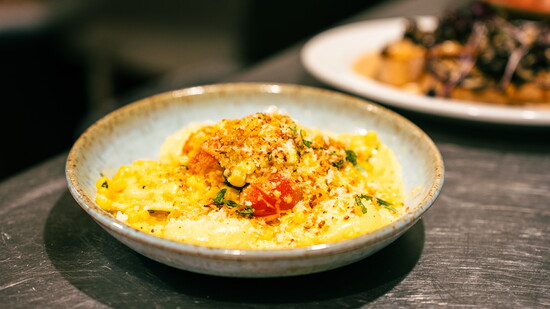
The menu is built around European small plates – French, Spanish and Italian dishes like duck confit and escargot, given what he calls "a little modern spin" and a rotating cast of seasonal ingredients. About five items stay constant; everything else changes often, partly because ingredient pricing shifts and partly because Kardos likes to keep experimenting. In the cooler months, he also runs hands-on classes in pasta-making, mozzarella, and risotto – all taught by Kardos himself.
Running the business, Kardos has learned, means resisting the urge to simply do more. Café Melba is currently open just three nights a week – Thursday, Friday and Saturday – after Kardos discovered that adding a fourth day didn't grow revenue so much as spread the same sales across more overhead. Thursdays now carry a standing deal: half-price wine bottles and ten-dollar sandwiches, a promotion that reliably fills the room.
What he wants, he says, are guests who come back two or three times a month – neighbors, not tourists chasing a deal. Reservations are reserved for parties of eight or more, both because the restaurant's outdoor space is weather-dependent and because Kardos wants to preserve a come-one, come-all feel rather than exclusivity. Weekend daytimes, when the restaurant is closed for regular service, are given over almost entirely to private events – baby showers, bridal showers, and birthday parties booked at prices he keeps deliberately reasonable.
That sense of neighborhood runs through nearly everything Kardos describes. Longtime customer Robin Kramer hosted her son's wedding at the restaurant; her husband Ken now leads a jazz night in the courtyard once a month, an event that fills the outdoor space with regulars and newcomers alike. Kardos has also shown up at the local farmers market to buy ingredients from vendors and cook them on the spot for anyone watching. "I've never had that before, where people know where my house is and I know theirs," he says of settling into Milford. "That sense of community is really what I've taken away from this place."
Next door, Kardos is also slowly building out Melba Crème, an ice cream shop housed in a former bakery he took over across the parking lot, now outfitted with a full kitchen and a new pizza oven. Seasonal staffing and unpredictable weather have kept its hours limited so far, something Kardos hopes to expand in time.
For now, though, his focus stays on Café Melba itself. He has no interest in opening another restaurant in town until this one feels finished, even though, he admits, it probably never fully will. “I’m in the kitchen every day,” he shrugs. “I’m a decent chef – there are plenty better than I am, of course, always – but people seem to like what I’m doing here. I try to keep that quality consistent.”
Asked what makes a good restaurant owner, he doesn't hesitate: understanding your customers, understanding your product, and staying willing to adapt. "If you don't have a real understanding of food, which is what you sell at a restaurant, you're in trouble," he says. “And that goes beyond knowing what tastes good. You also have to know what things cost, what you can get when, and what the people you’re serving actually want.” It's a lesson Kardos has learned across three decades and multiple restaurants, and a lesson he’s prepared to apply to Café Melba for the foreseeable future.
“My landlords really took a chance on me,” he reflects at the end of our conversation. “They gave me a shot, and what came out of it is my interpretation of what a restaurant can be, not necessarily should be.” He pauses, nodding slowly, looking around, and taking in what he has built over the last three years. “This is what works for me, what works for this community. I’m proud of it.”
"Honestly, it was the courtyard that drew me in. I thought it'd be cool for a low-key, neighborhood, off-the-radar kind of place."
"I've never had that before, where people know my house and I know theirs... That sense of community is really what I've taken away here."
IF YOU GO
Café Melba, 232 Melba St., serves modern European small plates Thursday through Saturday: Thursday from 5 to 9 p.m., Friday and Saturday from 5 to 9:30 p.m. There's no sign out front and no phone line — the front door is the only way in. The menu changes often depending on what's in season, though regulars can usually count on finding breads and spreads, salads, meat, and seafood year round.
Thursdays carry a standing deal: half-price bottles of wine, plus a $10 burger and $10 chicken sandwich.
Seating includes an outdoor courtyard, but the area is weather dependent, so plan accordingly if the weather turns. Reservations are accepted only for parties of eight or more; smaller groups are seated on a walk-in basis. Private parties, including bridal showers, birthdays, and similar gatherings, can be booked for weekend daytimes, when the restaurant is otherwise closed to the public. Rates for these events are kept intentionally modest.
To see photos, upcoming events, or samples of recent menus, follow them on Instagram at @cafemelbact.
232 Melba St., Milford
Thurs 5–9 p.m. | Fri–Sat 5–9:30 p.m.