Somebody told you about spinal decompression. A neighbor in The Woodlands, a coworker, a friend who swears it fixed the leg pain nothing else touched. So you looked it up, and what you found was a wall of clinic pages that all say the same handful of confident things and none of which tell you what the machine actually does.
That is a fair frustration. Decompression is one of the most oversold treatments in this field, and the marketing around it has gotten loud enough to obscure a real and fairly simple piece of engineering underneath.
So here is the plain mechanical version. What the table does, how it differs from the traction rig your uncle remembers from the nineteen eighties, who it is a reasonable option for, and, just as importantly, who should not be on one at all.
What is spinal decompression actually trying to do?
Start with the disc, because everything else follows from it.
Each disc between your vertebrae is a pressurized structure. A tough fibrous outer ring, a gel core inside, and a resting internal pressure that is always somewhat positive because your spine is always carrying load. Standing loads it. Sitting loads it more than standing, which surprises most people. Bending forward with weight in your hands loads it a great deal.
When part of that disc pushes outward against a nerve root, two things are irritating the nerve at once. There is mechanical contact, and there is chemical irritation from the material itself, which is inflammatory to nerve tissue.
Decompression targets the first of those two, mechanically. The goal is to lower the pressure inside a specific disc for a period of time, and in some cases to bring that pressure below zero, which is what the word decompression refers to. The idea is that a segment held under reduced load behaves differently than one under constant compression, and that fluid moves more freely in and out of a structure that has almost no direct blood supply of its own and depends on that movement for nutrition.
That is the mechanism. It is a reasonable one, and it is not a cure for anything. It is a way of changing the mechanical environment around an irritated structure long enough for other things to work.
How is a computerized decompression table different from old pulley traction?
This is the question worth spending time on, because the answer is where most of the confusion lives.
Traditional traction is a straight pull. A strap, a cable, a weight or a hand crank, and a sustained load applied along the length of the spine. It has been around for a very long time and it is not useless. It has two real limitations.
The first is targeting. A general pull distributes force across the whole lumbar spine, and the segments that give first are usually the loose, mobile ones, not the injured one you are trying to reach. You can pull hard and still barely change the pressure at the level that hurts.
The second is muscle guarding. Pull steadily on a spine and the muscles surrounding it contract to protect it. That is a reflex, not a choice. Within about thirty seconds of a hard sustained pull, the paraspinal muscles tighten enough to absorb much of the force, and the disc underneath sees far less of it than the gauge suggests.
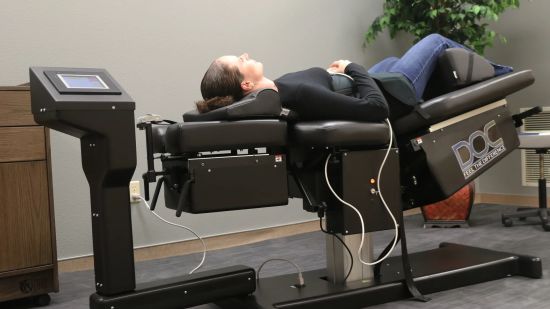
At HealthSource of Harper's Preserve, the decompression work is done on a DOC table, and both of those limitations are what the design addresses.
Targeting comes from position. The table sections move independently, so the angle of pull, the flexion or extension of the lumbar spine, and the pelvic position can all be set to concentrate force at a particular level, the one identified during your examination. An L5-S1 problem and an L3-L4 problem are not set up the same way. That is how a decompression plan is built around a specific spinal level rather than around the spine in general.
Guarding is addressed by the computer. Instead of holding a constant load, the system ramps force up and down through a repeating cycle, holding at a target tension, easing off, and building again. The cycling is meant to stay ahead of the protective reflex so the muscles never fully lock in. Sensors monitor resistance continuously and the system adjusts, so the force follows what your body is doing instead of overriding it. If you tense up, the load backs off.
That is the honest difference. Not a different category of treatment. The same physical principle, applied to a specific level, in a pattern the body does not fight.
Who is a good candidate for decompression, and who is not?
The candidates are reasonably well defined. Decompression is generally considered for disc-related problems. Contained herniations and bulges, degenerative disc disease with mechanical low back pain, sciatica or radiating leg pain driven by nerve root compression, certain kinds of foraminal narrowing, and failed conservative care where the mechanics were never addressed. Cervical discs can be treated on the same principle with different setup.
Now the part most clinic pages skip.
Decompression is not appropriate for everyone, and some conditions rule it out entirely. Spinal hardware including rods, plates, and screws is a common exclusion, because a distraction force applied across instrumented segments is not something to experiment with. Most fusions are the same, though the picture depends on the level and the surgery. Severe osteoporosis is an exclusion, since bone that is not carrying load well should not be pulled on. Pregnancy is an exclusion. So are spinal tumors, active infection, unhealed vertebral fracture, abdominal aortic aneurysm, and significant spondylolisthesis where the segment is already unstable.
There is also a category of symptoms that means you skip every option on this page and go to an emergency room. Loss of bladder or bowel control, numbness through the saddle region, or weakness in both legs that is getting worse quickly. Those are rare and they are genuine emergencies. A chiropractor should not be your first call for any of them.
Between the clear yes and the clear no, there is a real middle, and that middle is decided by examination and imaging, not by a phone call. Any office willing to schedule you for decompression before it knows which structure is involved is selling a table, not treating a problem.
What does a session actually feel like?
Undramatic, which is the goal.
You stay fully clothed. You lie on the table, usually face up for lumbar work, and a padded harness is fitted around your pelvis and lower ribs. The provider sets the angles, enters the parameters, and the cycle begins.
What you feel is a slow stretch through the low back that builds over several seconds, holds, and eases off, then repeats. Most people describe it as mild, and a fair number fall asleep. A session runs roughly twenty to thirty minutes. There is no incision, no needle, and no medication involved, and you drive yourself home afterward.
Some people feel looser immediately. Some feel mildly sore the first few sessions in the way muscles are sore after unfamiliar work. Neither reaction predicts much about how the overall course will go.
What does a course of care usually look like?
Decompression is rarely used by itself, and a clinic that offers only the table is offering half a plan. Reducing pressure at a segment without retraining the muscles that stabilize it tends to produce relief that does not hold. So sessions are typically paired with progressive rehabilitation, and where inflammation is a significant driver, Class IV laser therapy is often added to the same visit for the soft tissue around the involved level.
A course is measured in weeks, not visits, and it is front-loaded, with sessions clustered early and spaced out as things change. Be skeptical of a specific number quoted before anyone has examined you, and be more skeptical of a percentage.
A first visit at HealthSource of Harper's Preserve is $39, and it includes the consultation, movement screening, orthopedic and neurological testing, and imaging where it is warranted. What it produces is an answer about whether a disc is actually the source, and whether decompression is a sensible tool for your particular situation. Sometimes that answer is no, and sometimes it is a referral elsewhere. You want a provider willing to say both.
The realistic version
Decompression will not repair a spine, and nothing in this article should be read as a promise. What it can do, for the right candidate, is change the mechanical conditions at an irritated segment enough that rehabilitation becomes possible and daily life becomes tolerable again while the body does its own slower work.
That matters more than it sounds. Most people who come in for this are not chasing a perfect back. They want to sit through a drive from Conroe to Houston, get through a workday, sleep on their preferred side, and pick up a grandchild without calculating the cost first. Those are the goals worth measuring against, and for a good number of people in Harper's Preserve and the greater Woodlands area, they are reachable without an operating room.