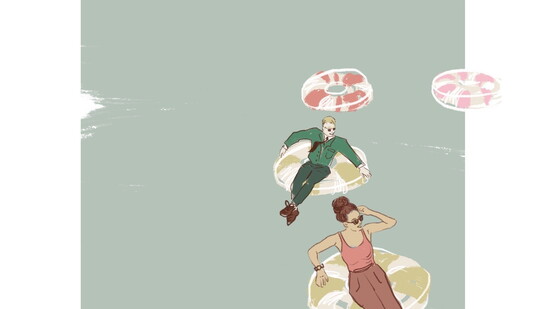
Boulder is a place where the everyday tends to bend. A commute becomes a float down a creek, a football kickoff starts with a bison sprint, and a fallen cottonwood turns into a library. History here doesn’t just sit in the past—it gets spoken, acted out, and revisited in places like Columbia Cemetery after dark. Across it all runs a shared impulse to turn familiar places into something more communal.
The Cottonwood Becomes a Library
A Landmark Tree Finds a Second Life as a Neighborhood Gathering Place
For decades, the towering cottonwood on West Pearl Street near 8th Street shaded the sidewalk, anchored the block, and became a neighborhood landmark. People stopped to admire its incredible size, and when the historic tree was removed after years of decline, many residents mourned its loss. The cottonwood even inspired community protests as neighbors hoped to preserve a piece of Boulder history.
Cottonwoods have long been part of the city’s residential landscape, especially along streets like Pearl, where mature trees helped define the character of older neighborhoods. As these trees age out due to disease, storm damage, or decline, some are removed for safety, while others are reused in small ways that preserve a trace of their presence in the community.
Today, the tree has found an unexpected second chapter. The remaining stump has been transformed into a Little Free Library, giving the old cottonwood a new purpose while keeping its place at the heart of the neighborhood. The project was led by resident Chess Piccione, who envisioned the stump continuing to bring people together.
Little Free Library, a nonprofit based in St. Paul, Minnesota, works to build community, inspire readers, and expand book access through a worldwide network of volunteer-run book-sharing boxes. The West Pearl library fits that mission naturally, offering neighbors a place to borrow a book or leave one behind.
The craftsmanship is filled with thoughtful touches. Inside, the shelves are made from pieces of the original cottonwood, preserving part of the tree in its new life. Elite Construction, the DeMatteo family, and Langley's Tree Specialist collaborated to build the library.
Its design also tips a hat to one of Boulder's most recognizable homes. The library's roof mirrors the historic Arnett-Fullen House next door, better known as the Gingerbread House. With its steep gables, decorative woodwork, and colorful roof tiles, the tiny library looks like a miniature version of its famous neighbor. The Arnett-Fullen House also inspired the setting for Marlys Millhiser's 1978 novel The Mirror.
Neighbors have already stocked the shelves with children's books and novels. It’s a fitting next chapter for a tree that spent generations bringing people together.
Tubing the Commute
A Creek Becomes a Floating Highway to the Office
Every city has its signature way of commuting. New York has the subway; Amsterdam has bicycles. One day a year, Boulder has a flotilla of professionals drifting down Boulder Creek in inflatable tubes before heading to the office.
Tube to Work Day began in 2008 as a friendly wager between two friends to commute without fossil fuels. Nearly two decades later, it remains one of the city's most distinctive traditions, bringing together engineers, entrepreneurs, teachers, students, and longtime locals for a morning that is equal parts transportation and community. Participants launch from Eben G. Fine Park wearing helmets and life jackets, with costumes enthusiastically encouraged, before floating downstream toward work. The event also raises money for local nonprofits, giving an otherwise whimsical commute a meaningful local impact. Now in its second decade, the event has become a fixture of Boulder's summer calendar, attracting participants from startups, established businesses, and every corner of the community.
For Race Director Lance Panigutti, the event captures something fundamental about the city.
"I've lived in Boulder for 20+ years and Tube to Work Day truly encapsulates what makes this city special: the quirky hippie counterculture fused with a modern tech scene."
He says the event reflects a thriving city, one that understands the best communities make room for both work and play.
"The year our theme was Mad Max was top-notch. We had one tuber in a fully decked-out Barbie jeep—Mad Max style! That was peak creativity, and we made sure he was our first tuber to hit the rapids,” Lance says.
Here, a morning on the creek can be the prelude to a day at the office. The organizers even describe it as "the world's greatest traffic jam," a title that's hard to dispute. Looking ahead, Panigutti hopes the tradition continues for the same reason it started.
"Over the years, the core of the event hasn't changed, a way to celebrate 'play and fun' in a safe environment with co-workers, friends, and fellow Boulderites,” Lance says. “I call it 'Burningman' by the creek because it requires us to step outside our usual day-to-day routine and embrace something unimaginable.”
He hopes the next generation preserves not just the tradition, but the philosophy that inspired it. "It's about taking a few hours every summer to join with friends and celebrate life-work balance!"
Ralphie Charges Folsom Field
A Live Bison Leads Game Day Into Motion
Before kickoff at Folsom Field, the game starts with a sprint. Not from a player, but from a nearly 1,000-pound North American bison named Ralphie, charging across the turf while a line of student-athletes runs alongside her.
Ralphie isn’t a sideline character. She’s the University of Colorado Boulder’s live mascot, guided by a team of student-athletes known as the Ralphie Handlers. The tradition dates back to the 60s, with next fall marking the 60th anniversary.
It started as a student project to bring a live bison to campus and somehow never stopped. Today, Ralphie VII carries it forward, cutting across the field in front of tens of thousands of fans, with handlers matching her stride just off to the side.
Ralphie lives at a private ranch in Colorado, where she is cared for year-round and conditioned for game-day runs. On football weekends, she is transported to Folsom Field in a custom trailer and handled on game days by her trained student team. The program operates through CU Athletics and follows detailed safety protocols, with coordination between handlers, stadium staff, and event personnel to ensure each run is carefully managed from start to finish.
The Ralphie Handlers are part of CU Athletics, and the program is one of the few live-mascot operations in the country with a varsity-level structure. Getting on the team is competitive in a very literal sense. Students go through tryouts that test fitness, judgment, and whether they can stay composed a few feet from a massive animal moving at speed.
Those who make it don’t show up on game day and figure it out. They train for months on strengthening, conditioning, teamwork, and animal behavior. And then more training with Ralphie herself, learning how she moves, when she hesitates, when she doesn’t. It happens fast enough that the rest of the game feels almost slower by comparison. One rush of movement across the field, and then the stadium returns to football.
Meet the Spirits
Voices From Columbia Cemetery Bring Boulder’s Past Into the Present
A living history experience held at Columbia Cemetery, Meet the Spirits is where volunteers step into the roles of people buried there and share their stories with visitors. The event is typically held every other year on an afternoon in early October at Columbia Cemetery, with scheduled dates released each season for visitors to attend.
“From its inception over three decades ago, Meet the Spirits has been lovingly crafted by dozens of volunteers who write their own scripts and, in many cases, do their own research about the people buried in the cemetery,” explains Melanie Julian Muckle of Historic Boulder Inc, which organizes the event with the City of Boulder Parks and Recreation Department. Much of that research begins with a name on a gravestone and expands through archival work.
They typically head to the Carnegie Library for Local History, where they sift through historical records to uncover details about a person’s life, family, death, and the role they played in a broader story of Boulder’s history.
Volunteers decide which details to highlight, but the goal is consistency with what is historically known. Melanie notes that the most effective stories illuminate the differences between the past and present but relate to themes that still resonate today, such as past epidemics and more recent public health experiences.
Some discoveries have changed how people understand Boulder’s history. One is that Columbia Cemetery has no racial segregation, meaning early Black citizens are buried throughout the grounds rather than in a separate section. Another well-known case involved research into a grave marked “Jane Doe,” which ultimately led to her being identified as Dorothy Gay Howard and brought closure to her family. Volunteer research has also extended beyond storytelling, including projects that evolved into published work and audio storytelling.
Some of the spirits have fans who come over and over to see them. The young spirits are really popular. “We’ve seen visitors become very emotional in hearing about the deaths,” Melanie says. “Visitors are encouraged to talk to the spirits. Asking them questions is a sure sign that the story is interesting.”
Melanie says the goal is to connect with the past to enrich our present and inform our future. “We hope visitors will come away with a sense of connection to the special place we live and work in… and a respect for the people who came before us,” she says.
Boulder Cruiser Ride
A Weekly Slow-Roll Celebration of Cycling and Community
The Boulder Cruiser Ride proves that not every bike ride has to be about speed. It's a more than 30-year-old Boulder tradition that brings people together for a relaxed ride through town, where the conversation is just as important as the cycling.
Unlike organized races or charity rides, the Cruiser Ride is centered on riding together. Riders roll through Boulder at an easy pace, leaving plenty of time to chat and enjoy the ride. While cruiser bikes inspired the event's name, every kind of bicycle is welcome. The emphasis is on joining the ride, following the rules of the road, and having fun.
The rides take place every Thursday evening from April through October. Riders gather at Greenleaf Park around 7 p.m. before heading out together at 7:30. The vibe is slow-paced, heavily themed, and welcoming to riders of all skill levels. Many rides also wind down with an informal outdoor dance gathering, extending the event after the bikes are parked.
Costumes are one of the ride's biggest draws. A different theme each time gives riders a reason to dig through the closet, raid the costume bin, or get creative with DIY outfits. This year's lineup has included Pride & Rainbows, Roaring '20s, '90s Night, Neon Rave, Animals/Zootopia, and Steampunk Wastelanders. The result is a colorful procession that's just as much fun to watch as it is to join.
Routes vary from week to week, but the spirit stays the same. Riders travel on public streets, obey traffic laws, and regroup along the way to keep everyone together. The relaxed format makes the event approachable for all types of participants.
Over the years, the Cruiser Ride has become a recognizable part of Boulder's cycling culture. It celebrates bicycles as more than transportation or exercise. For many participants, it's a chance to spend time outside, reconnect with friends, and meet new people.
Whether you show up fully decked out or simply wearing a helmet, the Boulder Cruiser Ride is a reminder that community doesn't have to be complicated. Sometimes all it takes is a bicycle, a shared route, and a few hundred neighbors ready to spend a Thursday evening together.
"I've lived in Boulder for 20+ years and Tube to Work Day truly encapsulates what makes this city special: the quirky hippie counterculture fused with a modern tech scene." — Lance Panigutti
“From its inception over three decades ago, Meet the Spirits has been lovingly crafted by dozens of volunteers who write their own scripts and, in many cases, do their own research about the people buried in the cemetery." — Melanie Julian Muckle