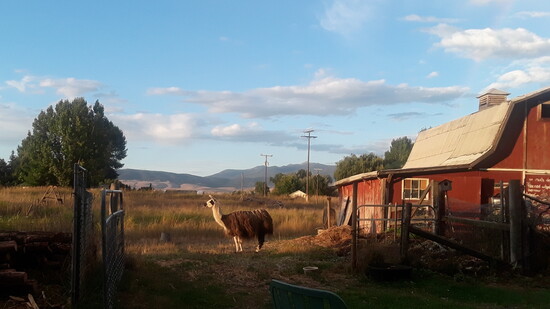
When my husband bought our home, the property came with some extras: a detached garage with a shop, a small barn, and a llama. That’s right, a female llama. Although we were the ones signing the deed, over the years we came to understand that we were just visitors on the land that she watched over for nearly 26 years.
We were told that the llama’s name was “Pancake.” I’m not sure how she got that name, but looking at her rough coat, it made sense. She hadn’t been sheared in a long time. Her hair had tangled into large, flat mats that draped her body like saddlebags. Since “Pancake” is also a comical term for dreadlocks gone wrong, it seemed like a good fit. To keep her company, my husband bought some chickens. I regularly lobbied for a pig. “Then we could have pancakes, bacon, and eggs,” I would joke.
After settling into our home, one of the first things we did was call a vet. A worn, sun-bleached halter dug into the front of Pancake’s long nose and, although we didn’t know much about llamas, we guessed that her toenails might be overgrown. These issues made sense. The previous owners cautioned that she had never let anyone close to her. We were told that she originally came from the old KOA petting zoo in Missoula and had been left traumatized. The day that the vet came, she proved them right. That morning, somehow we got her into the barn. However, when we tried to secure her to a post, she kept thwarting us with big swings of her substantial behind. Trust me, you do not want to get hit by a llama’s butt or get a spring-loaded kick in the shin with those long toenails. When Dr. Rollett Pruyn arrived, we were grateful and in awe at what he did next. This burly man lassoed our obstinate llama, clipped her toenails, removed the halter, and got some inoculations in her, all in under two minutes. Dr. Pruyn had brought his young son along that day, and the boy stood far back watching his dad work while Pancake made prehistoric bellows and spit green goo in protest. The boy looked up and exclaimed,“She’s a monster!”
Traditionally, llamas have been valuable resources by providing both work and wool. After that vet visit, though, any ideas we had of collecting wool from Pancake were definitely dashed. If we were to try shearing, her evasion of people meant that she would need to be tranquilized—and her age indicated that she wasn't likely to survive that. So, we let Pancake be. That doesn’t mean she wasn’t of great use, though. Llamas act as a kind of early-warning system by making a distinct call when they spot predators nearby. Ranchers often add them to herds for guarding livestock. On our tiny ranch, all we had were a few head of chicken, a goose, one cat, and two dogs. Still, Pancake did her job. I remember when I first heard that unique call. I jumped up in surprise at the odd sound. It wasn’t anything like that shriek we heard during the vet visit. For all the world, it sounded like the laughter of ducks. A picture formed in my head of a flock of ducks playing poker in the back field.
For many years, Pancake faithfully executed her self-appointed job by standing sentry in her back field. Eventually, we decided to open up the gate into our yard and let her retire in the green grass. She quickly took to her leisurely lifestyle. Several shade trees became good for sitting under while she chewed her cud. She also enjoyed the carefully chosen crop of perennial flowers I had planted. After much frustration, I surrendered to the idea that I was simply providing her with dessert. Even with these luxuries, though, she still kept a routine. In the mornings, Pancake sat in the front yard and watched as neighbors drove by on their way to work. Our neighborhood bus driver let us know how much he enjoyed seeing her on his daily route. In the evening, she returned to her back field to watch the sunset. She stood there, facing west, until the golden light faded from her face and it was time, once again, for overnight patrol.
In 2022, Pancake saw her last sunset and passed away at the age of 26. A year earlier, we had looked up the Guinness World Record for the oldest llama. She was on track to take the title if she had lived only a couple more years. Still, we like to think that we gave her the best of her years on the acreage she called home for most of her life. Thankfully, we were able to honor her dedication by burying her in the back field that she watched over so diligently. My husband made an Incan burial icon to mark her grave. We decorated it with colorful ribbons and bells in the cultural traditions from the Andes mountains of South America where llamas originally lived and worked. Now, when the sun sets in the west, the golden light reflects off those ribbons and bells.