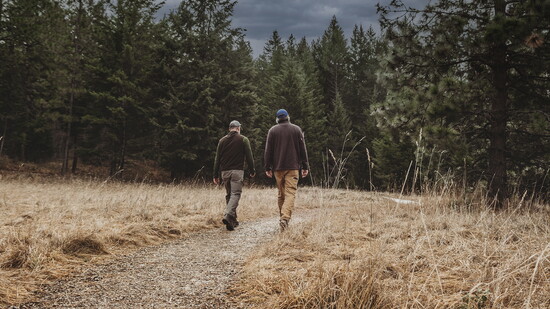
I keep thinking about how investment isn’t always about money. Sometimes it looks like a man walking among the trees with a shovel slung over his shoulder, listening for what the land wants to become.
That’s the feeling I had after talking with Darren Pfeifle, owner of Montana Made Trails. Darren has been carving paths through Montana for 26 years. First in Glacier National Park, where he learned the slow, reverent craft of wilderness trail building, and now across the Flathead Valley and beyond. If you’ve hiked, biked, or wandered a community trail around here, there’s a good chance you’ve followed his work without even knowing it.
Darren grew up on a fifth‑generation farm on the eastern front, where the song of wheat and barley fields shaped his sense of place. He laughs a little when he tells me he didn’t set out to become a trail builder. He was a University of Montana student who applied for a summer job in Glacier and fell in love (hard) with the work. “I just loved being out there,” he says. “I loved the process of it.”
But life shifts, as it does. When he started a family, the long stretches away from home that park work required no longer fit. So in 2008, he stepped out on his own and created Montana Made Trails. “It was a slow start,” he admits. “The first five years, I took whatever came—utility lines, thinning, landscaping.” Then the Whitefish Trail launched its first contracts, and Darren found his stride.
What strikes me most is how much the trail‑building world has changed since he began. “When I started, everything was contracted directly with the Forest Service or the state,” he explains. “About ten years ago, nonprofits started stepping in like Mountain Bike Missoula, Whitefish Trails, and Gateway to Glacier Trails. They propose the plans, raise the funding, and then they hire us.” Today, his partners range from the USFS to the Audubon Society to private landowners who want to reach the far corners of their property or create a quiet perch for wildlife viewing.
Most of the trails he builds now are what he calls “after‑work trails”. Close‑to‑town routes where people can slip into the woods for an hour and return home feeling more like themselves. And while the work is deeply physical, it’s also contemplative. “There are multiple aspects to building a trail,” he says. “Where do you want it to go? What do you want the experience to be like? And how do you make it last?” He talks about route‑finding like it’s a conversation with the land. Paying attention to erosion, slope, soil, and the subtle cues that tell you when a trail belongs and when it doesn’t.
Sometimes the investment shows up in unexpected ways. Darren tells me about Cedar Flats, north of Columbia Falls, a place that used to be primarily a dumping ground. “People were living out there on the forest roads. Mattresses everywhere.” After the trails went in, the energy shifted. “Now people are out there recreating. It’s a really nice area. It still supports logging, but it also supports community.” That, he says, is the real return on investment: when people feel connected enough to a place to care for it.
As he looks toward the season ahead—projects that will likely take him to Hamilton, Helena, Anaconda, and Seeley Lake—he’s especially excited to continue work at Cedar Flats. “They’ve given me a lot of freedom to make the trails as fun as possible,” he says.
While Darren’s work involves physically shaping the earth, it serves as a reminder of our own trail-building power. Whether we are carving paths in a physical landscape or within the terrain of our existence, we all have the ability to invest in the "land of our lives"—creating routes that invite others to walk alongside us.
Explore Montana Made Trails:
Cedar Flats Trails
Just north of Columbia Falls is 25 plus miles of multi-use trails, part of which are accessible for adaptive users.
CDT Trail, Lincoln MT
Lincoln, Montana offers three access points to start one of the most popular trails in North America, the Continental Divide Trail.
The Whitefish Trail
The Whitefish Trail allows for 47 miles of natural surface trails with 15 trailheads. The trails are perfect for dog-walking, mountain biking, hiking, and trail-running.
Mount Dean Stone Trail
Located in Missoula, Mount Dean Stone is a multi-partner project led by Five Valleys Land Trust. The trail raises awareness to protect wildlife habitat and helps to reduce the risk of wildfire on the edge of town.