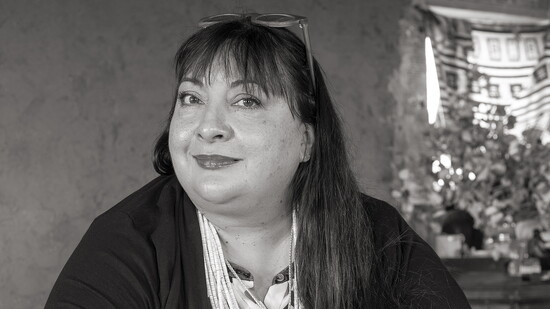
Patricia Michaels returns to SWAIA Native Fashion Week in Santa Fe this month as a defining voice in contemporary Indigenous couture. The first Native American designer to present a full collection at New York Fashion Week—and a competitor on Season 11 and All Stars of Project Runway—Michaels has spent decades creating space for Indigenous storytelling within an industry that was slow to recognize it. Her foundation was laid early in Santa Fe, where her mother became the city’s first Native gallery owner. She attended school on Canyon Road, surrounded by working artists, and grew up in a home where visual culture was part of daily life. “House walls covered with Navajo blankets” gave her, she says, “an understanding of the beauty in Native culture.” Pieces by Maria Martinez and Nampeyo—leading figures who redefined Pueblo ceramics—also shaped a visual language rooted in form, texture, and tradition.
Frequent drives to Taos Pueblo were formative. “We would only see five to 10 cars along the way,” she recalls. The openness of the landscape, “vast, quiet, uninterrupted,” sharpened her sense of attention and imagination. That way of seeing continues to inform her design process. “Most of my work involves hand-painted, dyed, felted, textured, and distressed leather, handmade sequins and embellishments, and some weavings,” she explains. Tactile and layered, each piece carries its own history, shaped as much by process as by intention.
Early on, Michaels understood she would need to define things on her own terms. “It has been important for me to carve my own vision and path, one that didn’t exist for Native people in contemporary fashion,” she says. At the time, an industry centered on ready-to-wear production offered little room for work grounded in narrative or craft. Her practice developed outside that framework—neither fully aligned with industry expectations nor easily categorized. Her 2011 appearance on Project Runway shifted how her work was seen. “The world looked at stereotypes for Native people, so my fashion wasn’t accepted as Native until I did the show,” she says. It gave her a wider audience—but more importantly, the space to define her work on her own terms. “Being there was an opportunity to tell my story and introduce the importance of textiles in fashion.”
The exposure broadened her reach, “bringing a world of opportunity that wouldn’t have happened otherwise.” In 2011, Michaels became the first Native American designer to present her own full collection at New York Fashion Week. “I had been in the studio for 30 years at that point, so it was long overdue,” she says, noting it would “open opportunities for other Natives to start creating visions of their own.” It also marked a shift in how her work was received. “For once, the stories behind my collections were appreciated, instead of being dismissed as too esoteric.”
That perspective carries into her teaching at Parsons School of Design in New York, where she works with students from around the world. “I teach what I was never taught in college: an appreciation for one’s cultural background,” she explains. Many arrive eager to create but unsure how to translate it into their designs; she encourages them to trust their instincts rather than default to fast fashion. That approach extends to materials and production. “I have never created bulk fashion and use natural fibers for 80 per cent of my collections,” she explains. Ideas like “no waste fashion,” rooted in Indigenous traditions, are now shaping how her students think about sustainability.
Throughout her global career, Michaels has maintained a strong connection to her homeland. “The way nature provides to the landscape gives us something to think about beyond ourselves,” she says. “It is subtle and silent, and in that silence, we can begin to give voice to what is there.” It’s also where she continues to draw her sense of form, color, and movement. “Native is always my first go-to.” At SWAIA Native Fashion Week (held May 8–9 at the Eldorado Hotel & Spa in Santa Fe) that influence comes into focus. “SWAIA has always been a place for all Native people and their families to shine.” Her latest collection draws from the natural world: “the theme is my corn field—weather, birds, the unseen miracle of growing life, our sacred stalks, and laughter.” As Native fashion gains wider visibility, Michaels remains clear about what she hopes people understand. “I want the world to know we are alive, strong, and still retain our traditions,” she says.
The first Native American designer to present a full collection at New York Fashion Week—and a competitor on Season 11 and All Stars of Project Runway—Michaels has spent decades creating space for Indigenous storytelling within an industry that was slow to recognize it. Her foundation was laid early in Santa Fe, where her mother became the city’s first Native gallery owner. She attended school on Canyon Road, surrounded by working artists, and grew up in a home where visual culture was part of daily life. “House walls covered with Navajo blankets” gave her, she says, “an understanding of the beauty in Native culture.” Pieces by Maria Martinez and Nampeyo—leading figures who redefined Pueblo ceramics—also shaped a visual language rooted in form, texture, and tradition.
Frequent drives to Taos Pueblo were formative. “We would only see five to 10 cars along the way,” she recalls. The openness of the landscape, “vast, quiet, uninterrupted,” sharpened her sense of attention and imagination. That way of seeing continues to inform her design process. “Most of my work involves hand-painted, dyed, felted, textured, and distressed leather, handmade sequins and embellishments, and some weavings,” she explains. Tactile and layered, each piece carries its own history, shaped as much by process as by intention.
Early on, Michaels understood she would need to define things on her own terms. “It has been important for me to carve my own vision and path, one that didn’t exist for Native people in contemporary fashion,” she says. At the time, an industry centered on ready-to-wear production offered little room for work grounded in narrative or craft. Her practice developed outside that framework—neither fully aligned with industry expectations nor easily categorized. Her 2011 appearance on Project Runway shifted how her work was seen. “The world looked at stereotypes for Native people, so my fashion wasn’t accepted as Native until I did the show,” she says. It gave her a wider audience—but more importantly, the space to define her work on her own terms. “Being there was an opportunity to tell my story and introduce the importance of textiles in fashion.”
The exposure broadened her reach, “bringing a world of opportunity that wouldn’t have happened otherwise.” In 2011, Michaels became the first Native American designer to present her own full collection at New York Fashion Week. “I had been in the studio for 30 years at that point, so it was long overdue,” she says, noting it would “open opportunities for other Natives to start creating visions of their own.” It also marked a shift in how her work was received. “For once, the stories behind my collections were appreciated, instead of being dismissed as too esoteric.”
That perspective carries into her teaching at Parsons School of Design in New York, where she works with students from around the world. “I teach what I was never taught in college: an appreciation for one’s cultural background,” she explains. Many arrive eager to create but unsure how to translate it into their designs; she encourages them to trust their instincts rather than default to fast fashion. That approach extends to materials and production. “I have never created bulk fashion and use natural fibers for 80 per cent of my collections,” she explains. Ideas like “no waste fashion,” rooted in Indigenous traditions, are now shaping how her students think about sustainability.
Throughout her global career, Michaels has maintained a strong connection to her homeland. “The way nature provides to the landscape gives us something to think about beyond ourselves,” she says. “It is subtle and silent, and in that silence, we can begin to give voice to what is there.” It’s also where she continues to draw her sense of form, color, and movement. “Native is always my first go-to.” At SWAIA Native Fashion Week (held May 8–9 at the Eldorado Hotel & Spa in Santa Fe) that influence comes into focus. “SWAIA has always been a place for all Native people and their families to shine.” Her latest collection draws from the natural world: “the theme is my corn field—weather, birds, the unseen miracle of growing life, our sacred stalks, and laughter.” As Native fashion gains wider visibility, Michaels remains clear about what she hopes people understand. “I want the world to know we are alive, strong, and still retain our traditions,” she says.
It has been important for me to carve my own vision and path, one that didn’t exist for Native people in contemporary fashion.