Peter Mortimer arrives at meetings by bike, and there is a boyish rakishness to him that sits comfortably alongside the intense artistic ethos he applies to his life and his work. When you begin to speak to Pete, his face does something remarkable: it listens. Fully, openly, with the kind of active, unhurried attention that has become almost countercultural. It is the face of a man who has spent decades waiting for people to reveal the most important thing about themselves, because capturing that, the spirit of a person at full extension, is ultimately what every film he creates aims to do.
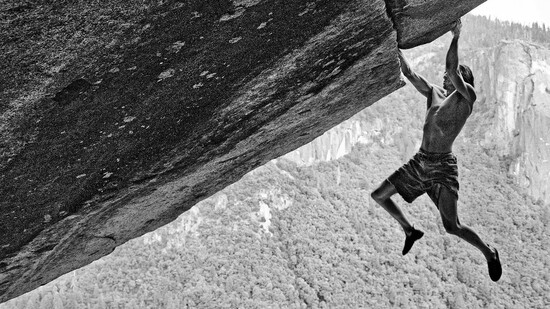
That quality of presence is perhaps the best key to understanding what makes his filmmaking so singular. The Boulder-based Emmy-winning filmmaker and founder of Sender Films and Reel Rock has spent more than two decades crafting documentaries about climbers who treat vertical rock faces, frozen alpine walls, and open sky as both canvas and crucible. His films: Valley Uprising, The Dawn Wall, The Alpinist, and most recently The Dark Wizard, are not simply about climbing. They are dispatches from a world where the stakes are high, and the people who inhabit it have chosen that height deliberately.
Mortimer’s perspective on storytelling begins with a deceptively simple premise: the best climbing stories are not really about climbing at all. For Mortimer, the rope and the rock are merely the grammar of a larger lexicon, one that speaks to obsession, freedom, identity, and the particular clarity that arrives only at the edge of one’s own limits. In a media landscape crowded with action-camera footage and highlight reels, this insistence on narrative originality is itself a kind of risk.
Nowhere is this more apparent than in The Alpinist, his portrait of Marc-André Leclerc, a young Canadian who solo climbed legendary routes with almost no documentation, going out and climbing purely for himself. Leclerc was famously resistant to the camera, presenting Mortimer with a fundamental tension: how do you tell the story of someone who has rejected the very act of being seen? The result is a film that becomes as much about the limits of documentary filmmaking as the limits of the human body, what Merleau-Ponty might call the body as the very site of knowledge, the place where understanding lives before language arrives.
His most recent project, The Dark Wizard, follows climber and BASE jumper Dean Potter as he chases the edge until he falls off. Mortimer knew Potter well and had been working with him before his 2015 death in a wingsuit accident. The ethical weight of that proximity, of being both friend and filmmaker, both witness and storyteller, is central to Mortimer’s approach. He has spoken about “the accountability that comes with telling their story,” a phrase that suggests filmmaking in this arena is not merely an aesthetic act but a personal one, as well. These are real people, not characters. Their choices have real consequences. And the filmmaker who places a camera in their lives must reckon with what it means to translate a life lived in extremis into something relatable to a larger audience.
After twenty-five years of documentary work, Mortimer is now turning toward feature filmmaking. Releasing the safety net of real events to venture into the territory of the imagined. It is, in its own way, the most exposed position he has yet occupied. Documentary offers the filmmaker a kind of anchor: real lives, real places, real stakes. Fiction asks him to conjure truth rather than capture it. For a filmmaker whose entire practice has been rooted in authentic human experience at its most extreme, the leap is not incidental. It is the next logical edge. What Peter Mortimer ultimately offers is an argument, quietly and beautifully made, that to live dangerously, as Nietzsche urged, is not always recklessness but sometimes a kind of rigor. His job—his telos, really—is not to explain that choice, but to bear honest witness to it. The edge, it turns out, is where a lot of the most honest stories live. Mortimer is listening.