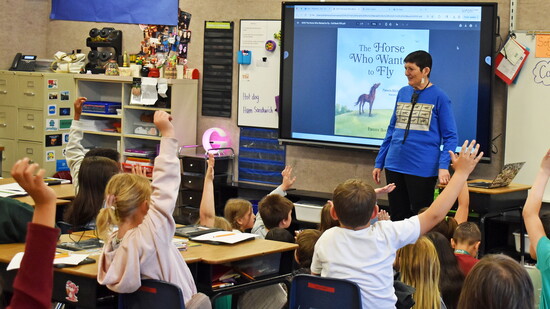
More than just bedtime stories, picture books are crucial in helping children develop language skills, literacy, and empathy. Picture books are vital tools for early education, language acquisition, and cognitive development. They foster critical thinking and visual literacy, and help children understand complex subjects.
These Treasure Valley authors create picture books that readers treasure, and they share why those books continue to matter.
Visual artist and author Mary Ann Fraser has written and/or illustrated more than seventy books. Her recent titles include WALL TO WALL: Mural Art Around the World, LET IT GROW, and MILTON AND ODIE AND THE BIGGER-THAN-BIGMOUTH BASS. Awards include Junior Library Guild Selections, Book Links Book of the Year, and American Booksellers Pick of the List.
Fraser believes the best picture books respect their audience.
“A good book for young readers must be a story that does not talk down to children or hit them over the head with a lesson,” she says. “It should spark creative thought and still entertain after many, many reads, but most importantly it must have heart.”
She began her publishing career as an illustrator before deciding she wanted to write her own stories. Workshops, critique groups, and involvement with The Society of Children's Book Writers and Illustrators helped shape her career.
“By far the best thing I ever did was join a critique group,” Fraser says. “There is nothing like constructive critique for improving your craft. Without their support and insights, I doubt I would have ever been successful.”
The hardest part of writing for Fraser is the first draft.
“I always say crafting a story is like sculpting,” she says. “First, you have to gather the clay before you can mold it. Even a picture book needs A LOT of clay!”
Even after more than seventy books, Fraser still enjoys sharing stories with young readers and hearing their reactions. Her measure of success remains simple: writing a book children want to hear again and again.
Kimberly Horch's love of storytelling began early. Her mother, an elementary school teacher, encouraged her creativity before she even entered kindergarten.
“I would tell her the story out loud and she wrote the words down and put a portfolio cover on it to make it a book,” Horch recalls. “My mom was always a huge supporter of my writing.”
Years later, after becoming a parent herself, Horch rediscovered that passion when she shared a story about her grandfather with her mother.
“I was surprised when a friend asked where he could buy a copy,” Horch says. “It was the first time I ever considered that someone outside my family might be interested in something I wrote.”
That spark eventually led to publication after years of classes, submissions, and persistence. Today, Horch's debut picture book, SAWYER'S BIG IDEA, follows a child struggling with focus and finishing a project.
For Horch, picture books remain one of the most effective ways to help children learn.
“Books are an amazing way to help kids learn,” she says. “In the past, children's books often focused on a single moral. Today there are so many different stories that cover the same topic, making it easy to find some that resonate with your child.”
Like Fraser, Horch credits SCBWI and critique groups for helping her grow as a writer.
“I learn so much from the work of other authors and from their feedback,” she says. “Being part of a writing team is a game changer.”
The value of picture books extends beyond literacy and learning. Many authors point to the connection that forms when adults and children share stories together.
"Picture books are a gateway to literacy," says local author Pamela Kleibrink Thompson, whose award-winning picture book The Horse Who Wanted to Fly explores perseverance and believing in one's potential.
Thompson says reading with her daughter every night reinforced the importance of making books part of a child's daily life.
“Reading boosts brain development, builds vital language skills, expands vocabulary, and cultivates empathy,” she says.
For Fraser, Horch, Thompson, and countless other children's authors, picture books are more than words and illustrations on a page. They are opportunities to spark imagination, encourage empathy, and create lasting memories between children and the people who read with them.
As Fraser puts it, “Success for me is writing a book that kids want to hear (or read) over and over again.”
Any parent who has read the same favorite book for the fiftieth time knows exactly what she means.