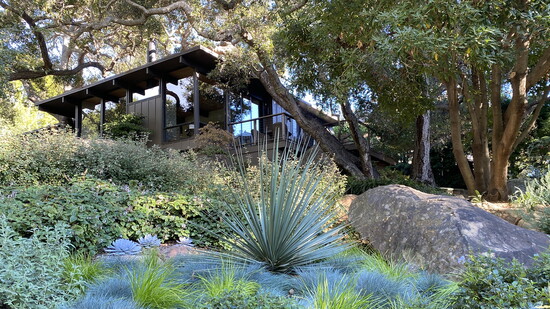
“Landscape architecture has the power to connect people to place, expressing the identity of a building, region, or environment through thoughtful design, materiality, and planting.” ~ Courtney Jane Miller (CJM::LA)
Local landscape designers are some of the most influential champions of what we grow in our gardens and public spaces. Seasoned professional and Seaside Garden contributor, Pat Brodie. The mother-daughter design duo at Earthworks Garden Design. A whipsmart design studio with a team of energetic talent. These designers are rooted in respect for this bountiful stretch of land and its inhabitants, and they operate from sustainability and intention. Get to know three landscape designers envisioning our beloved green spaces.
Pat Brodie
Pat is a seasoned landscape architect based in Santa Barbara with over 25 years of experience. Originally from the East Coast, she specializes in eclectic garden designs inspired by Mediterranean aesthetics and water conservation. Through her firm, Brodie Design, she offers a wide range of services, tailoring each project to her clients' unique needs.
What do years of working with the land teach that textbooks can’t?
Short answer: Patience, practice, and observation. Long answer: Santa Barbara is a unique place with varied microclimates and topography. Every home location has unique qualities that make it special. The trick is to use these qualities to create a useful and beautiful space. Research can offer a good starter guide, but it’s not a substitute for years of working in the garden. Knowing what works best in our varied conditions takes some trial and error, intuition, and the ability to listen to what the land and plants are saying.
What do your clients appreciate most after living with a landscape for several years?
They love how the garden has given them a connection to nature and the enjoyment of time spent in their outdoor spaces. People love watching their garden mature and how it reflects their personality and design aesthetic. Besides fun features like fountains, outdoor kitchens, fire pits, swimming pools, and hangout spaces, the garden provides a private retreat that evolves over time.
brodiedesign.com
Jessica Bortman / Earthworks Garden Design
Jessica is a landscape painter and the principal designer at Earthworks Garden Design. Her artistic journey began at age 14 during a camping trip in Scotland, which sparked her deep connection to nature. Today, she creates sustainable and inviting gardens across Santa Barbara, Ventura, and Santa Ynez. Jessica works alongside her mother, Gudrun Bortman, an artist, garden designer, and poet in Santa Barbara, originally from Hamburg, Germany. In July 2025, she also showcased her art at the Museum of Contemporary Art Santa Barbara.
What should a landscape give you that a home can’t?
More space to entertain or be alone, a connection to nature and its rhythms, bird song, and a respite from your to-do list.
When does a landscape feel finished…and when should it stay a little wild?
A landscape is never finished. A garden is a process. A cycle of planting, growth, maturation, death, and constant change. The rooms, or hardscaping of a landscape, can be finished—the spaces that enable you to live outdoors, but the planting itself is always in process. And one shouldn’t hope for a static and perfected outcome. Even in Southern California, gardens have seasons and cycles within cycles.
There is the pleasure of looking forward to a blooming that only happens once a year. Viewing a garden this way leads to less frustration and more curiosity, even when some other organism comes in and has its way with some of your plants. Some wildness in your garden leaves habitat for native species and native creatures. It also visually grounds your garden in the local landscape. And something about a wild corner, an unmowed bit of space, or a native food forest leaves room for the imagination.
What materials feel authentic to this region, and which ones don’t belong?
Agaves, aloes, oaks, and olives make up a big part of what we think of as authentically Santa Barbara style. With its Mediterranean climate, Santa Barbara can host plants from all over the world. More and more, we like to include natives or native cultivars—such as certain grasses, sedges, ceanothus, and native ferns—into a landscape for habitat and resilience.
Sandstones in the hardscaping feel important. While Southern California has a hodgepodge of architectural styles, referencing the gray and gold sandstones of the local mountains makes a garden feel indigenous. We generally avoid using granite rock and any really water-needy plants.
earthworksgardendesign.com
Courtney Jane Miller / CJM::LA
CJM::LA is a landscape architecture and creative studio based in Santa Barbara, founded in 2013 by Courtney. The firm offers a wide range of services, from multi-family residential projects to commercial spaces and historic renovations. They emphasize sustainability and collaboration in their designs. Their projects span California, Arizona, and Hawaii, with a focus on Santa Barbara and LA.
What role should landscape architecture play in the success of a commercial project?
“Success” in landscape architecture can take many forms; for us, it’s realized in outdoor environments that reflect both contemporary cultural values and the rich historic identity of the places they inhabit. Landscape architecture has the power to connect people to place, expressing the identity of a building, region, or environment through thoughtful design, materiality, and planting.
At their best, the spaces we create are meaningful to the people who move through them, provide habitat for diverse plant and animal communities, and contribute to addressing broader environmental and societal challenges through resilient, sustainable design.
What design elements most improve how people move through their property?
In residential gardens, we approach the outdoor environment as a series of interconnected rooms. Each space is thoughtfully shaped to serve a distinct purpose and express its own character, tailored to our clients' needs and lifestyles. The journey through these spaces may be calming, contemplative, or full of discovery. Design features such as fountains, sculpture, and fire elements provide visual interest and help anchor the composition of the rooms, while framed views and thresholds guide movement through the garden. Together, the design creates a sense of flow, revealing moments that offer both delight and comfort.
cjm-la.com