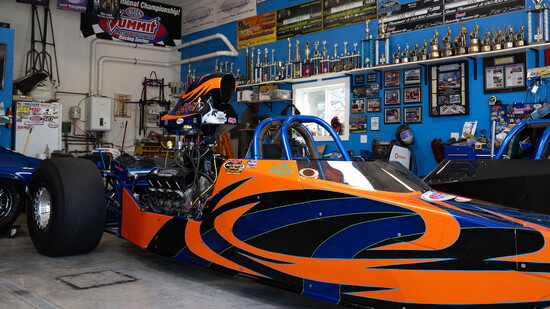
In an unsuspecting residential shop just outside Manhattan, sits a pair of slender, 24-foot-long aerodynamic racing machines that look like space rockets waiting for launch.
A bold orange and blue paint scheme wraps around an intimidating big-block racing engine crowned by a prominent intake scoop. This exposed powerplant alone looks capable of shaking the walls. Surrounded by championship banners, plaques, and dozens of trophies, the setting tells as much of the story as the cars themselves.
When these rockets on wheels do launch, they cover an eighth-mile of asphalt in just over four seconds, reaching roughly 160 miles per hour in a blur.
To achieve this, every line, fitting, and system on the cars must work perfectly. And in a fitting twist for a Manhattan story, nearly every hose running through the engines came from the same place: the Parker-Hannifin Hose Products plant on Hayes Drive. For Larry Piper, that connection isn’t coincidence. It’s the result of nearly four decades of investment.
Larry started at Parker in July 1989, beginning his career in production before eventually moving into maintenance. Today he works as a maintenance technician, responsible for keeping major plant systems running, including the steam boilers that help power the facility’s manufacturing operations.
“I’ve been there 37 years,” Larry says. “It’s afforded me the opportunity to do all this.”
“This,” in Larry’s case, happens to include championship drag racing.
Originally from Formoso, Kansas, Larry built his life in this region alongside his wife Renee, whom he married in 1988. Around the same time he began working at Parker, he also began racing seriously. Over the years, that passion evolved into a family tradition. Today, Larry races alongside his son Todd Piper, who grew up watching his father compete at tracks across the country.
Before long, Todd wasn’t just watching. He was driving. At just ten years old, he climbed into a junior dragster at the old Manhattan Raceway. Within a few runs, it was obvious the racing instinct had passed from one generation to the next. Since then, the father-and-son duo has built one of the most successful grassroots drag racing programs in the nation. Their garage shelves are lined with trophies, including coveted NHRA “Wally” trophies that many racers chase for decades without ever winning.
“We’ve been very fortunate,” Larry says. “This is really hard to win at.”
Their success has taken them to tracks across the country, from Pomona, California, to Las Vegas, to historic Heartland Park in Topeka, where Larry captured the NHRA Top Dragster title at the Nationals there in 2013.
But perhaps the most dramatic chapter of their racing story came recently at one of the sport’s biggest independent events: the Mickey Thompson Million Dollar Drag Race in St. Louis.
In 2024, during the event’s 29th running, 746 racers entered the competition. Through seven rounds of elimination, Larry delivered nearly perfect reaction times. By the end of the week, he had won the race’s combined $100,000 final round, one of the largest payouts in sportsman drag racing. The following year, Todd nearly repeated the feat. In the event’s 30th running, which drew 792 racers, he battled all the way to the final round before finishing runner-up.
Both Larry and Todd are deeply involved in building and maintaining their own equipment. Todd works professionally as a machinist at E&R Machine in Wamego, giving the team another layer of mechanical expertise.
Their current dragster engines are serious pieces of equipment. Larry’s car runs a naturally aspirated big-block engine measuring 632 cubic inches and producing roughly 1,300 horsepower. It burns about half a gallon of fuel during a single, eighth-mile run. Another car in their stable, a modified 1972 Chevrolet Nova, runs a 565-cubic-inch engine producing about 950 horsepower. The cars themselves sit on lightweight chromoly chassis that are designed specifically for drag racing.
But look closely under the hood and you will see a different kind of engineering story. Fuel lines. Water lines. Transmission pressure lines. Even ignition components.
“All the hoses on these cars come right out of Manhattan,” Larry says. In a few cases, he personally helped build the same components that now power his race cars.
In the late 1990s, when Parker hosted an open house, the plant manager invited Larry to bring his dragster to display. There was just one problem: the car was built with hoses from a competitor. Soon afterward, the car was refitted by the manager entirely with Parker components. For Larry, it was another example of how his career and his passion had become intertwined.
For nearly half a century, Parker-Hannifin has invested in Manhattan, operating one of the city’s largest manufacturing facilities since 1979. For employees like Larry, that investment has created careers, opportunities, and livelihoods. And in Larry’s case, it also helped fuel a racing legacy.
Today, the Piper family includes not only Larry and Renee, but their children and grandchildren: Todd and his wife Lindsay, Larry’s other son Bryan and wife Melinda, and a growing generation of young fans including Brayden, Hayley, Madelyn, and Makenzie.
Back in the garage, the cars wait patiently for their next race weekend. Soon enough they will fire to life again. Engines will roar, tires will smoke, and the cars will rocket down the track in just a few seconds at nearly 200 miles per hour.
And powering those engines will be a small - but mighty - piece of Manhattan engineering.
**Sidebar headline & Text **
We Are Manhattan
For nearly 50 years, Parker-Hannifin’s Hose Products facility has been part of Manhattan’s manufacturing landscape. The company first opened its doors in the Little Apple on December 30th, 1979, expanding the reach of a motion and control technology company that traces its roots back to 1917. Today, the Manhattan plant produces hydraulic and industrial hoses used in agriculture, construction, transportation, and other heavy industries around the world. Parker has grown into a steady local employer of around 165 people, while supplying precision-engineered products to industries that keep the modern world moving.
"Every hose on these cars comes out of Manhattan. Some of them I even helped build years ago at Parker, so it’s pretty special seeing them power our race cars." - Larry Piper