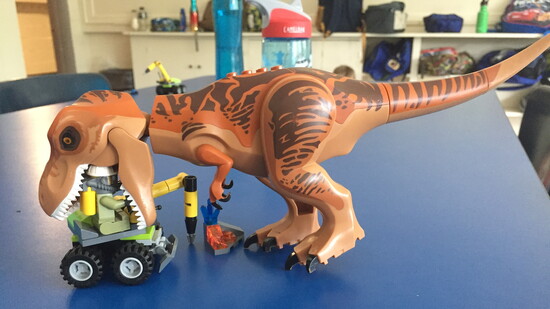
On a recent Saturday morning, the Brick by Brick Maine studio in Falmouth was filled with the familiar sounds of childhood: excited chatter, ideas being shared across tables, and the click of LEGO bricks snapping into place. Around the room, children were hard at work creating everything from animals and vehicles to entirely original inventions born from their own imaginations.
For founder Tracy Carrier, those moments represent something bigger than a completed build. "As an educator, I saw how much pressure kids can be under to perform and excel," she says. "What I didn't see were enough opportunities for them to experiment and create and just learn through play."
That observation inspired Brick by Brick Maine more than a decade ago. What began as a home-based program with after-school enrichment classes along with summer camps offered through local recreation departments became a dedicated studio space in Falmouth, which opened last year.
The concept is simple: provide children with bricks, encouragement, and room to explore. The benefits, however, extend far beyond playtime. "When they're building, they're not just stacking bricks," Carrier says. "They're testing ideas, solving problems, experimenting, and learning through trial and error."
Depending on the activity, those lessons might involve discussing why a polar bear's black skin helps it stay warm in the Arctic or figuring out how to make a tower strong enough to support additional weight. Along the way, children are developing critical thinking, spatial reasoning, communication skills, patience, and perseverance.
But perhaps the most valuable lesson is that there isn't always a single right answer.
At Brick by Brick, some children carefully follow instructions while others use them only as a starting point—or skip them entirely. Both approaches are encouraged. "We really focus on the process rather than the outcome," Carrier says. "There's no right way to build."
That philosophy helps create an environment where children of different ages, interests, and abilities can all find success. A kindergartner and a fifth grader may be working on entirely different challenges, but both are given the freedom to create at their own pace and in their own way.
Imagination, of course, plays a central role in that process. "Imagination is really at the heart of everything we do," Carrier says. "LEGO bricks are amazing because they don't come with a script."
Over the years, Carrier has seen children create everything from flying taco restaurants to detailed fantasy worlds. One build that still stands out was an independently designed chess set, complete with a board and carefully crafted pieces that looked like traditional rooks, kings, and queens. "It was amazing," she recalls. "That wasn't something we scripted for him."
Families today are balancing sports schedules, extracurricular activities, and increasing screen time, and Brick by Brick offers something refreshingly open-ended. The goal isn't perfection or performance—it's curiosity.
That same mindset can be applied at home, Carrier says. Creativity doesn't require specialized materials or expensive toys. Cardboard boxes, paper towel tubes, books from the local library, and open-ended conversations can all help spark imagination. "Creativity isn't just about arts and crafts," she says. "It's also about problem-solving and vocabulary building."
Ultimately, Carrier hopes parents remember that play serves an important purpose. "Play isn't a break from learning," she says. "It is learning." Through play, children learn to solve problems, navigate challenges, express themselves, and build confidence in their own abilities.
And sometimes, they build a four-foot-long dragon out of LEGO bricks.
Those are the moments, Carrier says with a laugh, when adults have a simple but important responsibility: stop what they're doing and admire the dragon.