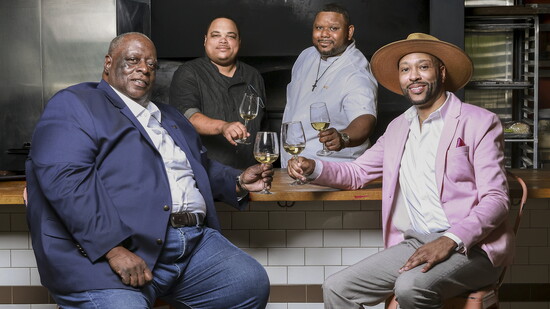
There are stories that belong to no single man, stories so deep, so old, so beautifully human that they can only be carried, never owned. The story of Black culinary excellence in Atlanta is one of them. It was written long ago in the kitchens of grandmothers who fed entire communities with nothing but genius and love. What moves me most about Cal, Quentin, Gary, and Robert isn't what they've accomplished, it's what they do: investing in young people, honoring where they came from, and showing up for a community that is counting on them.
At the center of that belief stands the Navigate Foundation, a woman-founded, minority-owned organization built on one unshakeable conviction: that talent without access is a tragedy our community can no longer afford. Navigate serves students from high school through young adulthood, offering specialized culinary training, professional development, and direct pathways to sustainable careers. Its signature Passport Project sends the next generation of culinary talent abroad to study at world-class institutions, turning potential into purpose, one extraordinary life at a time. It was around the Navigate table that these four men first found one another. And what happened next is proof of everything I have always believed: When we gather for goodness, greatness happens.
Some Bottles Hold More Than Spirits; they Hold a Family's Entire Story
Cal Wimberly is building legacy with both hands, one reaching back into family history and one extended forward to the community around him. His portfolio tells the whole story. Ma Fannie Vodka was named for his grandmother Fannie Pollard, a bootlegger and entrepreneur from Lee County, Alabama, who created an extraordinary opportunity from almost nothing. Papa Joe's Single Malt is a tribute to the patriarch who carried a family name forward with quiet dignity. And Wimberly 116 Bourbon is the anchor of a legacy still being written. The Wimberley Collection is a conversation across generations. And, as Cal says himself: "Legacy is built by moving forward and inspiring the next generation."
There Are Wines That Fill a Glass, and Then There Are Wines That Change the Trajectory of a Young Life
When I reached out to Quentin D. Wilson, he saw young people preparing to step into the world and said, without hesitation, “I want to be part of that moment.”
Q10, crafted in France's Loire Valley using the same traditional method as Champagne, is approachable enough for a Tuesday and refined enough to honor life's most significant milestones. Quentin is building a platform that opens genuine doors for minority winemakers long locked out of this industry. You cannot become what you cannot see; when a young Black student watches a man who looks like them command a world-class sparkling wine he built from the ground up, it is beyond inspirational. It is a mirror. It is permission. It is proof that any goal can be achieved.
Some Chefs Feed a City; the Rarest Ones Shape a Generation
I first encountered Chef Gary Caldwell through Chef Simone Byron and the Navigate Foundation in a room of people gathering for goodness, producing something greater than any of us anticipated. As executive chef at Marcus Bar & Grille, he works with hyper-local farms, honoring recipes unearthed from family matriarchs and training his team of culinarians to understand why the story behind every ingredient matters. Every plate is an act of education as much as it is nourishment.
"Hospitality is something passed down, taught and emulated; it can't be forced,” says Gary.The door is wide open and Gary is already inside, doing the work.
Where the Past Feeds the Future
Chef Robert Butts & Auburn Angel
Auburn Angel occupies the very building on Auburn Avenue where civil rights leaders once gathered, strategized, and fed a movement. Chef Robert Butts didn't just inherit that address. He accepted its full weight. His kitchen is a living archive — hoe cakes reimagined, braised traditions rescued from being forgotten, Black food stories told with technical brilliance that silences every critic. A fierce supporter of the Navigate Passport Project, Robert pours into young culinarians with the urgency of a man who built his path largely alone.
"I know for me starting in this industry, it wasn't a lot of Black chefs you could look up to; that was just not right," says Robert. Auburn Angel is more than a restaurant. It is a monument, a classroom, and a promise to Atlanta’s culinary history and future.
The Torch Bearers
These are not simply four successful men. They are four fathers to a generation that needs them, and when Navigate gave us a reason to gather, what happened confirmed everything: When we gather for goodness, greatness happens.
This Father's Day, Atlanta celebrates what these men refused to let die: the recipes that have not been forgotten, the traditions carried in the hands of grandmothers who fed communities with a genius no classroom could teach, and the spirits named for ancestors who made something from nothing. All of it is alive in these four men. And through them, it is being placed, with intention and love, into the hands of the generation that comes next.
The table is set. The glasses are raised. And the future of Black culinary excellence in Atlanta isn't coming. It is already here.