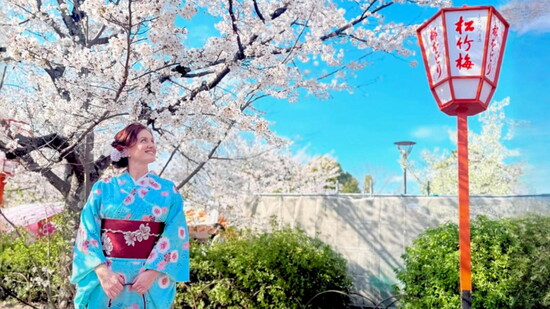
The elderly woman worked in silence. Layer by layer, fold by fold, she dressed Susan Laurent in a kimono, a traditional Japanese robe. The exacting process took nearly twenty minutes, each detail placed with the kind of ritualistic precision that signals the process is meaningful, and honorable.
When it was finished, Susan stood in Kyoto's Gion district during cherry blossom season, surrounded by women and men from a dozen countries, all wearing the same ancient garment… and something came over her.
"I felt so feminine," she says. "Like a respected feminine woman. And it just… it overtook me."
It was not the kind of moment she’d planned for. But then, Susan had stopped planning, in order to live more in the moment.
The Mount Clemens massage therapist and certified forest therapy guide had spent years doing what she calls pattern work: the deliberate practice of changing how she moved through the world. More mindfulness. More presence. Less distraction.
One day, in the middle of that process, a thought arrived without explanation: Japan.
Not Europe, where she had always imagined traveling. Japan.
"I've always been drawn to it," she says, "but I never thought I would go east." The pull kept coming anyway. So she listened.
She spent six months preparing. She studied the language, read and watched other travelers' accounts, learned the protocols of the temples and the torii gates. She and her niece Sierra Picotte mapped every hotel, every bullet train, every city.
Then they went and let the country do the rest.
What Japan gave her, she says, was not transformation. She’s careful about this distinction.
"I wouldn't say the trip advanced my healing. I see it as: I'd been doing all of this work, and Japan was the end note. Like it was saying, you did it."
That moment came in Kyoto. Standing somewhere in the middle of the ancient city, she understood why she’d come. Everything she’d been working toward was simply there. Built into the streets, and the trains, and the way the chef at their restaurant would remove his shoes each time he approached a table to set down food, then return to the kitchen, put them back on, and repeat. And repeat. And repeat. All night long.
Japan's service culture appears absent, she explains: no server checking in, no refills, no ‘is everything okay?’ But that’s because they know everything’s okay.
"Japan perfects things so much," she says, "that once they give you your food, they don't need to come back. Because it's perfect."
The country operates in what she calls ”synchronized chaos.” At Tokyo's Shibuya Crossing, three thousand people move through a single intersection every time the light changes. She crossed it ten times — her hotel was next door — and never touched a single person.
"Everything is precise,” she says with awe. “It’s the most beautiful thing."
On the bullet trains between cities, on the buses, no one speaks. What’s the reason for the silence? Consideration, Susan explains: “If the person next to you can hear you, you’re too loud.”
For someone like Susan, who’s devoted her life to showing people the benefits of slowing down, the effect was immediate.
"When you feel that safe," she says, "your nervous system knows it. You're calmer. You're more conscious of things around you, because you're not on alert."
The professional dimensions of the trip ran alongside everything else. Susan sought out training in Japanese bodywork traditions, and what she found in the treatment rooms confirmed what she was absorbing everywhere else. In Japan, she explains, women's healthcare includes things that rarely appear on American treatment menus: post-birth abdominal work, lymphatic support, breast care.
And after treatment, the session doesn’t simply end. The practitioner sits with you.
There’s tea.
"You don't just get your massage done and leave," she says. "They stay with you for a few minutes to make sure everything is okay. It's very intentional."
She recognized this immediately: her forest therapy practice is rooted in shinrin-yoku, the Japanese tradition of forest bathing, so it’s always ended with a tea ceremony. Susan had been doing a version of this for years. Now she was sipping it in the country that originated it.
The tea after the massage is relational. The matcha tea ceremony she took part in, in Osaka, was choreographed ritual, every centuries-old gesture prescribed: bowl turned, whisk moving in a specific pattern. Susan was struck by the measured pour, the deliberateness of it. She's already decided to bring it into her forest therapy sessions.
She brought other things home too, things less easily named. She stopped eating American food. She went straight to the Asian market when she landed, and that’s where she shops now. She also cooks every meal now, placing intention into what she prepares, the way she watched Japanese chefs place intention into theirs. The family eats with chopsticks: there’s no flatware in the house.
"When you eat with chopsticks," she explains, "you can only eat what you can pick up. You're not shoveling. You're intentional."
There was a moment near the end of the trip that she returns to, standing at the gate of an ancestor shrine. She sensed almost immediately that she and Sierra didn’t belong. Not because they were unwelcome. Because the space wasn’t for them. Resplendent as it was, she realized: this is where people come to mourn.
They left quietly.
Susan had studied enough to know the difference between a tourist site and a living act of worship. She’d also learned, early in the trip, that what you bring to Japan is what you receive from it. In an elevator, she and Sierra overheard an American tourist complaining, about the broken English, the repetition of arigatou gozaimasu, the inconvenience of being in a country that didn’t operate on his terms.
"I looked at my niece,” she recalls, “and said, 'You want to know what's amazing about that? We're having two totally different experiences.'"
She cried on the flight home. At the window, watching the white-gloved airport ground crew bow and wave as the plane moved across the tarmac, she wasn't certain whether she was grieving the leaving or dreading the return.
"I have never felt so safe in my life," she says simply.
She’s already planning Okinawa.
Now back in Mount Clemens, Susan’s added Japanese head and face massage, as well as Whole Woman Wellness Therapy, a restorative treatment that focuses on pelvic balance, lymphatic flow, breast wellness pathways, fascia release, and nervous system regulation. They’re certifications earned in the country that told her she'd finally arrived.
And the work — like the trip, like the tea, like the human herself — is intentional.
Susan Laurent practices at Natural Healing Therapeutic Massage, at 56 North Walnut Street in Mount Clemens. Reach her at (586) 738-4064 or nh-tm.com
"I'd been doing all of this work, and Japan was the end note. Like it was saying, you did it."