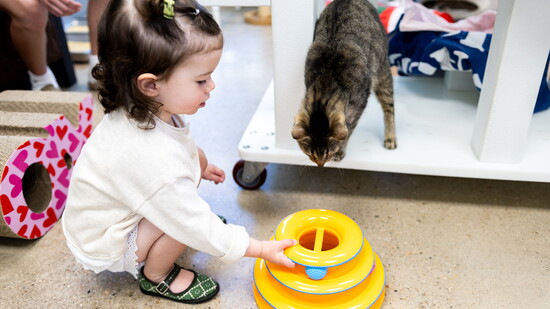
Few moments are as exciting for children as welcoming a new pet into the family, but creating a happy beginning for everyone requires patience and planning.
Experts say a successful adoption starts long before a family falls in love with a dog or cat. “Families can research breeds, involve children in selecting supplies, decide where the animal will sleep and eat, and discuss responsibilities such as walking and training,” says Sarah Sangree, Director of Community Engagement at St. Hubert’s Animal Welfare Center in Madison.
St. Hubert’s sits on a sprawling campus with multiple buildings housing an adoption center, doggie day camp, pet store, and dog training school. For more than 85 years, the organization has placed thousands of animals—from dogs and cats to even mice—into caring homes. As part of the Humane Rescue Alliance, St. Hubert’s is the region’s largest animal rescue provider.
According to Sangree, the most important factor for any family is commitment. “First, make sure everyone is committed,” she says. “A pet is a ten to fifteen-year responsibility.”
For Tatiana Yastremski, St. Hubert’s Shelter Behavior Manager and a Certified Professional Dog Trainer, choosing the right dog for families with children involves much more than appearance. “The goal is to find a pet whose energy level matches the family’s. Some families enjoy energetic dogs; others prefer calmer animals. It's about finding the right fit.”
Instead, she recommends visiting the shelter with an open mind and considering factors such as activity level, daily schedules, and lifestyle. “It begins with a family conversation,” Yastremski says. “Discuss what type of dog they want and what would fit their lifestyle. Families should come to the shelter together.”
Once a pet is selected, preparation at home becomes essential. Both experts emphasize the importance of giving animals their own safe space to decompress. “The most important thing is ensuring the animal has a safe space where it can retreat if needed,” Sangree says. “For dogs, that might be a crate or gated area. For cats, it could be a cat bed on a high shelf.”
While puppies are often the first choice for families, Sangree says older dogs can sometimes be a better fit. Adult dogs offer a clearer picture of temperament and energy level, making it easier to match a pet to a family’s lifestyle.
Preparing children is equally important. Yastremski encourages parents to consider their children’s ages and behaviors just as carefully as they evaluate a pet. “Toddlers may run, grab tails, or pull ears,” she explains. “Some dogs tolerate that behavior while others do not. Dogs have preferences just like people do.”
She also notes that puppies can be difficult companions for young children because they naturally nip, scratch, chase, and play roughly as they grow up.
For Yastremski, successful adoptions come down to research and realistic expectations. “Learn about dog behavior, understand the responsibilities involved, commit to training, and choose a dog whose personality and needs align with your family’s lifestyle,” she says. “A successful adoption is about finding the right match.”
Learn more at www.sthuberts.org.